

















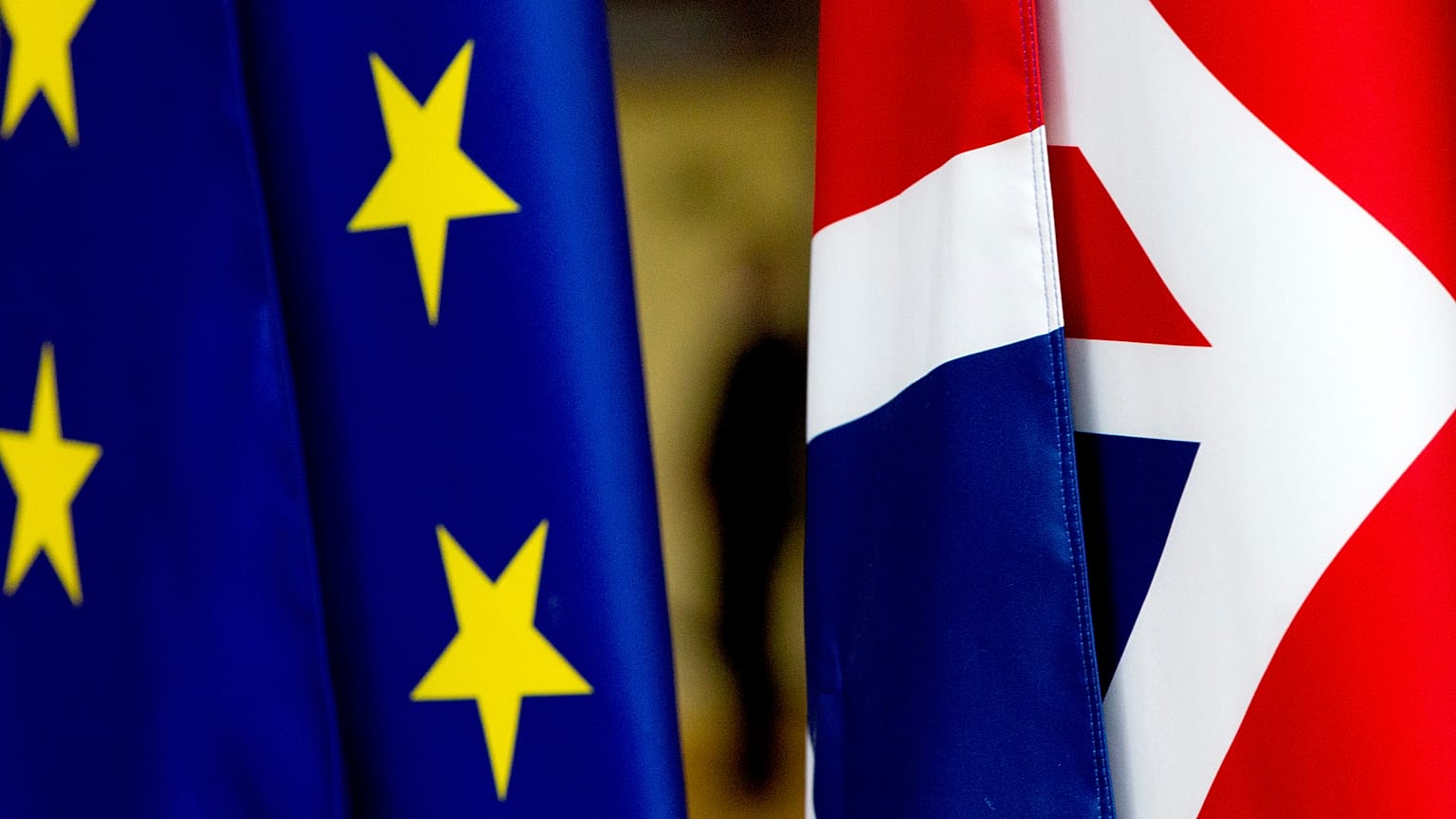













Euronews' updated explainer examines the far-reaching effects of the UK's departure from the EU and the events that led to Brexit.
This updated article was previously titled "Post-Brexit Guide: Where are we now — and how did we get here?".
 ADVERTISEMENT
ADVERTISEMENT
ADVERTISEMENT
The effects of the United Kingdom's departure from the European Union have been far-reaching, impacting business and the economy, as well as people on both sides of the English Channel and many aspects of their lives.
This guide examines the impact of Brexit so far, nearly three years after the UK left the EU and two years since the new relationship took effect. It looks back at the drawn-out negotiation process, Britain's difficult historical relationship with Europe, and there's also a postscript on how the EU works.
PART ONE: BREXIT'S IMPACT
- The United Kingdom's departure from the European Union — now a 27-nation economic and political partnership — brought to an end nearly half a century of British membership of the EU and the institutions that preceded it.
- "Brexit" — an abbreviation of "Britain" and "exit" — represents the most important constitutional shake-up the UK has known since it joined the then six-nation European Economic Community in 1973. It is also the first time the European bloc has lost a member.
The UK and Brexit: Unfinished business
Boris Johnson, Britain's last-but-one prime minister, campaigned successfully on the promise to "get Brexit done". But although the UK duly left the EU on mutually-agreed terms, and a subsequent deal was struck on trade and future ties, the country is still wrestling with itself and Brussels over the post-Brexit relationship.
A breakthrough in the longstanding dispute over trading arrangements for Northern Ireland — which also plagued the tortuous divorce process — brought hopes of warmer UK-EU relations after two years of post-Brexit tensions, as well as an end to the political paralysis in the UK territory. British Prime Minister Rishi Sunak's government succeeded in striking a new deal with the EU in February 2023. Unionists bitterly opposed to the original treaty agreed to study the terms.
Increasing evidence of Brexit's negative impact on Britain's economy put its new trading terms with the continent under scrutiny. New border controls and immigration restrictions, the result of the UK's choices, have disrupted commerce and the supply of labour. Business in particular has challenged the UK government's aim to exploit its new-found autonomy by pursuing a divergent path from EU norms.
There is evidence of some "Brexit remorse" among the British public, with some opinion polls suggesting a growing majority of voters now regretted the UK's departure from the EU. But there is little appetite for reviewing the UK's formal relationship with the EU, not least among the major political parties.
Rishi Sunak's arrival in Downing Street stemmed the resurgence of political turmoil that brought down his predecessors Boris Johnson and Liz Truss. But the fallout from Brexit has continued to shake the ruling Conservative Party, where the influence of hard-line, anti-EU factions who may resist compromise with the EU remains strong.
The mood between London and Brussels became warmer in the latter half of 2022, although core issues remain unresolved. Brussels will have noted the Tories' consistently poor poll ratings and the distinct possibility that the next UK election, due by January 2025, may bring a change of government.
Friction between the UK and the EU has been tempered to some extent by a recognition of the need for European unity with Ukraine. But for many in Europe, the divorce has weakened the continent as it tries to face up to global challenges including Russia's war, the post-pandemic economic downturn, the climate emergency, and threats posed by China and Iran.
Meanwhile, post-Brexit tensions have continued in Scotland where a majority voted to remain in the EU, and the devolved government has been barred by the UK Supreme Court from holding a new referendum on independence without approval from London.
Brexit in dates
- 23 June, 2016: The UK votes to leave the EU by 52% to 48% in a referendum.
- 31 January, 2020: The UK leaves the EU under the terms of a negotiated divorce deal, but most arrangements remain the same under an 11-month "transition period".
- 24 December, 2020: The UK and the EU strike a last-minute agreement on post-Brexit trade and future relations, after months of deadlocked negotiations, heading off a damaging "no-deal" scenario.
- 31 December, 2020: The transition period expires, and the terms of the UK's new life outside the EU come into force on 1 January, 2021.
The economy and trade
As in other countries, there are numerous factors behind the UK's economic woes — not least the fallout from COVID-19, Russia's war on Ukraine and the consequent energy crisis — but there is a near consensus among economists that Brexit has made them worse.
An official forecast by the government's own independent analysts estimates that the new UK-EU trading relationship will "reduce long-run productivity by 4% relative to remaining in the EU".
2022 has brought a slew of reports indicating that the UK has underperformed since the onset of the pandemic, compared to its peers.
Official figures have shown that its economy was alone among G7 countries in having shrunk. A report by the Centre for European Reform in December 2022 is the latest to illustrate how Brexit has hit the UK's GDP, investment and trade. Opinions vary over the impact of Brexit on the UK's high inflation rate, but it has been linked to rising food prices.
Boris Johnson, who as prime minister struck the post-Brexit EU-UK trade deal in late 2020, made several erroneous claims about it, saying that there would be "no non-tariff barriers to trade", and that it would allow UK firms "to do even more business with our European friends".
In fact, several reports have detailed a steep fall in UK-EU imports and exports, with many particularly smaller companies stopping cross-Channel trade altogether. A British Chamber of Commerce report in December 2022 finds the trade deal is still "not delivering" for more than three-quarters of firms.
- The EU-UK trade agreement which came into force in 2021 allows for tariff-free, quota-free access to each other's markets for goods — but not services — and also covers future competition, fishing rights, and cooperation on matters such as security.
- The UK's departure from the EU's Single Market and Customs Union brought significant new border formalities and regulatory controls. The EU had previously stressed that these would bring more red tape and "longer delivery times", a warning that appears to have been borne out.
Some reports said the damage began even before the UK actually left the EU, a fall in the pound in the wake of the Brexit referendum causing import prices to rise in particular.
The UK's departure from the EU has hit the continent too, although Britain has yet to impose full regulatory constraints on EU imports. An EU report in February 2022 described an uneven impact across Europe, with northern and western regions more exposed overall.
Citizens' rights: residency and travel
- Brexit brought to an end the right to "free movement" (a conditional not absolute right of EU citizens to move to other EU countries) between the UK and the EU. However, the divorce deal protects the existing rights of Europeans living in the UK, and Britons on the continent, who were already resident when Brexit took effect.
- Those resident in their particular country by the end of the transition period continue to have the same rights to live, work, study, and access benefits and services there.
The UK has granted "settled status" to more than six million people under its EU Settlement Scheme for EU, EEA (European Economic Area) and Swiss nationals, along with their family members living in the country.
However, a significant minority of people have experienced serious problems. Hundreds of thousands of applicants have been caught in a backlog, and there have been issues in securing rights for family members. Meanwhile, many have complained of difficulties proving their status as the digital-only scheme issues no physical documents.
In a December 2022 report, researchers from Kings College London highlighted injustices due to a series of bureaucratic contradictions linked to the application process.
Britons living in the EU by the end of 2020 also have the right to stay but need to have the right paperwork. This varies across EU countries, with some adopting a stricter approach than others. There have been complaints of access to basic rights being denied because of a lack of proper documentation.
Secondly, although the Brexit deal guarantees British residents' rights in their individual host country, it grants no automatic rights to move to other EU countries to live and work. This too has caused problems for some travelling between different EU countries.
Research has identified particular problems for "mixed status" families — mostly where one partner is British, the other European.
Britons without residency rights in the EU are now affected by rules whereby non-EU visitors are only allowed to visit Schengen area countries for 90 days in every 180 day period.
From May 2023, UK visitors to the EU will be subject to a new automated Entry Exit System (EES) for third-country nationals entering the bloc.
Immigration and labour shortages
Several sectors of the UK economy have suffered severe labour shortages due to a number of factors, including Brexit and the coronavirus pandemic. Other countries too have experienced problems, but they have been particularly acute in Britain.
Many European workers have returned to their home countries from the UK, and the stricter entry conditions have not facilitated their return. Euronews has chronicled the impact across a range of sectors, from farming to hospitality.
- Under the UK's new immigration rules EU nationals no longer have preferential treatment, and many low-skilled jobs are now off-limits for them. Instead, a new points-based system is designed to attract skilled workers. Although net migration to the UK has risen sharply, among EU nationals it is estimated to have fallen.
A study by Oxford University's Migration Observatory in August 2022 said evidence suggested that UK immigration policy was one of multiple factors contributing to shortfalls in the workforce.
The government's migration advisers also cite Brexit — along with rising economic activity, high job vacancy rates, soaring inflation and Russia's war against Ukraine — for contributing to an unstable labour market.
The Migration Advisory Committee's annual report in December 2022 said the end of EU free movement had caused "a labour supply shock to the UK economy", especially in sectors most reliant on EU-born workers" such as hospitality, logistics, administration, manufacturing, and agriculture.
The MAC highlights multiple efforts by employers to seek British workers, raise pay and improve other measures to retain staff, and maximise use of recruitment schemes — often in vain.
Business leaders have called on the government to relax immigration rules, but the migration committee says it "should resist calls to open new visa routes without a strong economic rationale", due to the risk of migration workers being exploited.
But it accuses the government of "a lack of joined-up thinking", with "no coherent, overarching strategy for skills and employment", and appeals for a "sustainable long-term policy to address shortages" by tackling the "root causes".
Northern Ireland
In late February 2023 the UK and the EU reached a breakthrough deal in the dispute over trading arrangements set out in the Northern Ireland Protocol, part of the legally binding Brexit divorce deal.
- Although part of the UK, Northern Ireland continues to follow some EU rules to keep an open land border with the Irish Republic, an EU member. It remains in the EU's single market for goods, benefitting Northern Ireland's manufacturers who have access to both EU and UK markets.
- Northern Ireland unionists have vehemently opposed the original protocol because of the internal UK "Irish Sea border" it created, putting restrictions on trade from Great Britain.
- Studies have suggested variously that Northern Ireland's growth has outperformed the rest of the UK — but also that new trade frictions with Britain have a significantly negative impact.
The "Windsor Framework" announced by Prime Minister Rishi Sunak and European Commission President Ursula von der Leyen followed a thaw in relations since the fractious stand-off during the premierships of Boris Johnson and Liz Truss.
A subsequent agreement on data sharing helped. So did a commitment by the British government to drop the Northern Ireland Protocol Bill — a controversial measure introduced by the Johnson government seeking to override the original treaty if necessary, and which prompted retaliatory legal action by the EU.
The new accord introduces a "green lane" for goods sent from Britain to Northern Ireland only, and eased checks on goods heading south to the Republic. British medicines should be allowed to circulate freely in the territory. Restrictions should be removed on parcels, sausages, seed potatoes and plants sent from Britain.
A "Stormont Brake", named after the devolved Northern Ireland assembly, is designed to address the "democratic deficit" by giving Northern Ireland a greater say over new EU rules. The UK government has hailed the measure as granting a potential veto, but the conditions for its use are strict.
Despite the new accord, political obstacles remained high. In particular it was unclear whether Conservative Brexiteers and the main unionist party, the DUP (Democratic Unionist Party) — vehemently opposed to the original protocol because of the internal UK "Irish Sea border" it created — would accept it, and end its boycott of Northern Ireland's power-sharing executive, a requirement of the 1998 peace accord that ended decades of sectarian trouble.
The stakes are high. A solution to the Northern Ireland impasse could also unlock other areas of friction between London and Brussels, such as a return for UK science to the EU Horizon research scheme, held up by the row over the protocol. It could also bring improved cooperation in areas such as migration, energy, defence and cyber security.
The 25th anniversary of the Belfast/Good Friday Agreement in April 2023 concentrated minds. New elections for the Belfast Assembly have been postponed, but cannot be put off indefinitely. All sides will need to consider the costs of failing to compromise.
Trade deals with non-EU countries
Since 2021 the UK has been free to pursue an independent trade policy under Brexit, and its supporters have often championed the ability to strike trade deals with other countries.
But to date there has been no trade deal with the United States, a big prize promised by some, while a target for striking a free trade agreement with India was also missed.
Deals have been signed with dozens of other non-EU countries — but most have been "roll over" EU agreements with those nations which the UK benefitted from as a former EU member, but which no longer applied once it left the bloc.
The UK government hailed an early agreement struck with Japan as "historic", but it differed little from the EU deal the UK lost access to, and official figures show British exports to the country actually fell in 2022.
A trade deal agreed with Australia has been criticised by the British farming industry and even a former Conservative agriculture minister for making too many concessions with little in return. The government's own assessment estimates that it will boost long-term GDP by just 0.08% by 2035.
Dismantling EU laws and regulations
The UK government is keen to highlight the "Brexit opportunities" that freedom from EU rules offers. However, the evidence so far that the benefits outweigh the costs is thin on the ground.
A Retained EU Law bill put before parliament is designed to deliver a promise to "review or revoke" all EU law still applicable in the UK by the end of 2023. The so-called "Brexit Freedoms" bill has been criticised for being driven by ideology and described by an independent watchdog as "not fit for purpose". There are fears that the sheer volume of law set to be wiped off the statute book risks creating many a legal vacuum and threatens established rights such as worker protections.
A reform package has been put forward for financial services, seen as an attempt to boost the City of London which has lost ground to European centres since Brexit. Some measures have been welcomed, but critics condemn the reforms as risky and say they will do little to offset the damage cause by new barriers with the EU.
UK government plans to set up new post-Brexit regulatory regimes, to replace so-called "EU red tape", have sparked alarm in sectors from food to chemicals, which fear crippling new costs.
A UK replacement scheme for EU farming subsidies has been delayed, although a new regime to control state subsidies and replace the EU version is set to come into force in early January 2023.
Services, science and education
UK service providers can no longer operate across national borders in the EU as they did before, something which has caused particular concern in the music industry. There is no automatic mutual recognition of professional qualifications.
Brexit has also meant some mobile operators reintroducing data roaming charges for UK travellers in the EU, and vice versa.
An EU decision recognising compliance of the UK's data protection regime with EU law means personal data can continue to flow between the UK and the EU in the post-Brexit era. This can be reviewed after four years.
The UK has begun legal action against the EU claiming it has been unfairly excluded from the bloc's science programmes such as Horizon Europe, amid the row over Northern Ireland. The February 2023 deal on Northern Ireland trading arrangements brought hopes that the UK could return to the fold.
Brexit has also impacted the world of education. No longer part of the EU's Erasmus+ student exchange programme, the UK has set up its own replacement scheme. There has been a drop in the number of EU student applications to UK universities, and a reported decline in the number of school trips between the UK and the EU.
PART TWO: The REFERENDUM and the BREXIT DEALS
'Taking back control': The background to Brexit
The UK voted to leave the EU by 52% to 48% in a referendum in June 2016. The campaign message that the country wanted to "take back control" of its borders, money and laws resonated with voters.
The vote followed decades of increasing hostility to the European project, which enforced the supremacy of EU law in certain areas and whose "freedom of movement" principle led to millions of EU citizens moving to the UK to work and settle.
Other factors cited as having had an influence were a rise in nationalist sentiment, particularly in England, as well as austerity and frustration with traditional politics. The outcome has fed into a wider debate over the role of the nation-state and the rise of populism in an age of globalisation.
The vote revealed strains between the UK's individual countries: England (53%) and Wales (52.5%) voted to leave the EU, whereas Scotland and Northern Ireland voted by 62% and 56% respectively to remain. Other divisions have also been exposed: between metropolitan areas and small towns for example, and different age groups and social classes.
The referendum's aftermath plunged the UK into its worst political and constitutional crisis since the Second World War. Brexit day was repeatedly delayed amid deadlock in the British parliament over the divorce terms negotiated with the European Union.
Post-Brexit TRADE AND FUTURE COOPERATION AGREEMENT
After the UK finally left the EU on 31 January, 2020, London and Brussels raced against time throughout the year to reach an agreement on the future EU-UK relationship, to take effect from January 2021. Failure would have seen the two sides revert to basic international trading rules, increasing costs and disruption, and leaving arrangements on other matters in limbo (see "No Deal" sections below).
The main obstacles to a deal were EU fishing rights in UK waters, safeguards to ensure fair competition, and a mechanism to enforce a deal.
This all came amid the COVID-19 pandemic and the greatest economic crisis in Europe since World War II.
The deal struck on Christmas Eve 2020 — the Trade and Future Cooperation Agreement (TCA) — came too late to allow a conventional ratification process to take place. It was approved by EU national leaders and the UK parliament, and came into force provisionally at New Year. Ratification by the European Parliament followed in late April 2021.
The post-Brexit EU-UK deal on trade and future relations preserves tariff-free, quota-free access to each other's markets for goods. It banished the threat of a catastrophic "no-deal scenario" that could have sent thousands of businesses to the wall.
However, it came with many strings attached — and the UK's departure from the EU's Single Market and Customs Union brought extra bureaucracy and costs for importers and exporters on both sides of the English Channel.
Trade and competition
The two sides can diverge on the likes of employment and environmental standards, but there are safeguards — a "rebalancing mechanism" governed by arbitration — to ensure fair competition.
The UK is beyond the remit of EU law or the European Court of Justice (ECJ). But challenges are possible in each other's courts, and punitive measures may be taken if subsidies distort trade.
And for service industries — highly important to the UK — the deal heralded further uncertainty, as it contained only vague commitments. Financial services were not covered at all, to be dealt with by a separate process.
Fishing rights
The trade deal brought a five-and-a-half-year transition period on fisheries — one of the main stumbling blocks in the negotiations. During that time, EU access to UK waters will be cut by a quarter, and British quotas will be increased.
Annual negotiations will then take place, but the EU can take retaliatory action if access is further reduced. And the UK, which sells most of its fish into the EU, is likely to continue to need the European market.
Post-Brexit fault lines came to the fore in the autumn of 2021 with a row between the UK and France, irate at dozens of its boats being denied access to waters off the coasts of England and the Channel island of Jersey.
Future cooperation
There will still be cross-border police investigations and law enforcement. The UK remains in some EU security exchange programmes, but is no longer part of the European Arrest Warrant or Europol.
The UK also stays in the European Convention on Human Rights. But several other key policy areas are excluded from the accord.
"Foreign policy, external security and defence cooperation is not covered by the Agreement as the UK did not want to negotiate this matter," the European Commission said in its statement.
Supervision and dispute settlement
A joint Partnership Council is set up under the deal to supervise its application. It has representatives from both sides, will meet at least once a year, and has the power to change parts of the deal if errors come to light.
A separate arbitration and dispute settlement mechanism is set up, which does not rely on EU law and includes no role for the European Court of Justice.
Education, energy, science
Scientific cooperation was due to continue with the UK remaining in the EU's Horizon Europe programme for seven years. It was also set to stay in the EU's Earth observation programme Copernicus and the nuclear energy organisation Euratom.
However, access has been blocked amid the row over the Northern Ireland Protocol and in August 2022 the UK launched legal action against the EU.
The UK has left the EU's Erasmus+ student exchange programme, to set up a new UK international study and training programme, the Turing Scheme.
BREXIT DIVORCE DEAL: The UK's exit terms
The UK's departure from the EU on January 31, 2020 took effect under the terms of the revised divorce agreement struck by London and Brussels in October 2019.
An ill-fated previous version negotiated under Theresa May's UK premiership met stiff opposition in the British parliament which repeatedly rejected it. The new accord was negotiated by her successor, Boris Johnson, whose subsequent election victory ensured its rapid ratification.
The deal consists of a Withdrawal Agreement on the terms of departure, accompanied by a Political Declaration on future ties.
The deal also established a transition period which came into effect upon the UK’s departure and ran until December 31, 2020. During this period many existing arrangements remained in place.
The Withdrawal Agreement: a binding treaty
The revised Withdrawal Agreement kept many of the provisions in the deal previously negotiated by Theresa May's government.
The divorce terms contained in it cover matters such as the UK's financial settlement, provisions for Northern Ireland, and citizens' rights: safeguards for the rights of EU nationals living in the UK, and Britons living on the continent.
It establishes a mechanism for calculating the amount of money the UK owes the EU to settle its obligations. No figure is mentioned but estimates have put it above €40 billion. It includes contributions to be paid during the transition period.
The agreement also protects residency and social security rights for EU nationals living in the UK and Britons in the EU, and maintains freedom of movement until the end of the transition period. People already resident will be allowed to stay afterwards and apply for permanent residence after five years.
The main change from the deal negotiated by Theresa May's government is that the controversial Irish "backstop" contained in the previous accord (see below) — to keep an open border on the island of Ireland — is scrapped in the revised agreement.
The divorce terms came into force when the UK left the EU at the end of January under the ratified deal, and have the force of an international treaty.
Arrangements for Northern Ireland agreed in 2019
Brexit means that the border between Northern Ireland (part of the UK) and the Republic of Ireland (part of the EU) — one of the most politically sensitive frontiers in the world — becomes the European Union's only land border with the United Kingdom. All sides agreed throughout the process that this must remain open, but the historically sensitive and complex issue bedevilled the divorce talks.
The arrangements in the Northern Ireland Protocol in the divorce deal agreed between Boris Johnson and the EU, as in the previous version negotiated by his predecessor Theresa May's government, are designed to avoid a hard border — such as border posts — and protect the cross-frontier economy.
As of January 2021 and the end of the transition period, Northern Ireland left the EU's Customs Union with the rest of the UK, which wanted to pursue an independent trade policy. But in practice, it has still been subject to EU customs rules and EU oversight.
The North remained aligned with some aspects of the EU's Single Market — and applies EU law on VAT (Value Added Tax) rules.
Northern Ireland was guaranteed "unfettered access" to the UK's internal market. But the rules meant there was effectively a new regulatory divide in the Irish Sea, especially concerning goods sent from Great Britain to Northern Ireland.
Customs and regulatory checks would not be carried out on the island of Ireland, but at ports. The UK government accepted that there would be some controls on goods, backtracking on Boris Johnson's previous insistence that there would be no checks.
In December 2020, the EU and the UK struck agreement on details for implementing the arrangements for Northern Ireland contained in the divorce deal. As part of the accord, the British government agreed to ditch a controversial plan to override parts of the original deal which would have breached international law.
The implementation of the protocol from January 2021 brought more conflict, as trade between Britain and Northern Ireland was disrupted. The Johnson government moved to disapply parts of the accord unilaterally, and later introduced more legislation paving the way for the treaty to be overriden.
The UK and the EU remained at loggerheads over the issue until the new agreement struck by British Prime Minister Rishi Sunak and EU Commission President Ursula von der Leyen in February 2023 (see above section).
Goodbye to the backstop
Johnson's revised protocol on Northern Ireland replaced the plan in the previous, rejected withdrawal deal known as the backstop. In the absence of a trade deal or an alternative solution, Theresa May's idea was for the whole of the UK to remain in a customs union with the EU, while Northern Ireland would be aligned even more closely with EU rules. The backstop's removal means this arrangement will no longer happen.
The revised agreement had similarities with an original EU proposal for a Northern Ireland-only backstop — which was rejected by May's government — but was more complex, and had one key difference in that legally, Northern Ireland remained in the UK customs union.
The accord dealt with the issue of Northern Irish consent for these changes: Northern Ireland's assembly would be able to decide on whether to keep the new arrangements — but only four years after the transition period.
The Political Declaration: Divorce deal pledges for the future
As part of the Brexit divorce deal, the EU and the UK also issued a Political Declaration on the shape of future EU-UK relations. The document provided a framework designed to form the basis for the future trade agreement.
Both sides signed up to various assurances on future trade competition and other matters. This included a commitment to a "level playing field" covering issues such as state aid, social and workers' rights, the environment and climate change.
The declaration related to a future EU-UK economic relationship where the UK opted for a Free Trade Agreement (FTA). But in return for zero tariffs and quotas, the UK made "robust commitments" to ensure "open and fair competition".
However, the document was legally non-binding — as opposed to the divorce deal's Withdrawal Agreement, on the terms of the UK's departure, which has the force of an international treaty. Critics were wary that the commitments might not be watertight — especially given the Johnson government's avowed intention to diverge from EU rules and forge an independent trading path.
Some observers argued that negotiations over future ties risked being much more complicated and harder to resolve than the terms of the divorce deal. The stalemate resulting from the talks in 2020 appeared to bear this out — although in the end a deal on the future relationship was struck in the nick of time.
However, its application in the years to come is bound to involve many more negotiations and, inevitably, disputes.
PART THREE: HOW DID BREXIT HAPPEN?
Brexit follows decades of UK soul-searching over Europe
The United Kingdom's place in Europe — and vice-versa — is an issue that arguably was never properly resolved after the Second World War, and came to a head with the Brexit referendum.
Many in the UK, especially in England, have always been sceptical of the political pan-European project revered by many on the continent. The antagonism towards the EU that surfaced during Margaret Thatcher's premiership in the 1980s has been followed by decades of hostile media coverage, especially in British tabloids.
At the heart of the debate in the UK has been the balance to be struck between two objectives: a desire for independence, sovereignty and autonomy against the need to retain influence and access to European markets, which, the EU insists, means respecting its rules and committing to fairness in competition.
The turmoil in the British domestic political scene has cut across party lines. Internal party divisions have affected both the UK government and opposition. The ruling Conservative party in particular has long been riven between Eurosceptic and Europhile factions.
A history of UK-EU tension
Check out our series on the history of the United Kingdom's complicated relations with the European Union:
- Part 1, 1973-1990: Je T'aime, Moi Non Plus
- Part 2, 1990-2004: I'd Do Anything For Love
- Part 3, 2004-2016: Should I Stay or Should I Go
- Part 4, 2016-2017: I Will Survive
- Part 5, 2017-2019: Never Can Say Goodbye
FROM BREXIT VOTE TO EU EXIT DOOR
Theresa May's deal repeatedly rejected by UK parliament
The referendum result in June 2016 prompted the resignation of Prime Minister David Cameron — who had led the campaign to keep the UK in the EU. He was replaced the following month by Theresa May, who in March 2017 triggered the EU's Article 50 — giving formal notification of the UK's intention to leave — two years later on March 29, 2019.
London and Brussels then negotiated a withdrawal deal over an 18-month period, which was finally agreed in November 2018 and approved by the 27 other EU governments.
The former prime minister insisted her negotiated withdrawal agreement was in the national interest and there was no viable alternative. She argued that it delivered on the referendum result: an end to free movement, an end to huge UK payments to the EU, and an exit from the unpopular EU structures on farming and fishing.
However, May had been severely weakened at home by an ill-judged snap election in June 2017 which wiped out her majority in parliament. Her government struggled on thanks to a deal with Northern Irish unionists. But the EU agreement brought hostility from both opponents and supporters of Brexit, including many in the ruling Conservative Party.
Thanks to an alliance of forces, the EU divorce deal was rejected three times by the UK parliament between January and March 2019 — causing Brexit to be delayed and leading eventually to May's resignation and her replacement by Boris Johnson.
Read more: What was in Theresa May's Brexit deal and why was it so unpopular?
Derailed by the backstop
To guarantee an open border, the backstop envisaged the UK remaining in a "single customs territory" with the EU, in the absence of a free trade deal or an alternative solution. It proved to be a major stumbling block in the negotiations.
Eurosceptic critics, including the Conservative anti-EU European Research Group (ERG), suspected it would have kept the UK strapped permanently to EU trade policy. EU sources pointed out that the UK-wide mechanism in the withdrawal agreement was included at the UK’s request, to avoid splitting off Northern Ireland from the rest of the UK.
Northern Ireland's Democratic Unionist Party (DUP), on whose support the May government depended, has always vehemently opposed any move it believes might separate Northern Ireland from the rest of the United Kingdom. Under the backstop, as set out in May's deal, Northern Ireland would stay aligned to some EU rules.
Revisions fail to stop defeats
In 2019, as the clock ticked down towards the original March 29 deadline, the UK and the EU said they had agreed a revised Brexit deal following weeks of deadlocked talks between London and Brussels.
EU27 leaders had refused to alter the text of the withdrawal agreement. But Theresa May said she had secured legally-binding changes over the backstop’s application. The British parliament had voted to seek “alternative arrangements”.
The parliamentary deadlock prompted moves by MPs from different parties to wrest control of the Brexit process and allow a series of "indicative votes" to explore alternative solutions to the government's deal. But there was no majority for any particular solution, other than an opposition to no-deal.
Read more: How Brexit defined then destroyed Theresa May's premiership
Theresa May's Brexit battles
Theresa May always struggled to keep the pro and anti-European wings of the Conservative Party on board with her Brexit plans.
Her doomed UK-EU divorce deal represented a compromise. But the blurring of several of her so-called "red lines" on the limits of EU power sparked fury within her divided Conservative Party. As negotiations with Brussels brought more UK concessions, a string of government resignations followed.
After the 2017 general election, which left the Tories severely weakened in parliament, hostility amid their own ranks to any moves towards a "softer" Brexit restricted May's room for manoeuvre.
Eurosceptics including the DUP strongly opposed her Brexit plan and the subsequent agreement, with many calling for the UK to leave the EU with no deal. In early 2019, the Tories in particular haemorrhaged support to the new hardline Brexit Party.
Equally, several pro-EU MPs also opposed a deal which, in their view, would leave the UK worse off than it had been inside the bloc. Some joined calls from opposition parties for a second referendum. Both the Conservatives and opposition Labour parties suffered defections of some MPs to a new pro-EU centrist party.
Amid the parliamentary deadlock, pressure from Tory Europhiles obliged the prime minister to open the door to a Brexit delay — and engage in cross-party talks, which collapsed after a few weeks.
Theresa May's fate was sealed after she revealed a fourth plan for getting her thrice-rejected Brexit deal through parliament. She tweaked the legislative package and crucially opened the door to a possible confirmatory referendum — a move which angered many in her party and sparked another government resignation.
Brexit delay brings European election electroshock
In the wake of the repeated parliamentary defeats for the EU divorce deal, the House of Commons twice forced the British government to seek to delay Brexit. In April 2019 EU national leaders met for a special European Council summit and agreed to a six-month "flexible extension" to the UK's departure from the bloc, with a new exit date set for October 31 — or earlier if its parliament approved the original withdrawal deal.
But relief at avoiding a disruptive no-deal exit was tempered by renewed uncertainty and frustration for businesses and people — especially for EU and UK expats.
The extension of the UK's EU membership also forced the country to take part in the European Parliament elections in May 2019 — and send 73 newly-elected MEPs to Strasbourg in July.
Nigel Farage's new Brexit Party, which advocates leaving the EU without a formal agreement, came top of the European vote. But there was a strong showing from pro-EU parties, in particular, the Liberal Democrats, who wanted to reverse Brexit altogether.
Britain's two main parties — the Conservatives and the Labour opposition — were severely punished by voters. Many Conservatives are furious at the failure to “deliver Brexit”, while Labour was accused of sitting on the fence.
The results indicated that opinion in the UK had become still more polarised over Brexit.
'Get Brexit done': PM Johnson launches new drive for EU exit door
The prolonged period of turmoil in British politics came to a head when Theresa May — who failed to get her EU divorce deal through parliament — became the latest in a long line of Conservative prime ministers to be brought down by Europe.
The UK's stance towards Brexit took on a distinctly harder edge when Boris Johnson entered Number 10 Downing Street in late July, 2019. The former foreign secretary and London mayor took over the reins after winning the Conservative Party leadership contest.
He signalled immediately a reinvigorated drive to take the UK out of the EU on October 31 — "no ifs or buts" — raising the likelihood that the country would leave the EU without a withdrawal deal.
The summer and autumn of 2019 saw the UK government significantly ramp up its no-deal preparations — since stood down — with more funds promised. The Conservative conference in Manchester had a new slogan, “Get Brexit done” — which has echoes of the “take back control” rallying cry of the “Leave” campaign during the 2016 referendum campaign.
There was further turmoil in the British parliament, where there was stiff opposition to a "no-deal Brexit". The government lost numerous votes in the House of Commons, and lost its thin majority. Several Tory rebels were expelled for opposing Brexit strategy.
Johnson suffered a humiliating defeat when the country’s highest court ruled that his government had acted unlawfully by suspending parliament.
In the end Boris Johnson was forced to compromise over Northern Ireland to win a revised deal. UK law obliged the prime minister to seek a Brexit delay from the EU, which was duly granted.
Read more: Brexit timeline: Boris Johnson's month of turmoil in September 2019
Boris Johnson seals new Brexit deal with EU
Opposition parties granted Boris Johnson his much-sought general election after the threat of an imminent no-deal Brexit in October was overcome.
In the absence of parliamentary approval for his renegotiated deal by October 19, the prime minister was obliged by law to seek a delay of three months from the European Union.
On October 29 the European Council President Donald Tusk confirmed that the EU had formally adopted the latest extension of the UK's membership until 31 January 2020 — with the option of an earlier departure if the renegotiated divorce deal was ratified.
The delay put paid to Boris Johnson's vow, repeated many times, that the UK would leave the EU on October 31.
New Brexit deal is struck — but UK bill is derailed
The EU and the UK announced on October 17 that they had reached agreement on a revised exit deal. It came on the day of a crucial EU summit and followed a period of intensified talks. The accord was swiftly given the green light by EU national leaders.
The deal altered previously-negotiated arrangements for Northern Ireland, and envisaged a clearer break for the UK with the EU than the accord struck by Theresa May.
Boris Johnson became prime minister in late July, but it was early October before his government submitted a detailed proposal for a new divorce deal to Brussels. He then threw out its controversial plan for Northern Ireland to reach a compromise.
A bill to implement the new deal passed its first parliamentary hurdle, but was shelved by Johnson himself when MPs rejected the government's fast-track three-day timetable to get it passed. Many felt far more time was needed to scrutinise measures that will determine the UK's relations with Europe for years to come.
Read more: From deal to delay: what happened with Brexit in October 2019?
How did Johnson reach a revised deal with the EU?
In a nutshell, Boris Johnson made major concessions over Northern Ireland.
Out went the UK's previous proposals — much vaunted by Brexit supporters — for "alternative arrangements" including technological solutions to keep an invisible border. Instead, Johnson has agreed to a different status for Northern Ireland compared to the rest of the UK — accepting a plan very close to one the EU originally proposed.
The EU also gave ground, re-opening the withdrawal agreement it had always said was sacrosanct. Dublin and Brussels agreed to replace the controversial Irish border backstop that had plagued Brexit talks for months, and opened the door to a possible time-limit on border safeguards with a new consent mechanism.
However, Johnson's change of tack came at a price: Northern Ireland's Democratic Unionist Party (DUP), until then an ally of the government, said it could not support proposals that would create a "border in the Irish Sea".
Arrangements for Northern Ireland were a key sticking point throughout negotiations ever since the UK triggered the formal Brexit process in March 2017. Behind the details over trading arrangements are fundamental questions concerning identity. The possibility of new borders — between Northern Ireland and either the Irish Republic, or Great Britain, or both — is hugely problematic in a region with a troubled past.
Tory election win ends long Brexit deadlock
The UK finally broke the long-standing Brexit stalemate following the snap general election on December 12, 2019, which brought a crushing victory and 80-seat parliamentary majority for Boris Johnson's ruling Conservative Party.
The Tories campaigned on a promise to leave the EU by the end of January, and the prime minister's campaign slogan of "Get Brexit done" evidently struck a chord with voters. The 80-seat margin provided an ample cushion to put the UK's exit into effect.
The main opposition Labour Party suffered its biggest defeat since 1935. Under leader Jeremy Corbyn — since replaced by Sir Keir Starmer, the party's former Brexit spokesman — the party's policy was much criticised. Its plan if elected was to renegotiate a Brexit deal which would then have been put to the public in a second referendum.
The pro-EU Liberal Democrats won fewer than a dozen seats — despite increasing their share of the vote — as the "Remain" vote was split. The party's campaign pledge to stop Brexit altogether if elected proved unpopular with voters.
The Scottish National Party (SNP) which also campaigned to "stop Brexit", but via a second public vote, won the vast majority of seats north of the border with England. Across the Irish Sea, anti-Brexit votes also came to the fore as Northern Ireland elected more Irish nationalists to the UK parliament than pro-British unionists.
Read more: The road to Brexit: Boris Johnson's first six months as UK prime minister
January 2020: UK finally leaves the EU
Throughout 2019, the fear for many on both sides of the English Channel was that the UK could "crash out" of the EU without an agreed deal on either the terms of the divorce or the future relationship (see 2019 "No deal revisited" section below).
But the threat of such a "no deal" exit in January 2020 vanished with the UK election result in December 2019, which saw Boris Johnson's Conservative government re-elected with a large majority.
EU leaders welcomed the "clarity" brought about by the election result. Any remaining uncertainty was removed after the divorce deal was ratified by both the British and European parliaments — legal requirements for its terms to take effect.
The European Parliament passed the deal on January 29, 2020 by a large majority, despite expressing concerns over the rights of Britons living in the EU, and especially the rights of EU citizens resident in the UK.
In the UK, the Conservatives' election victory ensured that the legislation to implement Brexit was duly passed by parliament, receiving royal assent on January 23.
The UK went on to leave the EU on Friday, January 31 at midnight CET (11pm UK time) under a ratified divorce agreement. Its provisions on the exit terms — on the financial settlement, citizens' rights, and Northern Ireland — are incorporated into a binding international treaty.
Read more:
In pictures: Brexit sparks delight, despair and dissent
Macron: Brexit day is 'historic alarm signal' for reform in Europe
Brexit uncertainty: Study shows 30% rise in UK citizens moving to EU countries since 2016
'No-deal' divorce averted
In the run-up to the UK's anticipated departure from the EU in 2019, many political leaders, institutions, companies and individuals warned that a "no-deal" departure would bring severe disruption and economic damage on both sides of the English Channel — with the UK being hit worse than the EU.
However, Brexiteers dismissed “Project Fear” forecasts and some argued that the UK could survive perfectly well under World Trade Organisation (WTO) rules.
Government documents, published in early September 2019 and codenamed "Operation Yellowhammer", confirmed a grim assessment of the potential impact of a no-deal Brexit on October 31. Based on the government's own preparations for a "worst case" scenario, they contained warnings of possible food, medicine and fuel shortages.
The heightened uncertainty amid a year of British political turmoil in 2019 twice forced the UK and the EU — as well as people and businesses on both sides of the English Channel — to step up no-deal preparations, as the Brexit process dragged on without formal approval for an exit deal.
Read more: Why I'm excited to do business in Brexit Britain as an EU entrepreneur | View
Theresa May's government had published a series of papers — some updated under her successor — advising UK citizens and businesses on the consequences and how to prepare for no-deal. It said the EU would treat the UK as a "third country".
British economic sectors reliant on close, smooth arrangements with Europe warned of the dangers of new costs and restrictions being imposed overnight. Among those sounding alarm bells were manufacturing industries — including the car industry, food and drink, chemicals and pharmaceuticals – as well as aviation, the health service, tourism, and financial services. There were also warnings over farming and fishing — despite strong support for Brexit from within these two sectors.
In August 2019, after the Bank of England lowered its growth forecast for the UK post-Brexit, its governor Mark Carney warned that in the event of no deal the economy would suffer an instant hit, prices would rise and the pound would fall, and even large profitable industries would become "uneconomic".
In April 2019, a leaked letter by the government's most senior civil servant warned of an economic recession, food price rises, a severe impact on Britain's security services, police forces and legal system, and a return to direct rule by the UK government in Northern Ireland. In early August a leaked government document contained similar warnings.
In November 2018, two major reports by the UK Treasury and the Bank of England assessed the potential damage to the British economy of various Brexit scenarios.
In an assessment of EU preparations for no-deal published in July 2019, the UK House of Commons Library described the Commission's programme as one of "damage limitation" to protect the EU27 countries.
Read more: What would 'WTO terms' have meant for UK-EU trade?
Post-Brexit talks: The struggle to agree the future UK-EU relationship
Following the UK's departure from the bloc in January 2020 under the terms of the divorce deal, the EU's chief negotiator Michel Barnier and his team were granted a new mandate from the European Council — made up of national leaders from the EU27 countries — to negotiate the post-Brexit EU-UK relationship. The UK under Boris Johnson's new government also set out its position.
The negotiations which began in March 2020 were based on the principles set out in the Political Declaration (see above), the non-binding part of the Brexit divorce deal. The talks covered trade in goods, plus a wide range of other areas including services, fishing and farming, aviation, security cooperation, data policy, education and science.
An agreement needed to be ready to come into effect when the transition period expired at the end of December. In practice a series of missed deadlines as the process dragged on meant there was no longer enough time for a conventional ratification process and for both sides to get ready for January 1, 2021.
Months of negotiations brought slow progress and no breakthrough on key issues: competition, fisheries and governance (a mechanism for dispute settlement and enforcement). Both sides’ red lines meant they were staring at a potential economic no-deal "cliff-edge" as 2020 neared its end — until finally a deal was struck on Christmas Eve.
What would 'no-deal' on trade and future ties have meant in practice?
The "no deal" talked about throughout 2020 referred not to the terms of the UK's exit from the EU — but to the potential failure to reach agreement on trade and future ties by the end of the 11-month transition period.
Without an agreement on the future relationship, barriers to trade and other aspects of life between the EU and the UK would have been aggravated.
Boris Johnson said "a trading arrangement with the EU like Australia’s... would be a good outcome for the UK". Australia however has no trade deal with the EU. After the trade talks breakthrough on December 24, Johnson lauded a 'Canada-style' agreement with the EU — although the reality is somewhat different.
With no deal, the EU and the UK would have had to trade on World Trade Organization (WTO) terms, bringing tariffs and non-tariff barriers. Here, each member must grant the same market access to all other members – except developing countries and those that have free trade agreements.
The friction that will result anyway as a result of the UK's exit from the EU's trading structures would have been aggravated by the absence of a trade deal. This would have hit the UK's economy but also those of its closest continental neighbours — and Ireland.
Other important matters such as cooperation on security and terrorism, education and science risked being left up in the air if no detailed agreement had been reached on future EU-UK relations.
What did each side want from post-Brexit ties?
The UK sought a free trade deal with maximum independence from EU rules. The EU's priority is to protect the integrity of its projects and to ensure the UK has no unfair competitive advantage in the future.
European Union leaders called at the outset of the negotiations for an “ambitious” wide-ranging agreement — subject to conditions. The EU wanted one comprehensive treaty covering everything, whereas the United Kingdom sought a simpler free trade deal and separate agreements on other matters.
Boris Johnson’s nationalist government — with no allies among the EU27 countries over Brexit — was seeking a far more distant, independent relationship with the EU than the one sought under the previous UK prime minister, Theresa May.
And though Johnson described the new deal as "Canada-style", Brussels had always stressed that the UK’s geographical proximity to the EU, and degree of economic integration with Europe, meant the same rules cannot apply.
Although the talks involved elaborate technical detail, both sides had over-arching political objectives. The UK wanted to make sure its European ties did not compromise its new independence; the EU needed to show that life inside the bloc is better than outside, and consistently said the UK could not "cherry-pick" benefits without obligations.
Deadlock over competition and fishing rights
These were the bane of the negotiations and looked for a long time like they were impossible to resolve. Throughout the talks, the EU's chief negotiator Michel Barnier repeatedly said the UK had failed to engage on a commitment to respect the "level playing field" in competition, while his British counterpart effectively accused Brussels of moving the goalposts.
Key sticking points included EU access to UK fishing waters and state subsidies.
The EU wanted to ensure that British firms could not undercut the bloc’s environmental or workplace standards. It was also determined to make a trade deal conditional on securing agreement on "state aid" rules, to prevent the UK from distorting competition by pumping public money into domestic industries.
Barnier's British counterpart David Frost had previously accused Brussels of unfairly trying to tie the UK into EU rules and standards, arguing that EU demands on fishing were incompatible with UK sovereignty.
The EU chief negotiator was equally disparaging over the UK's stance on matters such as governance, law enforcement, transport and sustainable development — adding that the British seemed to misunderstand the consequences of leaving the EU's Single Market and Customs Union.
Over transport rights, Barnier criticised London for wanting certain rules such as driving time and rest periods to be waived for British lorry-drivers while on European roads, but for access to be the same as that granted to workers from EU member states.
Trade talks timeline: Months of stalemate on future EU-UK ties
Both sides outlined sharply contrasting positions as they flexed their muscles in advance of the talks. Setting out the EU's position, Michel Barnier said there could be no trade deal unless Britain agreed to the "level playing field" commitment and did not undercut EU regulations.
But during the pre-talks period Johnson, other ministers and officials, all highlighted the UK's stance: that being able to diverge from EU rules and standards was the essence of Brexit and the UK’s “new footing as an independent sovereign nation”.
Coronavirus puts a spanner in the works
A first round of talks in March was followed by a six-week suspension amid the coronavirus outbreak, which totally overshadowed the process as it developed into a full pandemic. Key figures including Barnier and UK Prime Minister Boris Johnson were struck at various stages by COVID-19.
Three further rounds took place by video link instead of face-to-face talks, a step seen as necessary but unsatisfactory given the detail involved and the dozens of negotiators on each side.
At each stage, both sides expressed frustration at the lack of progress. At the end of the second round of talks in April, Barnier effectively accused the UK of dragging its feet.
He used similar language at the end of a third round of discussions in mid-May, accusing the UK in a speech of a lack of ambition. His British counterpart David Frost agreed that little progress had been made, accusing the EU of adopting an ideological approach.
After the fourth round in early June, the EU negotiator's language was starker than ever. Barnier said no significant progress had been made towards a deal, accusing the UK of backtracking on commitments. Frost said progress had been "limited" and regretted the remote format.
In June 2020, both sides agreed to intensify talks over the summer, after extremely sluggish progress during the first few months of negotiations.
But after further talks ended in early July, the EU's chief negotiator again said that "serious divergences remain", while his British counterpart used the phrase "significant differences".
Although large differences remained on fundamental issues such as competition and fishing rights, late July brought signs that both the UK and EU are willing to compromise in some areas -- leading to hope that a deal could be struck.
But optimism was short-lived: after a seventh round of talks in August brought "little progress", Barnier complained that "we are wasting valuable time".
In early September Boris Johnson threatened to walk away from the talks if no breakthrough was achieved by the time of an EU summit in mid-October. The beginning of that month saw both sides using similar language to describe the ongoing stalemate, despite "positive developments" in some areas.
UK Prime Minister Boris Johnson said after the fruitless EU summit on October 15 that Britain was now preparing for no-deal unless there was a significant change of approach from the EU.
The tone subsequently turned more conciliatory: Barnier said agreement was "within reach" if both sides compromised and talks resumed amid a media blackout. However, serious differences remained as another round ended in early November.
After many missed deadlines the two sides continued to negotiate right through December, even though time had run out for a conventional ratification process.
Transition extension is ruled out
The divorce agreement allowed for a two-year extension of the transition period to give more time for negotiation, with an end-of-June deadline for a decision on whether to invoke it. Both sides have agreed however that there will be no prolongation, the EU having accepted the UK's opposition to it.
Despite the coronavirus pandemic, Britain consistently ruled out any extension having legislated to that effect.
Some voices had called on the UK to seek an extension: they included the head of the International Monetary Fund (IMF) Kristalina Georgieva, the European Parliament's largest group the European People's Party, and the anti-Brexit campaign group Best for Britain.
Critics said the shorter deadline provided nowhere near enough time to conclude a deal embracing all aspects of future EU-UK relations. One possibility evoked was for a simpler, more “bare-bones” trade deal to be struck, leaving the detail of other policy areas to be sorted out later.
UK plan to breach EU divorce deal
In September 2020 the Johnson government sparked a furore with its bombshell UK Internal Market Bill, further souring UK-EU relations, casting a shadow over the talks on future ties. The EU launched legal action.
The bill contained measures which would have overriden sections of the Northern Ireland Protocol — part of the UK-EU divorce deal that has the force of international law (see Brexit Divorce Deal section below). The British prime minister described the bill as a legal "safety net" to protect the UK's integrity.
On December 8, 2020 the UK said it had agreed to withdraw the contentious measures when agreement was struck with the EU on implementing the arrangements for Northern Ireland contained in the divorce deal.
However, the episode raised fundamental questions over trust — and reinforced EU resolve to ensure that a deal on future relations included a robust mechanism to enforce it.
Finally, with just a week to go before a "no-deal scenario" would have seen the UK crash out of the EU's Single Market and Customs Union without an agreement, a deal was struck on Christmas Eve 2020.
The Trade and Future Cooperation Agreement (TCA) was quickly approved by EU national leaders and the UK parliament. It came into force provisionally on January 1, 2021, and was later ratified by the European Parliament in April.
POSTSCRIPT: How does the European Union work?
The EU originally developed after World War Two, with the aim of promoting economic co-operation and trade between countries to stop them from going to war again. Its members' economies are now integrated around a single market allowing the free movement of goods, people, services and capital.
Nineteen of the 27 member states use a single currency, the euro. The EU has its own institutions and passes laws affecting many issues across the union.
It highlights the benefits of membership as securing peace, promoting freedom and prosperity as part of the single market, safeguarding food and environmental standards, consumer benefits, protecting human rights, and enhancing Europe's global power.
The European Council is led by its president and is made up of the national heads of state or government, as well as the president of the Commission. It sets the EU's overall political direction but has no law-making powers.
Read more: What does the European Council do?
The European Commission promotes the EU's general interest. It is made up of Commissioners, one from each member state, nominated by national governments. It proposes and enforces laws and implements EU policies and its budget.
Read more: What does the European Commission do?
The European Parliament is the only institution directly elected by its citizens, and represents them. It also has legislative, supervisory and budgetary responsibilities.
Read more:
What does the European Parliament do?
How will the European Parliament look after British MEPs leave?
The UK's departure brought another headache for the EU, in the shape of a hole in its budget for the next few years.
Despite this and the devastating effect of the pandemic, a 7-year €1.8 trillion budget and coronavirus recovery package was approved by the European Council and European Parliament in December 2020.
Receive our regular newsletter directly to your smartphone
Every weekday, Uncovering Europe brings you a European story that goes beyond the headlines. Download the Euronews app to get a daily alert for this and other breaking news notifications. It's available on Apple and Android devices.