Swimming to work reveals ‘a surprisingly rich little urban ecosystem’ beneath Zürich.
On learning that some Swiss commuters swim into work, IT professional Mischa Gurov recalls thinking it was “wonderfully Swiss – and slightly mad”.
ADVERTISEMENT
ADVERTISEMENT
Now, the Russian native is one of them.
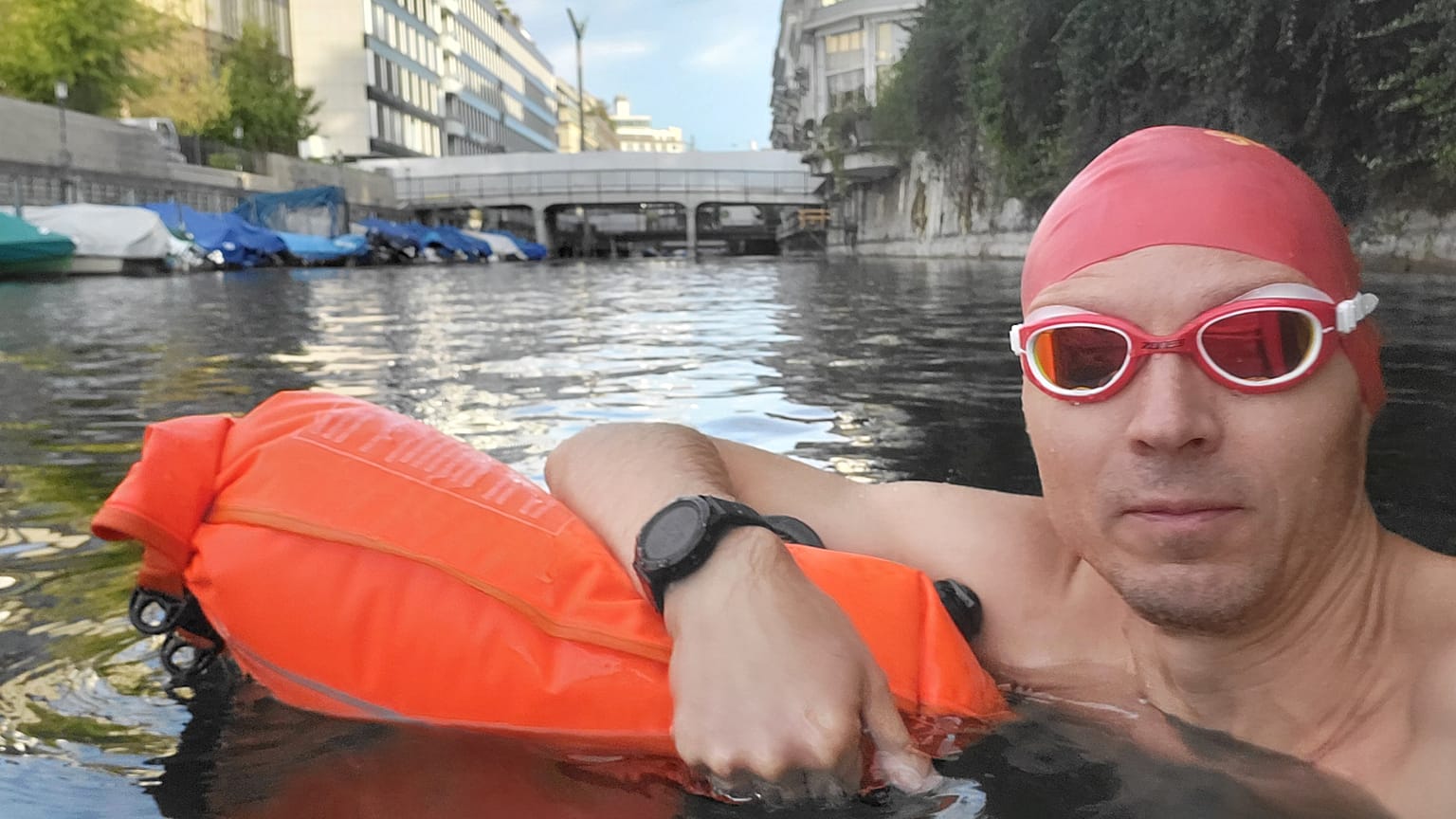
After moving to Zürich in 2019, he decided to trade crowded trams and trains for a cool swim down the city’s old moat.
When the weather is on his side, he takes public transport into the city centre, changes into swimwear and, with his belongings in a waterproof bag, he jumps into the Schanzengraben (‘fortification moat’) for the last 1.35 kilometres of his journey.
“It’s the best way to start a working day,” Mischa tells Euronews Earth. “Sometimes I see the sunrise at the lake before my swim or I observe swans taking their morning bath. Other times, several fish swim with me for many metres – it is truly a special feeling of harmony.”
So far this year, he’s swum more than 60 kilometres. But this summer’s drought-induced low water levels gave him a new perspective on his journey.
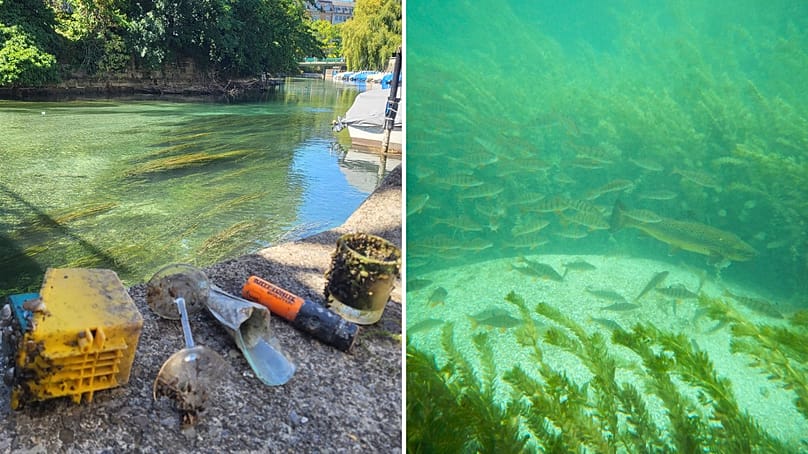
Fish join Mischa on his daily commute as he fishes litter out of the Schanzengraben.Mischa Gurov
‘A part of the city that’s hard to see from the street’
Alongside the canal are trams, bicycles, offices and people moving through Zürich.
But, taking an underwater camera with him on a recent commute, Mischa discovered “fish, old stone walls and a part of the city that is much harder to see from the street”.
“I realised nature is not necessarily somewhere far away in an ocean, rainforest or mountain. Sometimes there is an entire world living almost unnoticed beneath a bridge people cross every day,” he says.
He even managed to photograph a large fish that he later – with the help of the city’s waste disposal and water protection organisation Entsorgung + Recycling Zürich (ERZ) – identified as one of the Schanzengraben’s rarer brown trout.
These fish need clean, cool, oxygen-rich water to survive, so their presence is testament to the quality of the water. But a lack of care for their hidden world could be putting this at risk.
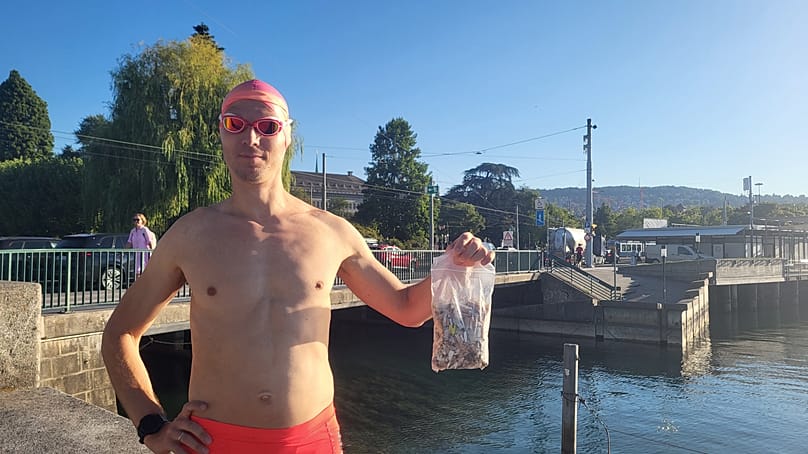
Mischa collected 500 cigarette butts discarded along the water's edge in under 30 minutes.Mischa Gurov
500 cigarette butts along 30 metres of the Schanzengraben
Mischa has long been frustrated by rubbish left in places he loves.
Living in London in 2018, he launched an anti-littering petition to clean up Richmond Park and the River Thames.
The same issue has become difficult to ignore in Zürich.
Earlier this summer, he decided to see how many cigarette butts he could collect along a short stretch beside the Schanzengraben. In 30 minutes, across roughly 30 metres, he collected more than 500.
Cigarette butts are Switzerland’s most littered item nationally, with over six billion discarded into the environment each year, costing an estimated CHF 53 million (€56m) in cleanup. In water, the toxins they leach can be lethal to fish.
He believes stronger regulation including heavier fines for littering could help to discourage negligent behaviour and offset the cleaning costs currently borne by taxpayers. At present, littering in Switzerland carries potential on-the-spot fines of between 80 and 250 CHF (€85-266).
Using his camera underwater made it clear what he’s fighting for: “There were not only discarded objects beneath and beside the water. There were fish, birds and a surprisingly rich little urban ecosystem too.”
It has only strengthened his resolve to keep this hidden part of Zürich clean – and to encourage those passing overhead to do the same.
Mischa says waking to a sunset swim is "the best way to start a working day".Mischa Gurov
‘Keeping Switzerland clean is a shared responsibility’
It’s not only aquatic life and unconventional commuters that depend on Zürich’s waterways.
Lake Zürich provides about 70 per cent of the city’s drinking water.
Every summer, the city’s residents cool off in the 18 official Sommerbäder (summer baths) across the pristine lake and Limmat river – with 4,500 people even rushing to take part in the annual two-kilometre Limmatschwimmen.
But Mischa wants more people to join him on his commute. Switzerland’s hottest, driest summer on record caused algae to multiply in Zürich’s waterways – but on appealing to the city he was told too few people swim in the Schanzengraben to justify the high clean up cost.
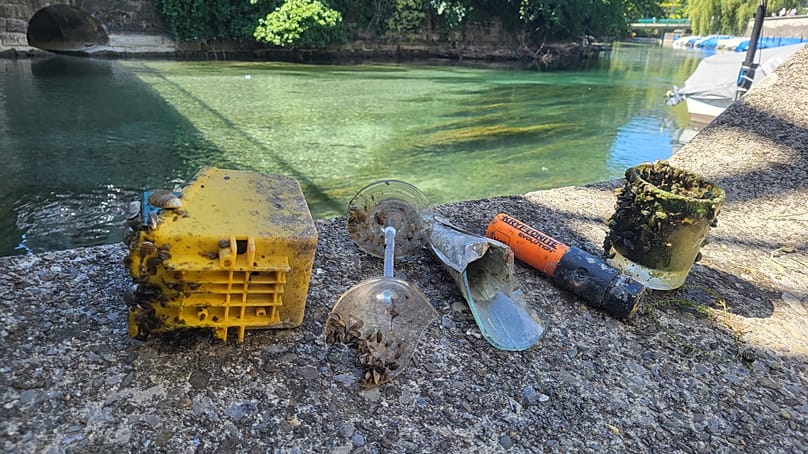
Trash fished out of the Schanzengraben by Mischa.Mischa Gurov
For Mischa, keeping the water clean isn’t just about protecting the ecosystem he’s come to know so well – it’s about everyone doing their part to look after a resource the whole city relies on and enjoys.
“Keeping Switzerland clean is a shared responsibility,” says Mischa.
“Littering cannot be solved by cleaners, authorities or individual volunteers alone. It only works if all of us do our part – people, communities, businesses and authorities.”
Swiss residents can take part in a IGSU’s National Clean-Up Day (the Interest Group for a Clean Environment) on 18 and 19 September 2026.
For his part, at 7am on the day, Mischa plans to swim the length of the Schanzengraben wearing a helmet adorned with 1,000 discarded cigarette butts and a Swiss bell: “Symbolically ringing the environmental alarm and expressing a protest against poisoning my ‘friends’” – the fish who accompany him on his commute each day.































 ADVERTISEMENT