














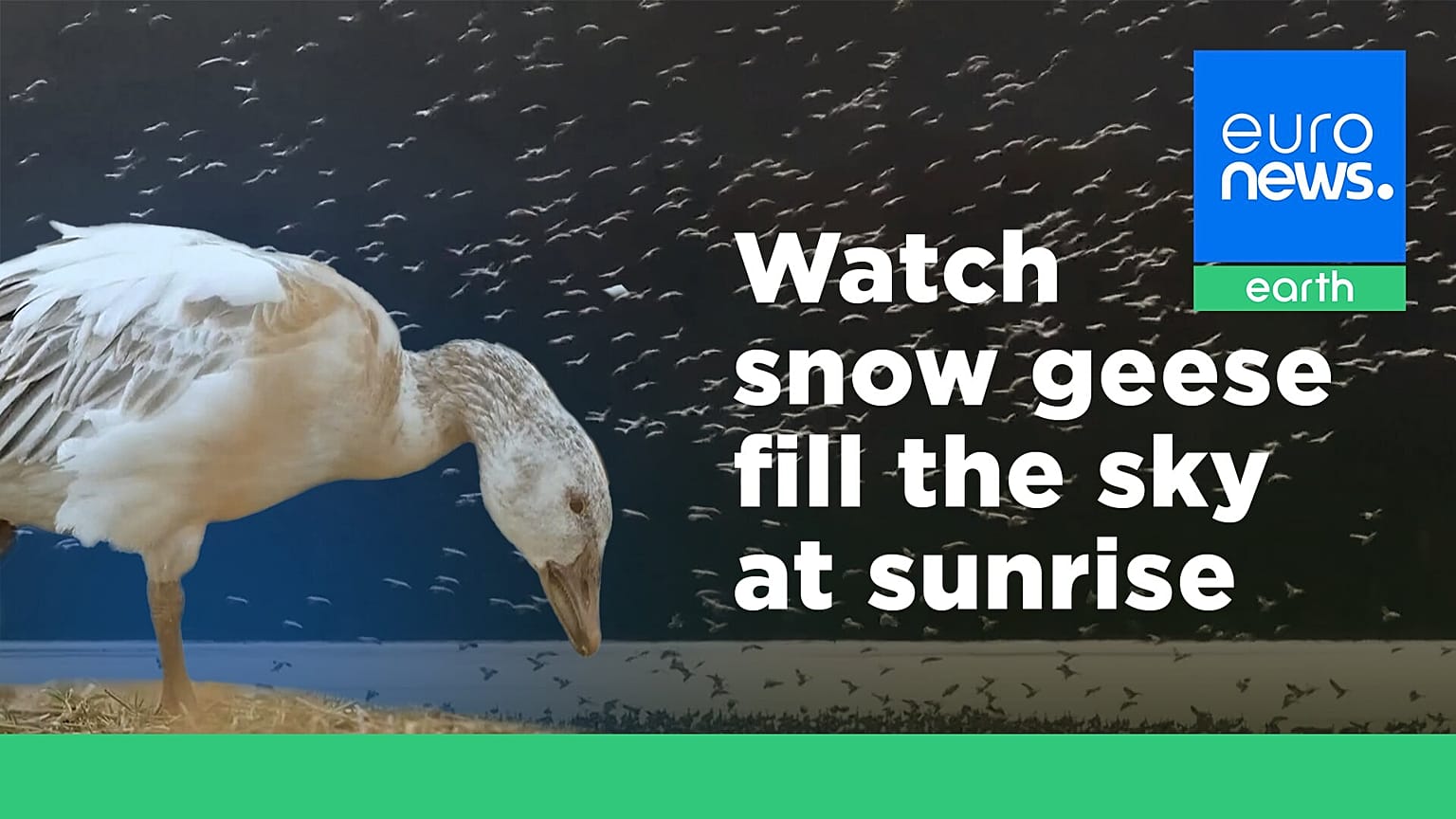














Snow geese are thriving in warmer weather – but it's bad news for crops and habitats.
Birdwatchers gather to share in one of nature's great spectacles: a "raucous tornado" of snow geese taking flight over a Pennsylvania reservoir.
 ADVERTISEMENT
ADVERTISEMENT
ADVERTISEMENT
Gathered in the predawn darkness, they wait for the moment when thousands of migrating birds stop honking and preening.
They're rewarded with a mesmerising – yet fleeting – display about an hour after sunrise.
The birds circle a few times and then head out to neighbouring farm fields, seeking unharvested grains and other sustenance for their epic annual spring flight northward into New York state and Quebec.
'It reminds you that nature is awesome'
Among those taking it all in was Devon Kriebel, a 30-year-old Pennsylvania resident who's spent two hours driving here with a friend to enjoy the spectacle.
Watching all the birds and animals at the reservoir, she says, "You can start to see everything kind of take off, forage in the water and you get to see the beauty of everything as the sun's rising, and not just the waterfowl, but you get to see some bald eagles here, all of your different songbirds and some different ducks. And it's just it's a great quiet calm environment that kind of grounds you and reminds you that nature is awesome.”
The Pennsylvania reservoir was built a half-century ago to attract waterfowl and over the years the gaggle has grown.
Pennsylvania Game Commission environmental education specialist Payton Miller describes it as a "raucous bird tornado" that lifts off from the water.
"We normally see a peak of over 100,000 snow geese," he says.
Snow geese numbers are growing
Snow geese have been arriving in growing numbers at this 2,500-hectare Middle Creek property since the late 1990s, spurred on by increased food availability from agriculture, changes in farming practices, and warming Arctic conditions.
At this time of year, they have just spent months along the Atlantic coast from New Jersey south to the Carolinas, with many of them overwintering on the Delmarva Peninsula that forms the Chesapeake Bay.
They don’t stay long at Middle Creek – it’s just a waystation on their journey to summer breeding grounds in the Canadian Arctic and western Greenland.
But for a few short weeks they become Middle Creek's main attraction with 150,000 visitors annually, including about a thousand hunters.
The Pennsylvania Game Commission, which owns Middle Creek, says about 100,000 snow geese were roosting at Middle Creek on the busiest day last year.
That's on par with recent peak activity but below the single-day record of about 200,000 on 21 February 2018.
Rising snow geese numbers come at a cost
Snow geese are doing well, but their large numbers have come with a cost.
A 2017 study found that greater snow geese grew in population from about 3,000 in the early 20th century to some 700,000 by the 1990s.
By some estimates, there are about a million of the birds now, along with maybe 10 million of lesser snow geese, which are smaller and also breed in the Arctic.
As snow geese numbers have boomed in recent decades, wildlife officials in the US and Canada have navigated a balancing act.
These involve hunting regulations, concerns about crop damage, shifts in snow geese migration and changes to overwintering patterns.
Environmental damage from overgrazing in the Arctic has led experts to conclude the birds are overabundant.
David M. Bird, a McGill University wildlife biology professor, describes the population as “probably one of the biggest conservation problems facing wildlife biologists in North America today."
He says: "The problem is, is that if you're a farmer and you're trying to subsist on your alfalfa and wheat crops that you planted for the spring, and suddenly you've got a hundred thousand snow geese landing on your fields and devastating your crops, then, I got a feel for those guys, those people. Because I mean, that's their living. It's not fair to them either. And so that's why it's such a conundrum."
Snow geese feed by pulling up plants by the roots, which damages habitats for themselves, as well as various other birds and wildlife.
Bird says that for nature lovers, snow geese can be a delight but for farmers, they're a pest.
For hunters, they're food but for animal rights advocates, they're a species that needs protection, he says.