




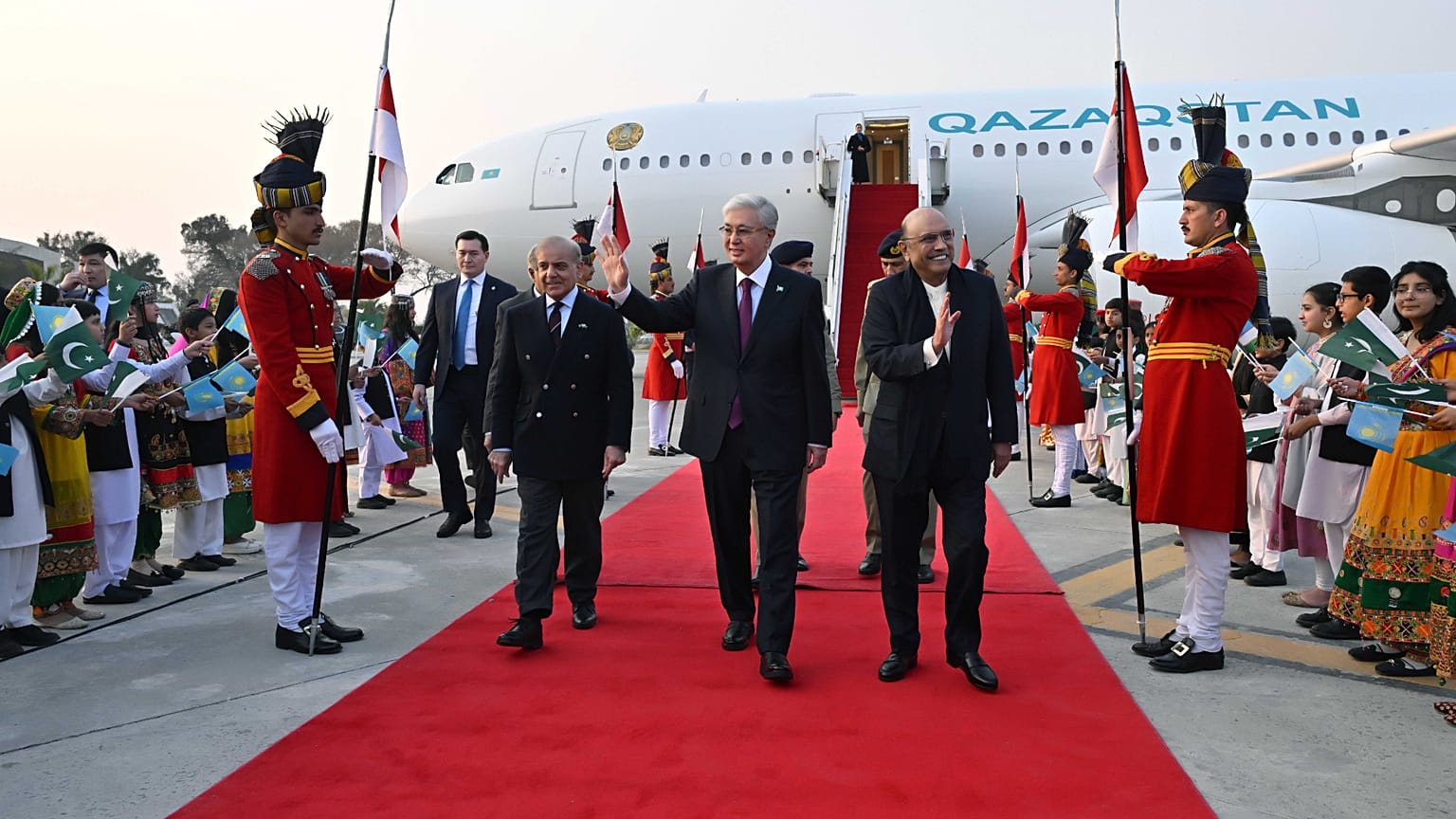













Kazakh president's visit to Islamabad brings major transport, trade and cultural deals as Kazakhstan and Pakistan plan new corridors via the Caspian Sea and Afghanistan.
Kazakhstan and Pakistan signed a strategic partnership agreement during a state visit by Kazakh President Kassym-Jomart Tokayev to Islamabad, focusing on transport corridors that would give the landlocked Central Asian nation access to Arabian Sea ports.
 ADVERTISEMENT
ADVERTISEMENT
ADVERTISEMENT
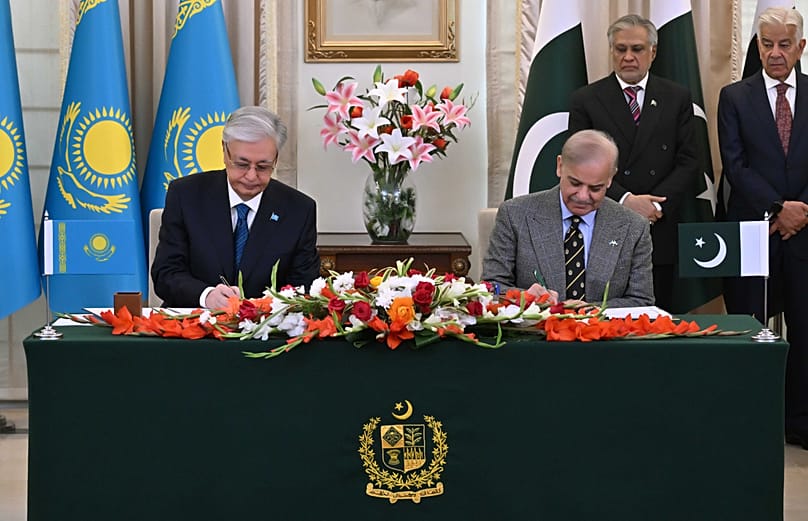
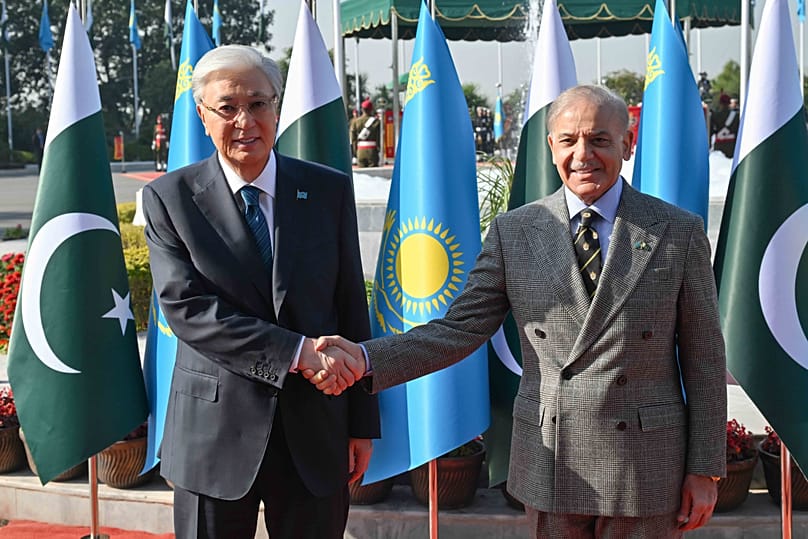
Tokayev met with Pakistani Prime Minister Shehbaz Sharif to discuss access to Karachi and Gwadar ports, with both leaders signing 20 agreements covering transport, logistics, mining, healthcare, education and other sectors.
“The development of the Trans-Caspian Transport Corridor and transit routes through Afghanistan were also considered as a priority,” Tokayev said.
The partnership would benefit both nations: Kazakhstan would gain access to ports connecting to India and the Arabian Sea, while Pakistan would reach European markets through the Middle Corridor via Central Asia.
“The two regions are economically complementary,” said Mukhit Assanbayev, Chief Expert of the International Security Department at the Kazakhstan Institute of Strategic Studies under Kazakh President.
“South Asia, represented by Pakistan, India, and other countries, are energy-deficient regions with significant consumer potential. Pakistan has a population of 250 million, India - 1.5 billion. Central Asia, on the other hand, is a region rich in energy reserves.”
Trade between Kazakhstan and Pakistan doubled in the past year to nearly €86 million, but underdeveloped logistics remains the main obstacle to reaching full trade potential.
A road connects Kazakhstan and Pakistan through mountainous areas in Kyrgyzstan and China, but is unavailable during winter.
“In this context, the parties discussed the prospects for implementing a railway project along the Kazakhstan-Turkmenistan-Afghanistan-Pakistan route,” Tokayev noted.
What about Afghanistan?
Afghanistan remains a critical uncertainty for the proposed corridors. The country has experienced deadly clashes on both its Pakistani and Tajik borders in recent months, raising questions about the Taliban's ability to provide regional stability.
Pakistan closed its border with Afghanistan following clashes in October 2025, leading to a 40% drop in bilateral trade. Both Kazakhstan and Pakistan now view Central Asia as a possible alternative route.
“Kazakhstan and Pakistan recognise the need for a comprehensive and balanced approach to developing transport routes through Afghanistan, taking into account regional security and the country's socioeconomic stability,” noted Manarbek Kabaziyev, Deputy Chairman of the Foreign Policy Research Institute under the Kazakh Ministry of Foreign Affairs.
Kazakhstan's approach is based on supporting Afghanistan's economic recovery through trade, transit and infrastructure projects, Kabaziyev said.
“Cooperation on Afghanistan will be carried out in phases, utilising existing multilateral formats and mechanisms, with strict adherence to the principles of sovereignty, non-interference, and responsibility of all parties involved,” Kabaziyev added.
Kazakhstan and Pakistan have maintained diplomatic and trade relations since 1992, but with limited intensity. For years they were separated by Afghanistan and its instability.
Since the Taliban came to power in 2021, some neighbouring countries, including Kazakhstan, decided to pursue trade with and travel through Afghanistan.
Increasing trade to $1 billion
Speaking at the Kazakhstan-Pakistan Business Forum, both leaders announced a goal to increase trade turnover to $1 billion (€847 million).
"Today, we agreed to make every effort to increase the trade turnover to $1 billion per year within the next two years," Sharif said. "We also agreed to do everything in our power to achieve this goal even sooner."
More than 30 commercial agreements worth almost €170 million were signed during the business forum, attended by 250 business leaders from both countries.
The largest agreement involves shipment of 600 buses from Kazakhstan worth €91 million.
Tokayev and Sharif opened three cultural centres and one sports centre in Islamabad where people can learn Kazakh language, culture, history and national sports.
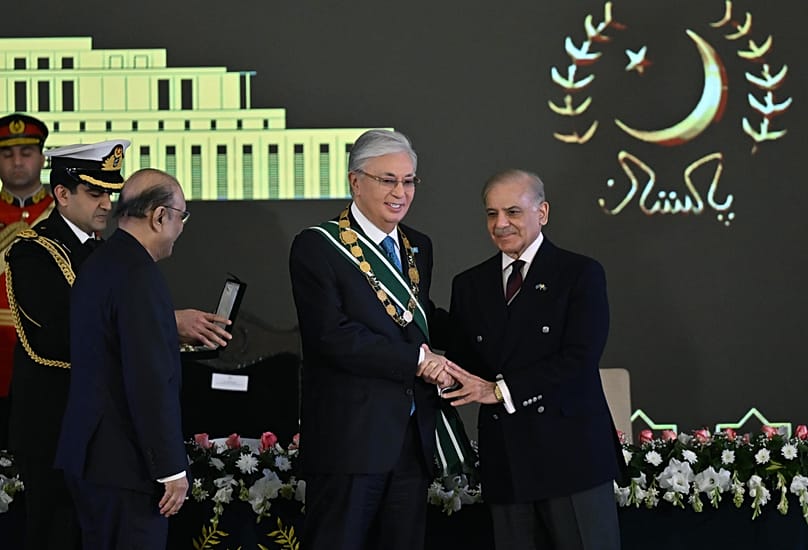
Pakistani President Asif Ali Zardari awarded Tokayev the Nishan-e-Pakistan Order, Pakistan's highest civilian honour. Previous recipients include Queen Elizabeth II, Nelson Mandela and US Presidents Dwight Eisenhower and Richard Nixon.