





























Spain spent the last six years investing heavily in wind and solar energy, leading to some of the cheapest power prices in Europe.
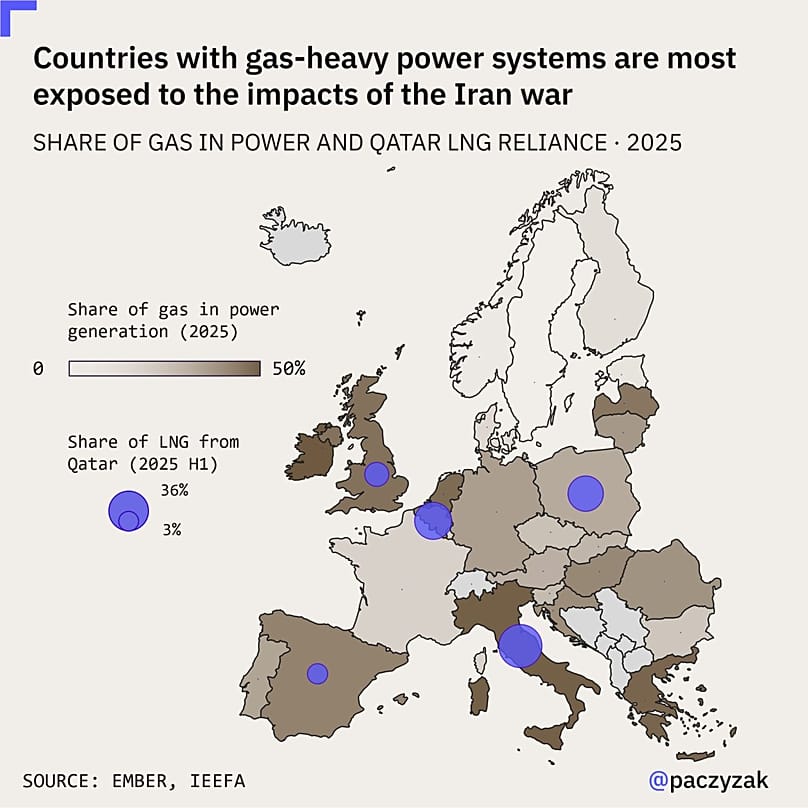
The Iran war has plunged the world into an overnight energy crisis. The closure of the Hormuz Strait and reduced Middle East energy exports have sparked fears of higher bills for already stretched households.
 ADVERTISEMENT
ADVERTISEMENT
ADVERTISEMENT
But one European country is well placed to weather these shocks thanks to its investment in renewable energy.
Since 2019, Spain has doubled its wind and solar capacity, adding over 40 GW - more than any other EU country except Germany, whose power market is twice the size of Spain’s.
As a result, Spain’s electricity price is much less influenced by the ever-fluctuating cost of gas, which increased by 55 per cent the day after the Iran war started and has continued to rise.
“Spain’s wind and solar growth has reduced the influence of expensive fossil generators on the electricity price by 75 per cent since 2019. This decline in the hours where the electricity price was tied to gas power cost was faster than in other gas-reliant countries, such as Italy and Germany,” according to a report by energy think tank Ember, published in October last year.
Experts agree that reliance on fossil fuel imports leaves countries dangerously exposed.
“The turmoil we are witnessing today in the Middle East makes it evident that we are facing a global energy system largely tied to fossil fuels - where supply is concentrated in a few regions and every conflict risks sending shock waves through the global economy,” says UN Secretary General António Guterres.
Spain’s energy bills are some of the lowest in Europe
According to Ember’s report, between 2020 and 2024 Spain “cut its power sector import bill more than any other EU country.” It did this by adding new solar and wind farms which “avoided 26 billion cubic metres of gas imports costing €13.5 billion”.
Spain did not use coal-fired power at all in August 2025. A far cry from just 10 years before, when coal accounted for a quarter of Spain’s power.
Its pivot to renewables has been a big win for household energy bills. In 2019, prior to Spain’s wind and solar revolution, it had some of the highest electricity prices in Europe. Now it has some of the cheapest.
“Spain started [2026] with some of the cheapest power prices in Europe, a trend that continued into the first week of March”, says Ember report authors Chris Rosslowe.
What’s still needed in Spain, as with much of Europe, is more energy storage capacity - its battery storage fleet of 120 MW is only the 13th largest in Europe.
Renewables are one-off, fixed costs
With governments under continual pressure to reduce debt and taxes, energy production needs to cost as little as possible.
Unlike wind turbines and solar panels, which countries buy and install once, oil and gas must be purchased continuously, with prices subject to unpredictable shocks, such as war.
Some have asked whether Trump’s war on Iran could unwittingly push Europe towards Chinese-made clean energy technology. Energy finance expert Gerard Reid points to renewables having lower long term costs than fossil fuels.
“I'd prefer to be dependent on China for the import of solar panels and batteries, than I would, for oil and gas coming from the Gulf, and I'll tell you why: because if I buy that solar panel, that battery, that wind turbine, that transformer, I buy it once every 25 years. I don't have to buy it every day.”
A new report published on 11 March by the UK's Climate Change Committee reinforces this point: the total cost of reaching net zero by 2050 is likely to be no greater than the cost of a single fossil fuel price shock - like the one triggered by Russia's invasion of Ukraine.
Modelling a similar crisis hitting in 2040, it found that if the UK were on the path to net-zero, it would see household energy bills rise by just 4 per cent, compared to 59 per cent without climate action.

Could the Iran war spark a shift towards clean energy?
Caroline Baxter, director of the Converging Risks Lab at the Council on Strategic Risks in Washington, says she “wouldn’t be surprised” if there was some shift towards green power because of the conflict, if only because renewable energy offers more stability than fossil fuels do.
“I think there is an opportunity, rightly or wrongly, for countries to really turn inward and try to power themselves in a way that cuts off their dependence on other nations for that source,” says Baxter, who was US deputy assistant secretary of defense for force education and training from 2021 to 2024 under the Biden administration.
Baxter says if she’s right and if “everyone does it in their backyard,” it will limit future climate change “without the thorny diplomatic negotiations and the glad-handing and the machinations behind closed doors” of international climate conferences.
Last year’s UN COP30 climate summit concluded without committing to a fossil fuel phaseout.
The war will lead to more solar panels and heat pumps installed in coming months, says energy analyst Ana Maria Jaller-Makarewicz, of IEEFA Europe.
This is where ordinary people can play their part to not only lower their own energy bills but also reduce their country’s reliance on fossil fuels. As Marin Gillot at Strategic Perspectives says, “Every heat pump, electric vehicle, wind turbine or solar panel deployed means fewer molecules of imported gas.”