


















Central Asia is entering a decisive demographic phase, with rapid population growth and a sharply expanding workforce, while Europe faces ageing societies and labour shortages.
Central Asia’s population is projected to exceed 114 million by 2050, according to the United Nations Population Fund (UNFPA).
 ADVERTISEMENT
ADVERTISEMENT
ADVERTISEMENT
The region is moving in a different direction at a time when Europe and East Asia are experiencing declining birth rates and increasingly older populations.
For families across Central Asia, these demographic trends are daily realities shaped by culture, economics and personal choices.
Central Asia is experiencing what demographers describe as a rare demographic window. According to the UNFPA report, the population of working-age adults aged 15-64 across the region is projected to increase from approximately 50 million today to approximately 71 million by 2050.
More than 20 million more women and men are set to enter the labour market over the next quarter-century.
According to Nigina Abbaszade, UNFPA representative in Uzbekistan, this demographic momentum creates a limited but critical opportunity for the region.
Nearly one-third of Central Asia’s population is under the age of 15, meaning education systems, labour markets and social institutions will face sustained pressure in the coming decades.
“Whether this growth translates into economic and social gains,” Abbaszade said, “depends on how well countries prepare now.”
"Investment in education, healthcare and decent employment, particularly for women and young people, is essential to ensure that the growing population contributes productively to society," she added.
Expanding women’s access to education and work plays a key role in shaping long-term demographic and economic outcomes, according to Abbaszade.
Culture, economics and reality
Behind the regional data are families making deeply personal decisions.
For Sayyora Mamaraimova, a 59-year-old homemaker from Uzbekistan, growing up in a large family shaped her desire to have children of her own.
“In our family there were eight of us. We always supported each other,” she said. “That’s why I wanted my children to have siblings, so they would never feel alone.”
Mamaraimova had five daughters while carefully considering health and financial limits. “No matter how many children you have, you still have to think about education, food and the future,” she added.
Feruza Saidhadjaeva, also from Uzbekistan, combined motherhood with a long professional career. She worked continuously while raising four children and believes planning and women’s independence are essential.
“Financial responsibility matters. I never wanted to depend on anyone,” Saidhadjaeva said. “Large families have many positives, but they require discipline, planning and equal responsibility.”
Uzbekistan’s population growth
Uzbekistan is the most populous country in Central Asia. With 37.4 million people in 2024, it accounts for nearly half of the region’s population. By 2050, that figure is projected to reach 52 million.
The country’s demographic growth is also reflected in daily statistics. In the first 24 hours of 2026, 1,815 children were born in Uzbekistan, including 894 girls and 921 boys. The highest number of births was recorded in the Surkhandarya region, with 243 newborns.
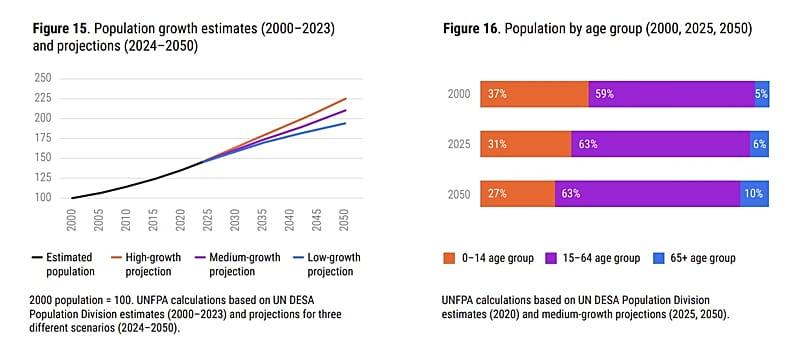
A defining feature of Uzbekistan’s demographic profile is its youthfulness. Around 60% of the population is under 30, creating strong momentum for economic growth, innovation and labour market expansion.
The country’s population is growing at around 2% per year, nearly twice the global average. According to Uzbekistan’s National Statistics Committee, the population increases by roughly 740,000 people annually, with the highest birth rates recorded in the Surkhandarya region in southern Uzbekistan.
This growth underscores the importance of sustained investment in education, skills development and job creation, as the number of working-age citizens increases by approximately 350,000 each year.
Kazakhstan’s demographic transition
Kazakhstan presents a different demographic picture. With a population of 20.3 million in 2025, it has increased by 23% since 1992 and is projected to reach approximately 26 million by 2050.
A significant portion of Kazakhstan’s population is also young. Around 29-30% of the population in Kazakhstan is aged 0-14, indicating a strong presence of children and adolescents in the age structure.
This proportion helps sustain demographic momentum even as the country gradually moves through a demographic transition.
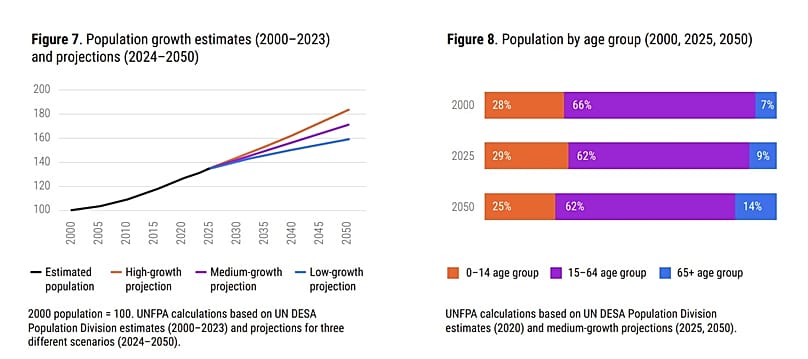
While fertility remains relatively high at around three children per woman, the country is entering a more advanced stage of demographic transition. By 2050, the share of people aged 65 and older is expected to nearly double: from 8% to almost 15%.
Population trends vary across Kazakhstan, with growth concentrated in the south and west, whereas northern regions experience population decline and slower economic activity.
In Kazakhstan, Azhara Kabitova, a mother of six including twins and triplets, describes how family size is shaped by both cultural values and everyday realities.
“Culturally, having many children is encouraged,” Kabitova said. “But families still have to think carefully about finances and long-term planning.”
“People often have strong opinions,” she explained. “There can be assumptions about responsibility or dependence, especially toward mothers.”
Kabitova added that these attitudes underscore the importance of balancing tradition with realistic planning, particularly as costs rise and lifestyles change.
A region growing when others are shrinking
Central Asia’s demographic trajectory contrasts with trends in Europe. Eurostat data indicate that the EU’s total fertility rate is approximately 1.38 births per woman, well below the replacement level of 2.1, while life expectancy continues to rise.
Together, these trends are reshaping labour markets, welfare systems and social policies across the continent.
For families living in Europe, the contrast is striking.
Ilkhom Khalimzoda, an Uzbek citizen who lives in Finland, said Europe’s individualised lifestyle makes large families more difficult.
“Every child requires more time, energy and money, and parents do almost everything themselves,” Khalimzoda explained. “There is no extended family support like in Uzbekistan.”
Jonas Astrup, a Danish father of three, notes that in northern Europe one or two children is the norm, while larger families are often viewed as an exception.
In Europe, women’s fertility decisions are more closely tied to career planning, housing costs and work–life balance.
In Central Asia, family size remains more strongly influenced by cultural norms and intergenerational support, although this is gradually changing.
Choice, not pressure
Abbaszade stressed that the declining fertility trends observed in Europe and other regions should not be interpreted as merely a shift in personal values.
In many cases, she says, people’s choices are shaped by broader economic and social conditions rather than preference alone.
This perspective is reflected in the European context by Fabio Losa, Regional Demographic Resilience and Policy Advisor at UNFPA. He pointed to practical constraints, including financial insecurity, housing costs, childcare expenses and work–life balance pressures, as key factors preventing people from having the number of children they would like.
Taken together, these views suggest that across regions, fertility decisions are influenced less by attitudes toward family and more by the conditions in which people live.
Ensuring access to stable employment, affordable housing, childcare and supportive work environments plays a central role in allowing individuals and families to make choices free from economic or social pressure.
By mid-century, Central Asia’s growing population will place increasing pressure on water resources, land and urban infrastructure, particularly in vulnerable areas such as the Aral Sea region and the Fergana Valley.
Without sufficient job creation, education and social protection, the risks include unemployment, reliance on migration, environmental strain and social fragmentation.
With sustained investment in human capital and labour markets, the region may be better positioned to integrate its growing youth population at a time when many European countries are facing labour shortages.