






























A former businessman, lawmaker and kingpin in the Democratic Party of Moldova, Plahotniuc fled Moldova in 2019, as he faced a series of corruption charges.
A court in Moldova sentenced oligarch Vladimir Plahotniuc to 19 years in prison on Wednesday in a case linked to the disappearance of $1 billion (€850 million) from the country’s banking system.
 ADVERTISEMENT
ADVERTISEMENT
ADVERTISEMENT
The former businessman and lawmaker controlled Moldova as a "captured state" from 2013 to 2019, wielding de facto control over the legislative, executive, law enforcement and judicial authorities despite never holding top government positions.
Plahotniuc, kingpin of the Democratic Party of Moldova, fled the country in June 2019 after his government collapsed and he faced a series of corruption charges.
That included complicity in the scheme that led to money disappearing from Moldovan banks in 2014, which at the time was equivalent to around one-eighth of the country's GDP, in a scandal that became known as "theft of the century".
He was extradited from Greece last year, after being arrested at Athens airport under an Interpol international alert.
A Chișinău judge announced the ruling on Wednesday.
The court also ordered the seizure of some $60 million (€51 million) from Plahotniuc's accounts, said prosecutor Alexandru Cernei after the sentencing.
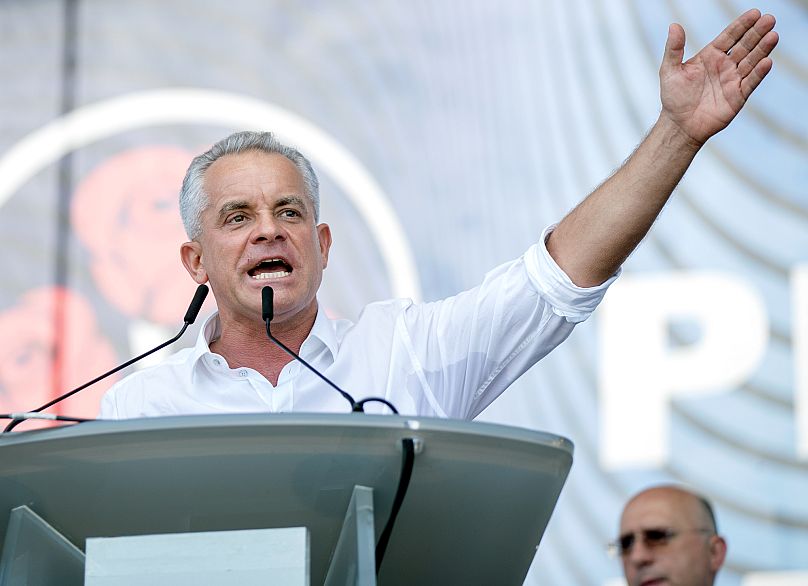
Plahotniuc, 60, was not present in court on Wednesday.
He had previously dismissed the charges, calling his trial "political" and "flawed from the outset."
His lawyer Lucian Rogac said he would appeal the decision, deeming it "clearly illegal".
Causing 'captured state'
From 2013 to 2019, Plahotniuc established control over Moldova's key state bodies through the Democratic Party, which he led.
Plahotniuc controlled the country's law enforcement to target political and business rivals and meddled in Moldova's elections, according to the US State Department, which added him to its sanctions list in 2022.
He wielded control over administrative, financial and media levers of society, and even the Constitutional Court was widely seen as making politicised decisions under his influence.
Plahotniuc fled Moldova on 14 June 2019, following the collapse of a Democratic Party-led government which he was widely seen as controlling from behind the scenes.
His departure came after the Socialist Party and the ACUM bloc formed a coalition government that same day, adopting a declaration on Moldova being a "captured state".
He was added to a UK sanctions list in 2022 and barred from entering the country. His assets were frozen in Britain and its overseas territories.
Plahotniuc was accused of involvement in pro-Russian political campaigns and efforts to derail Moldova's pro-EU course.
After Plahotniuc's extradition back to Moldova, prosecutors had demanded 25 years in jail, the maximum allowed by law, in a case linked to the disappearance of money from three banks in 2014.
They accused Plahotniuc of forming and leading a criminal organisation, and of committing fraud and money laundering on a particularly large scale.
The charges included controlling the country's law enforcement to target political and business rivals and meddling in Moldova’s elections.
The highest position Plahotniuc held in Moldova was vice president of parliament.
Dodon's case remains linked to Plahotniuc
Igor Dodon, Moldova's president from 2016 to 2020, was arrested on 24 May 2022 on charges including receiving between $600,000 and $1 million from Plahotniuc in June 2019 in the so-called "kuliok" or "black bag" case.
Prosecutors said the money was claimed by Dodon for payment of expenses for the Party of Socialists in Moldova, including salaries of party employees.
At the same time, prosecutors said Dodon was to negotiate in Moscow for the release of Plahotniuc from criminal liability for pending cases under the management of Russian law enforcement for drug trafficking and organised crime.
The charges were based in part on video footage from 2019 showing Dodon receiving a black bag from Plahotniuc at Democratic Party headquarters.
Dodon was placed under house arrest, then released in November 2022 and banned from leaving the country. His trial is ongoing.
Dodon, leader of the pro-Russian Socialist Party, has denied all charges against him, calling them political persecution.