





























A Spanish-Egyptian team have uncovered a fragment of Homer’s Iliad inside a mummy at Oxyrhynchus, revealing how ancient texts were reused in burial practices and shedding light on the spread of Greek literature in Roman Egypt.
Archaeologists working at the ancient Egyptian site of Oxyrhynchus have uncovered a rare literary fragment hidden inside a mummy, revealing verses from the famous Iliad, by ancient Greek poet Homer, in an unexpected funerary context.
 ADVERTISEMENT
ADVERTISEMENT
ADVERTISEMENT
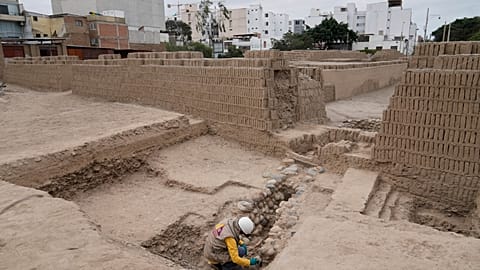
The find, announced by Sherif Fathy, Egypt’s Ministry of Tourism and Antiquities, was made at Al Bahnasa, around 190 kilometres south of Cairo, during a joint mission led by the University of Barcelona and the Institute of the Ancient Near East.
The discovery took place in "tomb 65", a hypogeum which, despite having been looted in antiquity, preserved a remarkable collection of funerary materials.
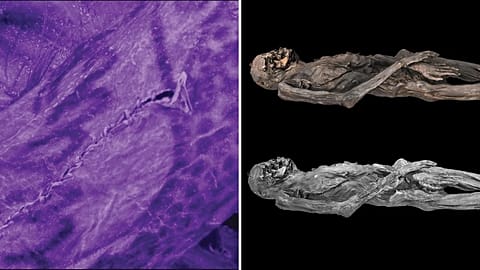
Dr Maite Mascort and Dr Esther Pons Mellado, directors of the project, documented several mummies with bandages decorated with geometric motifs and still bright colours, as well as polychrome wooden sarcophagi and a small batch of metal objects: three thin sheets of gold and a piece of copper.
Such items formed part of the burial trousseau typical of the Greco-Roman period, intended to guide the deceased in the afterlife.
Professor Hassan Amer of Cairo University, head of the Egyptian excavation team, said that tomb 65, despite its structural deterioration and the looting it has suffered, made it possible to reconstruct the fascinating process of fusion between Egyptian funerary traditions and influences from the Hellenistic and Roman Mediterranean.
A Homeric text in a mummy?
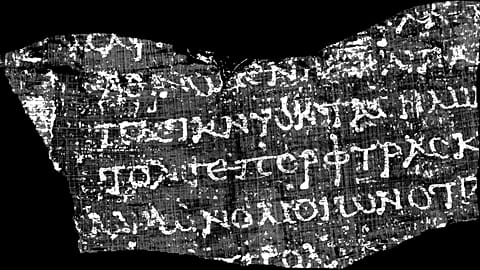
The most striking find came from within one of the mummies: a fragment of papyrus, ancient writing material, preserving lines from Book II of the Iliad, specifically the “Catalogue of Ships”, a long passage listing the Greek forces that sailed to Troy.
While papyri are commonly found at Oxyrhynchus, one of the most important sites for ancient Greek texts, their presence inside a mummy is far less typical.
This makes the discovery unique both literary and historically.
Experts suggest the fragment was likely reused as part of the mummy’s wrappings or cartonnage, a common practice in antiquity where discarded texts were repurposed in burial preparation rather than placed for symbolic meaning.
Egyptian authorities noted that the piece enriches the already prolific archaeological record of the Al Menia province.
This find dates broadly to the Greco-Roman period, when Egypt was under strong cultural influence from the Greek and later Roman worlds.
It provides rare insight into how classical literature circulated in everyday contexts, far beyond elite libraries.
Hesham Al Leizy, Secretary General of the Supreme Council of Antiquities, stressed that the site is providing new clues to the funerary rituals of Al Bahnasa in the Greco-Roman period.
Officials also say the discovery adds to the growing archaeological record of the Al Minya region, while reinforcing Oxyrhynchus’ long-standing reputation as a key site for uncovering written traces of the ancient Mediterranean world in the Ptolemaic and Imperial periods.