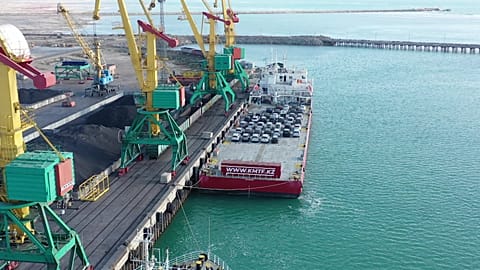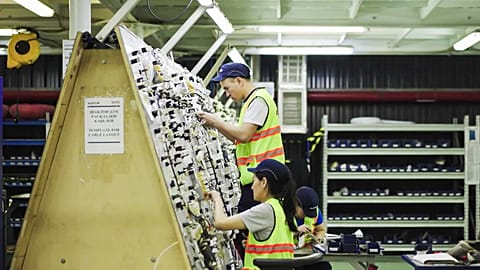
































Kazakhstan, one of the EU’s top suppliers of sunflower meal and durum wheat, wants value-added products to dominate its agricultural exports by 2028.
With more than 200 million hectares of agricultural land and over 25 million hectares of arable land, Kazakhstan has a strong resource base for agricultural processing.
 ADVERTISEMENT
ADVERTISEMENT
ADVERTISEMENT
The country now wants to become a regional food processing hub, as part of a broader strategy to drive non-resource growth and double GDP to €380 billion by 2029.
The government wants value-added products to account for 70% of exports by 2028. Last year, processed goods made up 60% of total agricultural output, while exports of processed food products rose by 35%, exceeding €2.5 billion.
Access to European markets
While Kazakhstan’s established trade routes are largely focused on Central Asia and China, the country is seeking to secure a long-term foothold in the European Union’s highly regulated markets.
“Our access is limited by fragmented production volumes, long logistical routes as a landlocked country, and the challenge of maintaining continuous supply chains. In global trade, and especially in Europe, price is no longer the sole decisive factor. Reliability, consistency of quality, rigorous international certification such as organic and ESG standards, traceability, and the ability to deliver stable volumes are what define market access today,” said the Chairman of the Development Bank of Kazakhstan, Marat Yelibayev.
Kazakhstan today primarily produces grain, vegetable oil and related oilseed products. It ranks among the top three suppliers of sunflower meal to the EU and is among the world’s top ten exporters of sunflower oil. The country is also the EU’s second-largest supplier of durum wheat.
To boost processing output, the government has introduced measures ranging from lending mechanisms and concessional financing to state-backed financial support and new investment projects across the sector.
“As of today, we have a concrete pipeline of investment projects in place, which we are tracking and monitoring together with investors and regional authorities. Clear timelines have been set, and the production capacities we have planned will fully support an increase in the share of processed goods and their subsequent export,” said Kazakhstan’s Vice Minister of Agriculture, Erbol Taszhurekov.
Processing capacity
Kazakhstan’s main processed agricultural products currently include vegetable oil, animal feed and flour, according to experts at QazTrade.
Data from the Ministry of Agriculture shows the country’s annual oilseed processing capacity stands at five million tonnes. Last year, Kazakhstan produced 890,000 tonnes of vegetable oil, up 17% year-on-year.
Similarly, with the capacity to process five million tonnes of grain annually, the country produced just over two million tonnes last year.
“At present, only the first stage of processing is largely carried out in Kazakhstan, while deep processing accounts for only a small percentage,” said Yelibayev.
By 2028, Kazakhstan plans to add six million tonnes of deep grain processing capacity, with a focus on higher-value products such as amino acids, syrups and vitamins.
Elsewhere in the sector, the dairy industry processes around 2.7 million tonnes of milk annually, while meat processing enterprises produce approximately 450,000 tonnes.
Tokayev calls for new agricultural co-op law
President Kassym-Jomart Tokayev has called for reforms in Kazakhstan’s agricultural sector, flagging structural weaknesses during a government meeting.
“We possess considerable potential for livestock development, yet this opportunity remains largely untapped. The livestock sector is hindered by the absence of a cohesive strategy, slow progress, and disorganised management,” the president said.
With around 40% of Kazakhstan’s population employed in agriculture, concerns over productivity and the deep processing of raw materials have become increasingly pressing.
Tokayev instructed the government to draft a new law on agricultural cooperation by 1 September, aimed at encouraging farmers to unite under new cooperative models.
Currently, 60% of meat and 80% of milk production still comes from household and family farms. Officials believe that more efficient cooperatives could provide a major boost to small-scale farming through stronger coordination and closer integration with large anchor projects.
There are now nearly 4,000 cooperatives operating across the country. These entities supply raw materials from both crop production and livestock farming and are linked to large export-oriented industrial projects.
According to Tokayev, Kazakhstan still lacks an effective end-to-end agricultural value chain.
“The country has not established a clear process chain, from forming the feed base to processing, logistics, and sales.”
Vice Minister of Agriculture Erbol Taszhurekov said the ministry has already launched work on the legislative overhaul.
“The ministry has now set up a working group tasked with gathering proposals on improving the current operating conditions for cooperatives and preparing the necessary legislative amendments.”
“These changes will enshrine all the required incentive measures in law to support the further development of cooperation,” he added.
Non-resource growth
The expansion of agricultural processing is being partly supported by the Development Bank of Kazakhstan (DBK).
The bank provides long-term debt financing of up to 20 years, with a focus on building a full value chain from land and raw materials to finished export products.
According to Yelibayev, the highest value-added potential lies in several key segments.
“The sectors with the greatest value-added potential are oils and fats, grain processing, especially deep wheat processing, as well as poultry-related projects.”
The bank currently supports full-cycle businesses in flour, vegetable oils, starch, syrups and animal feed.
It is also prioritising integrated project models designed to help producers move beyond fragmented export sales and secure long-term premium positioning in European markets.
“When export-oriented local companies want to sell abroad, they can apply to us for export financing to support those sales,” Yelibayev added.
In the oils and fats segment, DBK helped Maslo-Del expand its production capacity to 180,000 tonnes per year.
The company received a little over €5 million in pre-export financing to purchase raw materials for vegetable oil and oilcake shipments bound for Europe.
Further along the value chain, the bank is working with KfW, Germany’s development bank, and other European financial institutions on a major potash fertiliser project in western Kazakhstan.
Central Asia’s largest poultry farm
Kazakhstan’s poultry exports are being driven in part by Aitas Holding Group, which plans to almost quadruple output to 350,000 tonnes by 2030.
Last year, the holding accounted for around 35% of the country’s poultry exports, with a significant contribution from its Makinsk Poultry Farm in the Akmola region.
The facility is regarded as the largest poultry project in Central Asia, producing 90,000 tonnes of meat annually.
It offers around 80 products across the full-value chain, ranging from chilled meat to ready-to-cook processed items.
The Makinsk complex was launched in 2015 with support from the European Bank for Reconstruction and Development (EBRD) and the Baiterek Venture Fund, alongside a credit line from DBK.
“Twenty per cent of the cost came from our own funds, while 80% was raised externally. The external financing was provided through credit resources from the Development Bank of Kazakhstan,” said Rabiga Tokseitova, Vice President of Aitas Holding.
With exports already reaching Russia, Kyrgyzstan, Tajikistan, Uzbekistan and Belarus, Aitas Holding is now looking to expand into China.
As production grows, processing deepens, and export markets widen, Kazakhstan is positioning itself as an emerging food processing hub at the heart of Eurasia.