

















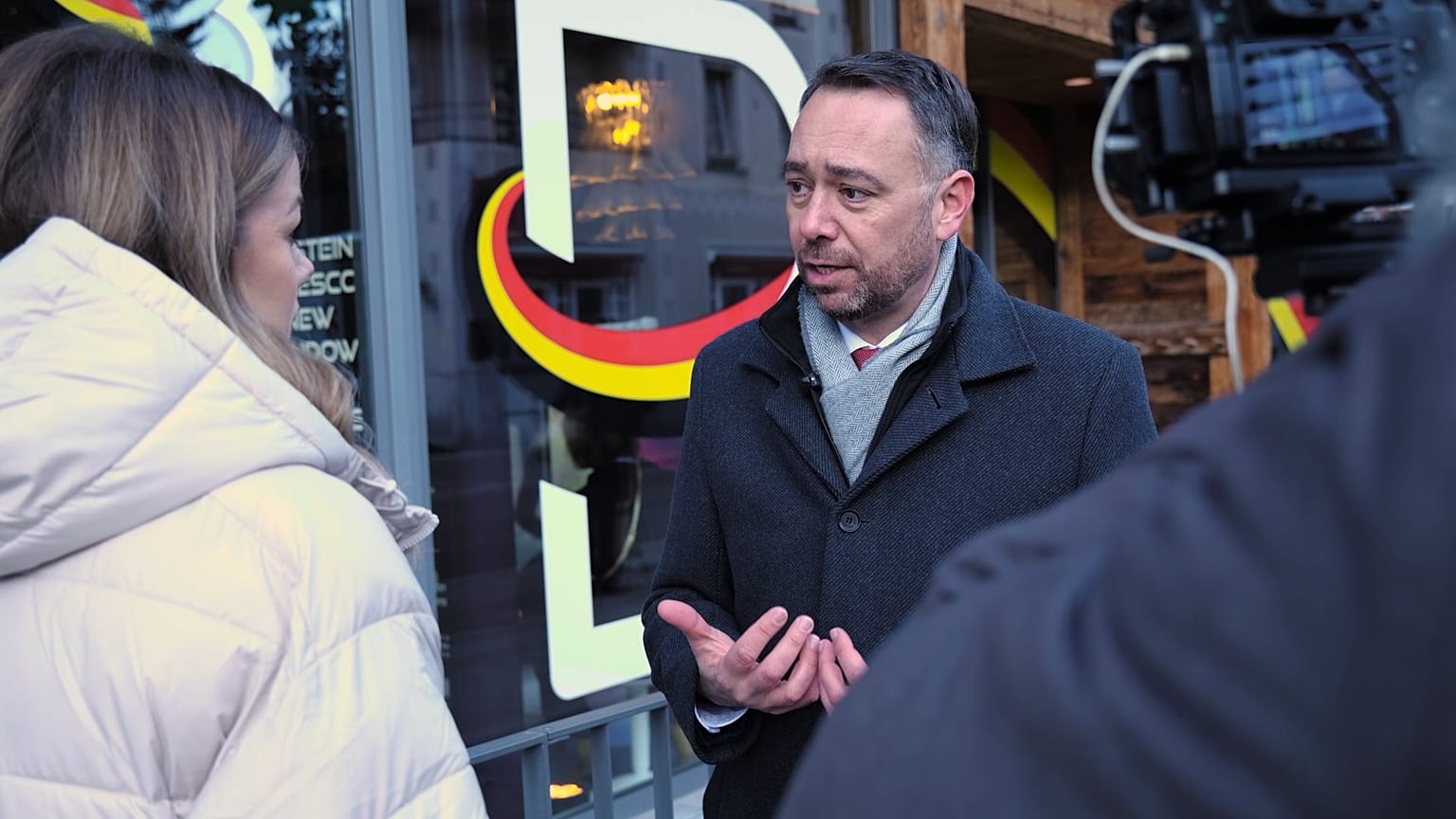













US President Donald Trump's plans to take control of Greenland are "incomprehensible and unnecessarily hostile", Belgian Foreign Minister Maxime Prévot told Euronews. His comments come amid an ongoing scramble among European leaders to devise a response.
In an interview with Euronews at Davos on Tuesday, Belgium's Foreign Minister Maxime Prévot strongly criticised US President Donald Trump's plans to take "complete and total control" of Greenland, the self-governing territory of the Kingdom of Denmark.
 ADVERTISEMENT
ADVERTISEMENT
ADVERTISEMENT
"Frankly speaking, the attitude of the US is incomprehensible and unnecessarily hostile," Prévot said on Euronews' interview programme 12 Minutes With.
Trump has stepped up his threats to seize Greenland in recent days and has not ruled out taking it by force. Asked about Washington's disregard for European leaders' response, he said there is "no rational explanation".
"But being blackmailed and threatening allies within the NATO family, this is totally unacceptable," he said at Davos, where the World Economic Forum's annual meeting is being upended by Washington's vying for Greenland.
Trump has argued that US control over Greenland is “imperative” for US national security, claiming "Russian and Chinese ships are all over the place" around the territory.
He doubled down on this bid to take over the territory on Tuesday morning, posting a digitally-generated picture of him planting a US flag on Greenland.
Prévot acknowledged these concerns raised by Trump. "Maybe they have identified some threats in the region of the Arctic. Okay, we can understand that, and maybe we can discuss how to address those fears and those threats together," he said.
The Belgian foreign minister underlined that a partnership already exists between the US and Denmark to discuss such matters, namely the Greenland Defence Agreement, which allows the US military to operate on the Arctic island.
"They only have one military basis today, but it is possible to have more in the future according to the current agreement, so it's not necessary to take, in an aggressive and old-style manner, any square kilometres of Greenland," said Prévot. "It is really a red line for European countries."
Despite his criticism of Trump's actions, Prévot hopes pragmatism will prevail. "I hope that it will be possible in the coming days and weeks to go back to a more reasonable way of thinking and acting. I think it's crucial," he said.
To this end, Trump has said he has agreed to a meeting in Davos on Greenland with "the various parties" involved, while Belgium's Prime Minister Bart De Wever and King Philippe are also in Davos. "We will take the opportunity of the Davos meetings to share this message," Prévot said.
Trump's desire to make the island of just 57,000 people part of the US is nothing new: in 2019, during his first term as president, he put in a bid for the territory, a proposal that was turned down and described as "absurd" by Danish Prime Minister Mette Frederiksen.
Muted EU response?
European leaders were quick to rally behind Denmark and Greenland as Trump upped the ante on Greenland in recent days.
In response, the US president threatened to impose a 10% import tax from 1 February on goods from eight European nations that oppose US control of Greenland and sent military personnel to the Arctic island.
"It is crazy to hear the US saying that the fact that some European countries have sent soldiers to Greenland is a kind of anti-American act," said Prévot.
"It is the opposite. It is a manner to demonstrate that we intend to take the fears expressed by the US into account more than we have in the past, and that European countries really have the intention to better secure the Arctic region in the future."
Trump's tariff threats have triggered an ongoing scramble among European leaders to agree on which retaliatory measures to use.
It was briefly suggested that Europe could adopt brass-knuckle methods similar to Trump’s approach and deploy its anti-coercion instrument (ACI) in retaliation. This trade "bazooka" allows the EU to shut off access to the single market, among other measures.
However, there is a division within the bloc over deploying this tool. Many want to first prioritise dialogue and diplomacy with the US and hold off on triggering retaliatory measures such as the never-before-used ACI.
Prévot told Euronews that the 27-member bloc is now faced not only with a crisis but also with a turning point, and that this demands action and potential countermeasures to "send a clear message to the US".
"It is not acceptable the way (the US) have treated their allies. So we will, of course, use diplomacy to de-escalate the current tensions," he said.
"We absolutely need to avoid any escalation on this tariff war, because it will be bad for both parties, also for the US. And I hope it will be possible to find a reasonable solution in the coming weeks. Otherwise, we would be forced to use the anti-coercion instrument, for instance."
EU leaders will convene in Brussels on Thursday for an extraordinary summit to nail down a common approach for the next steps.