




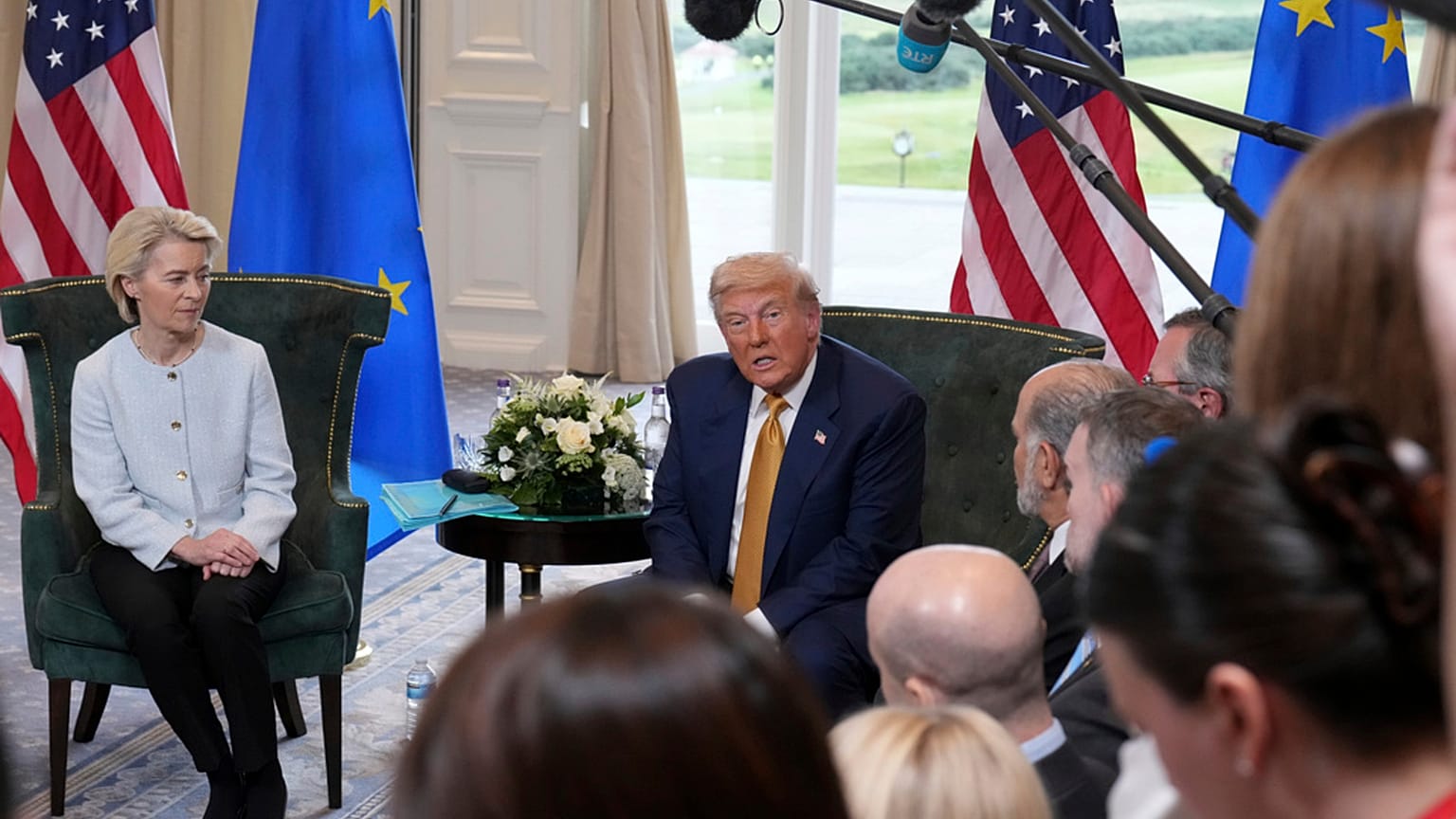













European Union leaders face a pivotal week as they seek to defuse tensions with the US while preparing to retaliate against Trump should he act on his tariff threats. Officials and diplomats consulted by Euronews say the bloc's anti-coercion instrument is part of the plan, but no magic bullet.
European Union leaders are gearing up for a week of shuttle diplomacy between Davos and Brussels as they seek to de-escalate tensions around Greenland while preparing broad retaliatory measures – including the bloc's so-called "trade bazooka".
 ADVERTISEMENT
ADVERTISEMENT
ADVERTISEMENT
European governments believe a dual-track strategy is the best way forward to ease the tensions over the territory, and that a diplomatic solution is still possible as they prepare for crunch face-to-face talks with United States President Donald Trump in Davos.
An extraordinary meeting of ambassadors held on Sunday crystallised the EU's strategy and is dictating the European Commission's response. At the meeting, member states showed solidarity with Denmark while calling to exhaust all diplomatic avenues before resorting to punitive measures, according to one diplomat familiar with the matter.
The approach was confirmed by German Chancellor Friedrich Merz on Monday, who said Europeans want to "avoid any escalation in this dispute if at all possible," while reminding the US administration that EU countries "could also retaliate."
The European Commission has also been tasked with exploring a range of retaliatory measures to deploy should diplomatic efforts fail, including the Anti-Coercion Instrument (ACI), which could shut off US companies' access to the European single market.
The EU could also allow a freeze on €93 billion of retaliatory tariffs on US goods to expire in a move of "passive retaliation", according to the diplomat.
"The easiest way to hit back is to let the pause on the counter tariffs expire. The EU wouldn't have to do much, and the package is sizeable," the diplomat added. "This is not incompatible with dialogue, which remains the preferred option."
A Commission spokesperson confirmed on Monday that the freeze on the package expires automatically on February 6, meaning that the counter-tariffs will kick in automatically on the following day unless the EU renews the suspension.
Sunday's extraordinary meeting of EU ambassadors came in response to Trump's threat to impose a 10% tariff on eight European countries – including EU members Denmark, France and Germany – aiming to pressure Copenhagen into selling Greenland to the US.
It also served to "take the temperature" around the activation of the ACI, seen as the ultimate trade weapon against predatory behaviour on the bloc. While the tool was mentioned last year as the US tripled tariffs on EU goods, its deployment was never seriously considered. This time around, the tone is different.
"Is Denmark being coerced into selling? Of course. This time, we would reach the qualified majority necessary to trigger it (the ACI)," said a separate EU diplomat, while noting that the instrument is not a silver bullet and its impact isn't automatic.
The anti-coercion instrument includes a broad range of measures in itself. The goal is now for the European Commission to define how it would be deployed and what it would look like.
The EU would only make a move after Trump's self-imposed February 1 deadline for fresh tariffs comes into effect.
High-stakes diplomacy from Davos to Brussels
For the time being, the EU is focused on a series of meetings described as key by people familiar with the matter.
Commission President Ursula von der Leyen will address the World Economic Forum in Davos on Tuesday, to be followed by Trump on Wednesday. In between, the EU hopes to lock in a one-on-one meeting.
The rendezvous could serve to defuse tensions by highlighting the bloc's commitment to securing Greenland and the broader Arctic against malign actors.
The White House has said that the EU lacks the hard power to secure the Arctic, and that only US ownership can protect Greenland and North America's Arctic fringe.
Over the weekend, Italian Prime Minister Giorgia Meloni said Trump's tariffs were "an error" but suggested there could have been a "misunderstanding" around Greenland. A joint exploration mission led by European soldiers drew Trump's ire over the weekend, leading him to suggest the eight countries involved were playing games.
A diplomat told Euronews that NATO Secretary General Mark Rutte could play a key role in convincing Trump of the non-menacing nature of the deployment, named Operation Arctic Endurance, when he attends Davos this week.
EU leaders will gather in Brussels on Thursday for a debrief on events at the forum in Switzerland.