




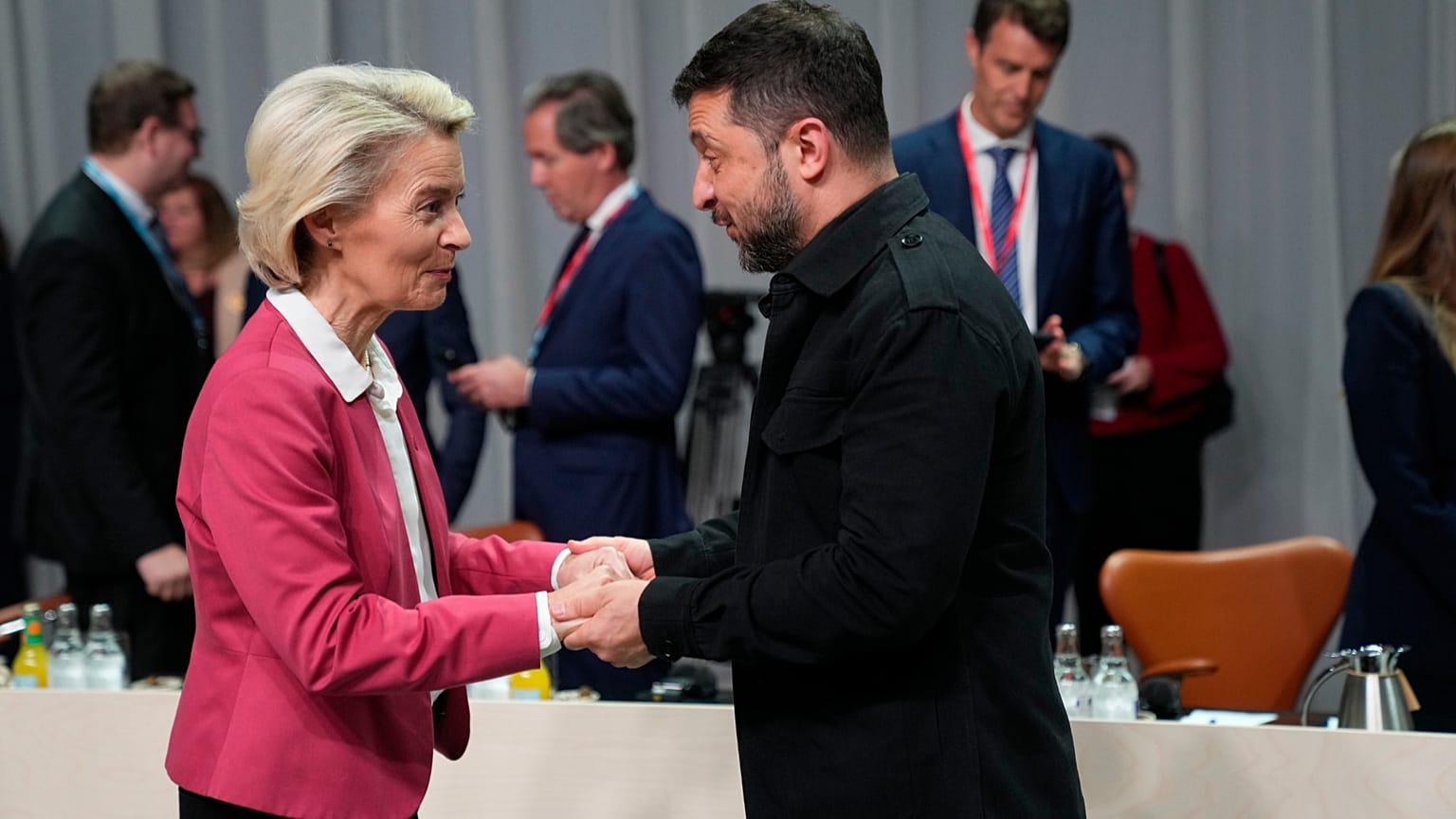













The European Commission is aiming to pay out the first tranche of funds for Kyiv as soon as April. The proposal replaces a plan to issue a reparations loan based on immobilised Russian assets.
The European Commission on Wednesday put forward its legal proposal to provide Ukraine with a €90 billion loan, calling on the European Parliament and member states to approve it swiftly so Kyiv can start receiving the money it desperately needs in early April.
 ADVERTISEMENT
ADVERTISEMENT
ADVERTISEMENT
Under the proposal, the money would cover Ukraine's financial needs for the next two years, with roughly €60 billion earmarked for military spending and the remaining €30 billion intended to support Ukraine's overstretched national budget.
"We are aware of Ukraine's both sizeable and urgent financing needs. That's why we are aiming indeed to start with disbursing in April," European Commissioner for Economy and Productivity Valdis Dombrovskis told reporters during a press conference.
For the plan to proceed, the European Parliament and member states in the Council of the European Union, known together as the co-legislators, will have to approve the proposal by late February or early March at the latest.
The EU is meanwhile talking with other international partners, particularly in the G7, "with the aim for them to frontload their financial contributions to the first quarter of this year so that to cover this funding gap which Ukraine is facing already," Dombrovskis also said.
This work, he added, "is advancing quite successfully".
€3-4 billion annually in interest
The €90 billion loan for Ukraine was approved by EU leaders in December at a summit in Brussels as a second-best option to raise the money the war-torn country needs over the next two years to stay afloat and keep defending itself.
Many leaders, including Commission chief Ursula von der Leyen, German Chancellor Friedrich Merz, Danish Prime Minister Mette Frederiksen and Ukrainian leader Volodymyr Zelenskyy had lobbied hard to tap into the €210 billion of Russian assets immobilised in Europe to finance Kyiv's needs. Their main argument for the so-called reparations loan was that Russia, as the aggressor, should pay for the cost of Ukraine's survival instead of European taxpayers.
But stiff opposition from Belgian Prime Minister Bart de Wever, under whose jurisdiction most of the assets are being held, brought the original plan to an end, with joint debt the only other viable option that could deliver at scale and on time. Ukraine needs fresh money from April at the latest.
Under a non-recourse loan agreement, Ukraine will be exempt from repaying interest and will be asked to pay back the €90 billion only after Russia ceases its war of aggression and agrees to pay war reparations.
Hungary, Slovakia and the Czech Republic were exempted from guaranteeing the joint debt in order to secure the unanimity required for the loan to go through. That means interest repayments, which are estimated at around €3-4 billion per year, will fall to the other 24 member states.
These repayments will first be made using money left unspent from other EU instruments, and should these funds prove too low, member states will have to cover the shortfall.
Dombrovskis said that for repayments past 2027 and therefore falling in the bloc's next budgetary period, "a dedicated instrument to cover interest rates can be considered", but that any such device will be part of the discussions concerning the next EU Multiannual Financial Framework.
'These investments should have a return on investment'
Additionally, the loan includes a "Made In Europe" requirement to ensure the funds primarily boost Ukraine's and Europe's domestic defence industries. Only when the equipment is not readily available on the continent will purchases outside Europe be allowed.
But since agreeing to the plan in December, member states have been divided on how big the share of the loan being used to buy non-European equipment should be.
The Netherlands and Germany, for instance, are calling for Ukraine to be given flexibility over the origin of the equipment it buys, with the Dutch arguing in a non-paper seen by Euronews that up €15 billion of the loan should go towards non-European military purchases.
They also advocate for some of the acquisitions to be made through NATO's PURL initiative, which was set up last year after Washington decided not to donate military equipment to Ukraine any more. It allows European allies to buy US-made weapons and dispatch them to Kyiv.
Defence packages the EU has agreed to in recent months, including the SAFE loan scheme and the European Defence Industry Programme regulation, have both included a European preference under which at least 65% of the military equipment being bought must be produced in Europe, with no more than 35% coming from third countries.
The Commission's proposal plans for Ukrainian or European-made weapons to be prioritised with purchases outside Europe to be allowed for equipment either not being produced by European manufacturers or not available quickly enough.
"The funds will be used to purchase equipment made from Ukraine, from the European Union, and the EEA/EFTA countries. But if these necessary equipments are not possible in this region or in due time, then it might also occasionally be possible to acquire the equipment outside," Commission President Ursula von der Leyen said.
"For us, it is a lot of money. These are billions and billions that are being invested. And these investments should have a return on investment in creating jobs, in creating research and development that is necessary for us. We have in parallel to boost our defence industrial base for the sake of not only the loan, but also for our own security," she also said.
An EU official, speaking on condition of anonymity, added that Ukraine will have to submit requests to deviate from the SAFE requirements and procure from third countries. An expert group is to be set up to assess and expedite these requests and thus ensure Kyiv can quickly purchase the equipment it urgently needs.
EU ambassadors are expected to have their first debate on the loan later on Wednesday, while leaders of political groups in the European Parliament will decide whether to fast-track the proposal so that MEPs can start debating it at their next plenary next week.