




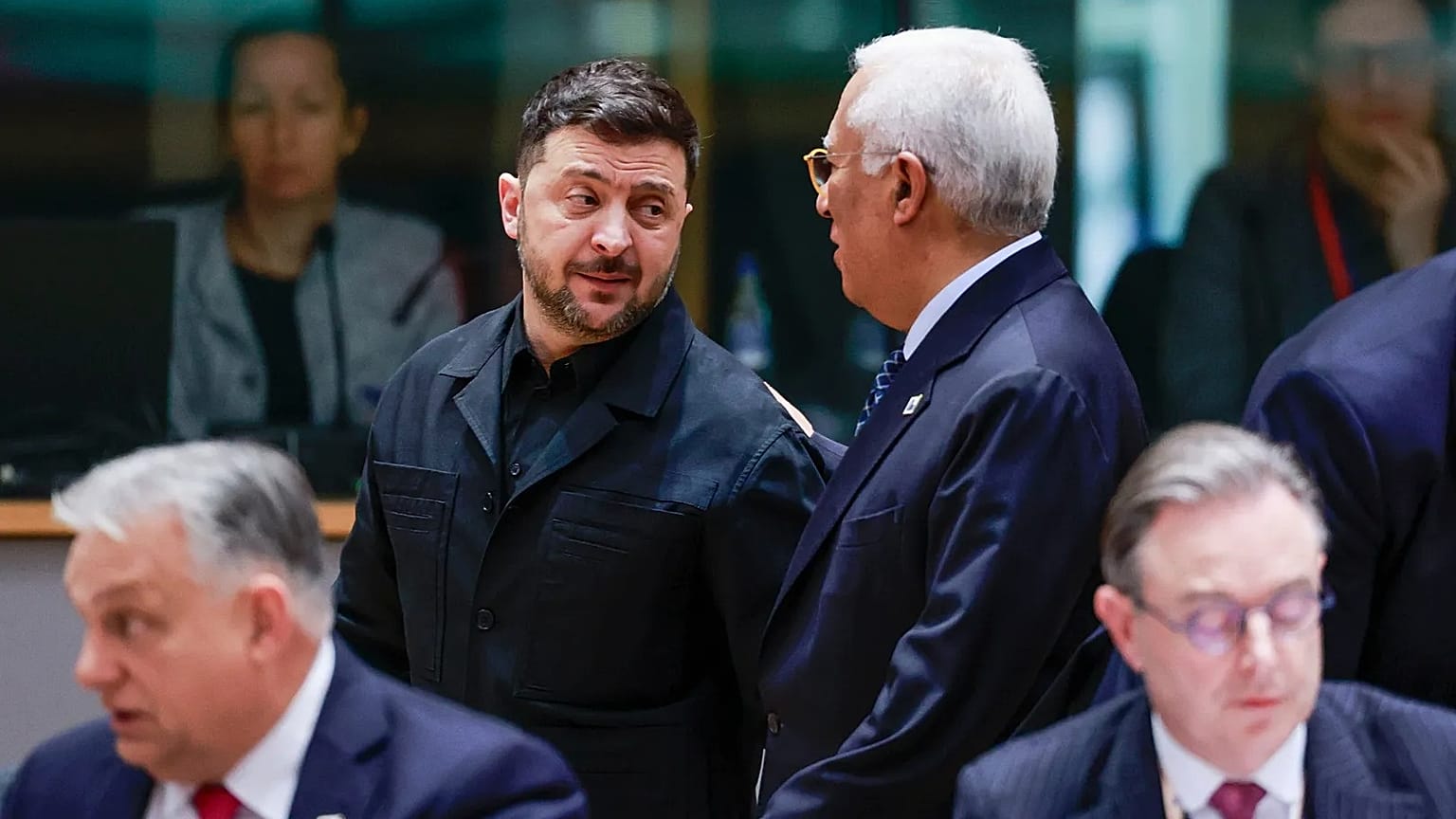













It was branded as a make-or-break summit for Ukraine and the EU, and it was. But the night didn't go according to plan. Based on conversations with diplomats involved in the deal, Euronews brings you a behind-the-scenes look at how the EU agreed an unprecedented loan to keep Ukraine going.
The real summit started the night before European leaders descended at the Europa building last Thursday for their final gathering of the year. As it often is the case in Brussels, the ordre du jour was only indicative, and the real business was done on the sidelines.
 ADVERTISEMENT
ADVERTISEMENT
ADVERTISEMENT
On the table was an innovative plan to issue a reparations loan for Kyiv based on immobilised Russian assets held mostly in Belgium. It was an option preferred by German Chancellor Friedrich Merz, Danish Prime Minister Mette Frederiksen and Commission President Ursula von der Leyen; the resistance from the Belgian Prime Minister Bart de Wever was the main obstacle, but not the only one.
In the end, the EU agreed on a very different solution and abandoned the reparations loan. This is an account on how the deal was made.
On Wednesday night, EU leaders and their counterparts from candidate countries hoping to join the bloc gathered for a working dinner.
While the event was ostensibly focused on enlargement, the real question weighing on leaders' minds was the future of Ukraine and how to keep the country financially afloat as negotiations for peace drag on and the US pulls back.
That same night, von der Leyen, Merz and de Wever excused themselves from the EU-Western Balkans dinner to take a sideline meeting about the reparations loan.
The Belgian prime minister – angered by his portrayal as a Russian asset in some media– was clear that Ukraine had to receive a financial lifeline, but that it shouldn't come at his country's sole expense or risk jeopardising the Belgian financial sector and, possibly, the eurozone.
By the time of the Wednesday night sideline discussion, de Wever could tell that the wind was changing. Italy had come out in his favour, requesting that different options be explored, with Rome growing louder about the knock-on effects the reparations loan could have.
Fuelling those concerns was a report by credit rating agency Fitch had put Euroclear, the depository holding the Russian frozen assets in Belgium, on negative watch, citing liquidity and legal risks. One diplomat told Euronews that Euroclear was at the centre of discussions. The thing about market forces, the official explained, is that once they are unleashed, they take a life of their own and cannot be controlled.
The reparation loan's backers insisted there would be no confiscation of the Russian assets and that risks for Belgium would be sufficiently covered, but it wasn't clear that the markets would agree. For Bercy, France's powerful finance ministry, that risk could not be ignored.
"The idea of systemic risk is no joke," one diplomat said.
Meanwhile, Hungarian Prime Minister Viktor Orbán teased his Belgian counterpart, saying he would be submitted to torture. Orbán also created confusion after he declared that the reparations loan had been removed from the points of discussion for the summit.
Officials denied his comments and even his Slovak ally Robert Fico joked in remarks to Euronews that his friend Viktor appeared confused about the order of the day at the summit. "The reparations loan is all we will talk about," he said.
But Orbán, who relishes in his image of enfant terrible but is also the most senior head of state in the European Council and knows the Brussels machine well, was on to something.
Activating plan B
The summit started with a dramatic declaration by von der Leyen: EU leaders would not exit the building until a solution on how to fund Ukraine was found. Among the Brussels press, speculation swirled that the summit could go well into the weekend, reminiscent of a four-day summit which saw a deal on a post-pandemic recovery plan in 2020.
Behind closed doors, Ukrainian President Volodymyr Zelenskyy addressed the 27. He told leaders that Russia, as the aggressor, should pay for the damage done to his country, and referred to the reparations loan as a "smart and fair approach."
After making his case, Zelenskyy left the assembled leaders to discuss the fate of the reparation loans behind closed doors. He employed a much more severe tone at the press conference that followed his intervention in the room, warning that without a cash injection by the spring at the latest, Ukraine's war effort would be dented.
By the start of dinner, the reparations loan was the main subject of discussion. Von der Leyen, Merz and Frederiksen all spoke about the merits of the proposal, arguing it would keep Ukraine well-funded and that Russia would have to pay for the damage under the principle of "you break it, you pay".
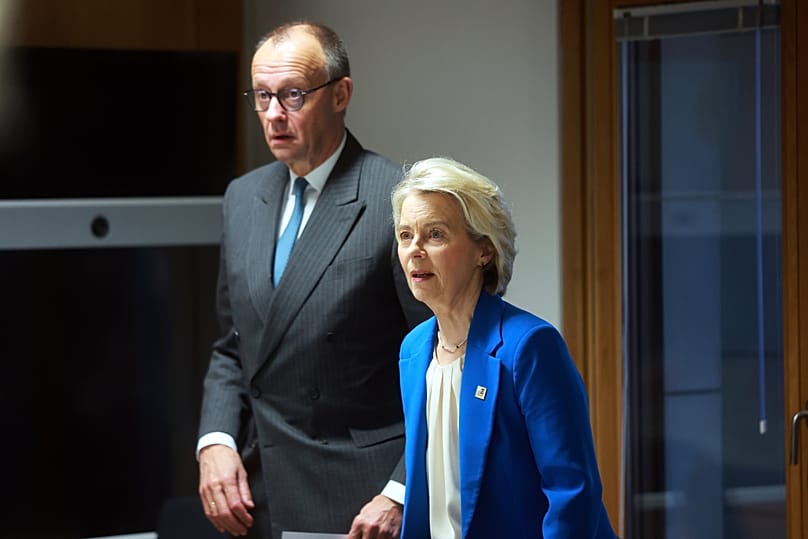
Politically, the optics of the reparations loan were good too as it meant that the bulk of the financing would not fall on the European taxpayer, which von der Leyen had argued would be very hard to understand for the European public opinion.
As different leaders around the table asked for time to speak, Giorgia Meloni made a long intervention casting doubt on the plan, described as detailed and well-thought out by people familiar with the discussions.
Orbán also spoke against it, while a Belgian demand for unlimited guarantees raised eyebrows, with other leaders aware that they would have to ask permission of their national parliaments to commit to something they could not even quantify.
At that point, it became clear to Council President António Costa that the reparations loan had hit a wall, and it was time to bring out plan B – which also came with strings attached.
Costa reminded leaders that the Commission had presented an alternative to cover the €90 billion Ukraine would need for next year and 2027 through joint borrowing backed by the EU budget. It would require a unanimous vote; Costa suggested that provided Orbán would not veto it, plan B was on the table.
"Costa understood the reparation loan was stuck and he took the lead, as von der Leyen couldn't, to activate the plan B," a diplomat said. "That changed the course of the night."
Huddle in the Hungarian room
With plan B in the open, Orbán huddled with his Czech counterpart Andrej Babiš and Slovak prime minister Robert Fico at the Hungarian room in the Council building.
Poland aside, it marked something of a resurrection for the Visegrad format, which had been moribund since the start of the Ukraine war due to divergences among its members over how to treat Russia, especially between Budapest and Warsaw.
Euronews was the first to report at midnight that Orbán, Babiš and Fico were meeting privately to discuss a way for the EU to issue joint debt without their input; countries willing to pay up for Kyiv would pay in, while the three of them would get an opt-out.
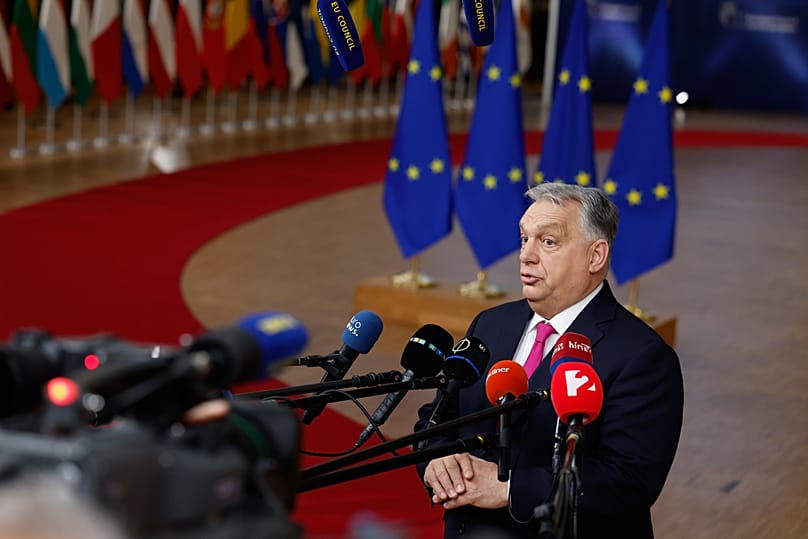
The Euronews report was confirmed three hours later in the summit conclusions.
A personal familiar with the talks said it was Babiš who floated the idea of using "enhanced cooperation" as foreseen in the EU treaties. Orbán posted a picture of the three's meeting on social media, and Babiš posted his own confirmation on X telling his followers "keep your fingers crossed for me that it turns out well."
Once their agreement was established, and with the legal proposal in writing, the summit moved fast towards a deal. Two diplomats told Euronews that "nothing was promised" in exchange for Orbán lifting his veto. One source explained that while the Hungarian prime minister is deeply sceptical of Zelenskyy and his government, it is not in his interest to have Ukraine collapse – and his country heads to the polls in April.
As Orbán exited the summit, he lifted his hands in front of reporters. "We are innocent."
Germany sidelined in a 'win for Europe and Ukraine'
With the deal done, it was time for the politics.
Belgian PM de Wever celebrated a victory for Ukraine, Europe and international law. “Everyone can leave this meeting victorious. Funding Ukraine is not charity, it is the most important investment we can make in our own security,” he said.
De Wever had held his ground, understanding that resistance to the reparation loan went further than Brussels and riding a wave of cross-party and public support in Belgium.
Costa, meanwhile, said the EU had promised to back Ukraine and had now proved it was able to do so.
For von der Leyen and Merz, however, the optics look far more complicated. The Commission president had been sidelined in negotiations during the night as the talks moved away from the reparations loan. To the leaders who wanted a different solution, Costa seemed a more honest broker than von der Leyen, seen as too close to Berlin.
"It was awkward," said one official.
As for Merz, who had lobbied intensively both publicly and privately for the reparations loan, the outcome was a cold shower at an EU summit – the biggest European stage a head of state can hope for. The German chancellor had failed to read the room and ended up with a solution Berlin had long campaigned against: more EU borrowing.
It was also a disappointment for Frederiksen, the Danish prime minister hosting the rotating presidency of the EU on its final summit. At a press conference after the meeting, she conceded she had “backed one solution, the result turned out reasonably well”. As she took questions from reporters, her body language was severe.
For everyone to save face, the conclusions included a line suggesting that the immobilised Russian assets could be used in the future but not specifying how. It is also difficult to see how Ukraine will ever pay the €90 billion back if Moscow doesn’t pay reparations one way or the other.
But perhaps the most important development of the night is that EU leaders were able to make a consequential decision without unanimity. The fact that Ukraine’s funding will be secured through common borrowing among 24 member states, bypassing national vetoes, is nothing short of extraordinary. And it shows that the EU, for all its rigidity, can still find a way forward.