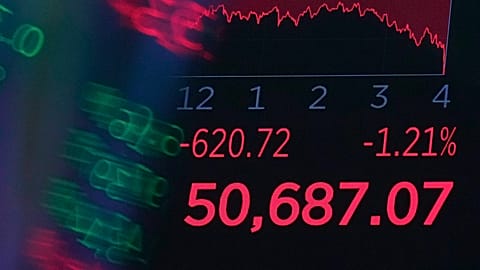













The 21-member euro area has entered negative territory for the first time in over a year, with a dramatic Irish contraction masking more nuanced performances across the bloc's major economies.
The eurozone economy contracted by 0.2% in the first three months of 2026, according to a final estimate published on Friday by Eurostat, the EU's statistical office.
 ADVERTISEMENT
ADVERTISEMENT
ADVERTISEMENT
The figure marks a sharp deterioration from the 0.1% expansion indicated in earlier flash readings and a reversal of the 0.2% growth recorded in the final quarter of 2025.
Year-on-year, the eurozone's economy grew by a mere 0.3% in the period, down from 1.2% last year, a deceleration that reflects the mounting pressure of the Iran war, which continues to inflict significant damage on European energy supplies, business and consumer confidence.
Ireland distorts the picture, but does not explain everything
The single most striking figure in the Eurostat release is Ireland's 12.1% quarter-on-quarter contraction and a 16.8% decline compared with the same period a year earlier.
Those numbers would spell catastrophe for most economies, but Ireland's GDP is well-known to be heavily distorted by the activities of large multinational corporations, particularly in the pharmaceutical sector.
Ireland's Central Statistics Office has previously noted that such swings are typically driven by the multinational-dominated industrial sector rather than domestic economic conditions, and economists routinely caution against reading Irish headline GDP figures at face value.
The first quarter plunge largely reflects an exceptional surge in prior quarters, when pharmaceutical exporters are understood to have front-loaded shipments to the US ahead of tariff deadlines, inflating Irish output and, consequently, eurozone-wide figures.
Excluding Ireland, the eurozone's performance looks less alarming.
Germany, the bloc's largest economy, grew by 0.3% in the first quarter after two years of chronic underperformance. Italy also expanded by 0.3%, while Spain continued to lead the major economies with 0.6% growth.
However, France contracted by 0.1%, adding to a pattern of weakness that predates the current energy crisis.
According to Eurostat's breakdown, the biggest drag on growth came from net trade, which cut 0.3 percentage points from economic output, while weaker investment reduced growth by a further 0.1 percentage points.
The Iran war's grip on European energy markets
The Iran war, which erupted in February 2026 following joint US-Israeli strikes in the region, is central to the eurozone's weakening trajectory.
According to the ECB's own Economic Bulletin, oil prices surged to around $104 per barrel in the immediate aftermath of the strikes. Following Iranian retaliation, prices have remained close to those levels, driven by the blockade of the Strait of Hormuz, which handles roughly 20% of global oil supplies.
Attacks on Gulf production infrastructure, including facilities in Qatar, have also crippled liquefied natural gas flows, on which European importers depend heavily.
Several economists have repeatedly warned that the combination of disruption in Hormuz, US tariff pressure, and Chinese export competition is battering European economies, and that the risk of stagflation — a combination of stagnant growth and rising prices — has become the bloc's central risk scenario.
ECB faces a defining choice at its June meeting
Eurozone consumer price inflation accelerated from 1.9% in February to 2.5% in March and reached 3% in April, driven overwhelmingly by energy costs.
The ECB held rates steady at its April meeting while signalling that it was closely monitoring inflationary pressures.
With its next policy decision scheduled for 11 June, markets are now pricing a near-certain 25 basis point rate hike to 2.25%, according to market-implied probability trackers.
A Bloomberg survey of economists published in May pointed to two hikes this year, in June and September. The new GDP contraction data complicates that outlook.
On the employment front, the number of workers in the euro area increased by 0.1% in the first quarter, although hours worked fell by 0.2%.
The unemployment rate edged up to 6.3% in April from 6.2% in March, a small but telling move consistent with softening labour demand and a market that, while resilient, is beginning to come under pressure.