
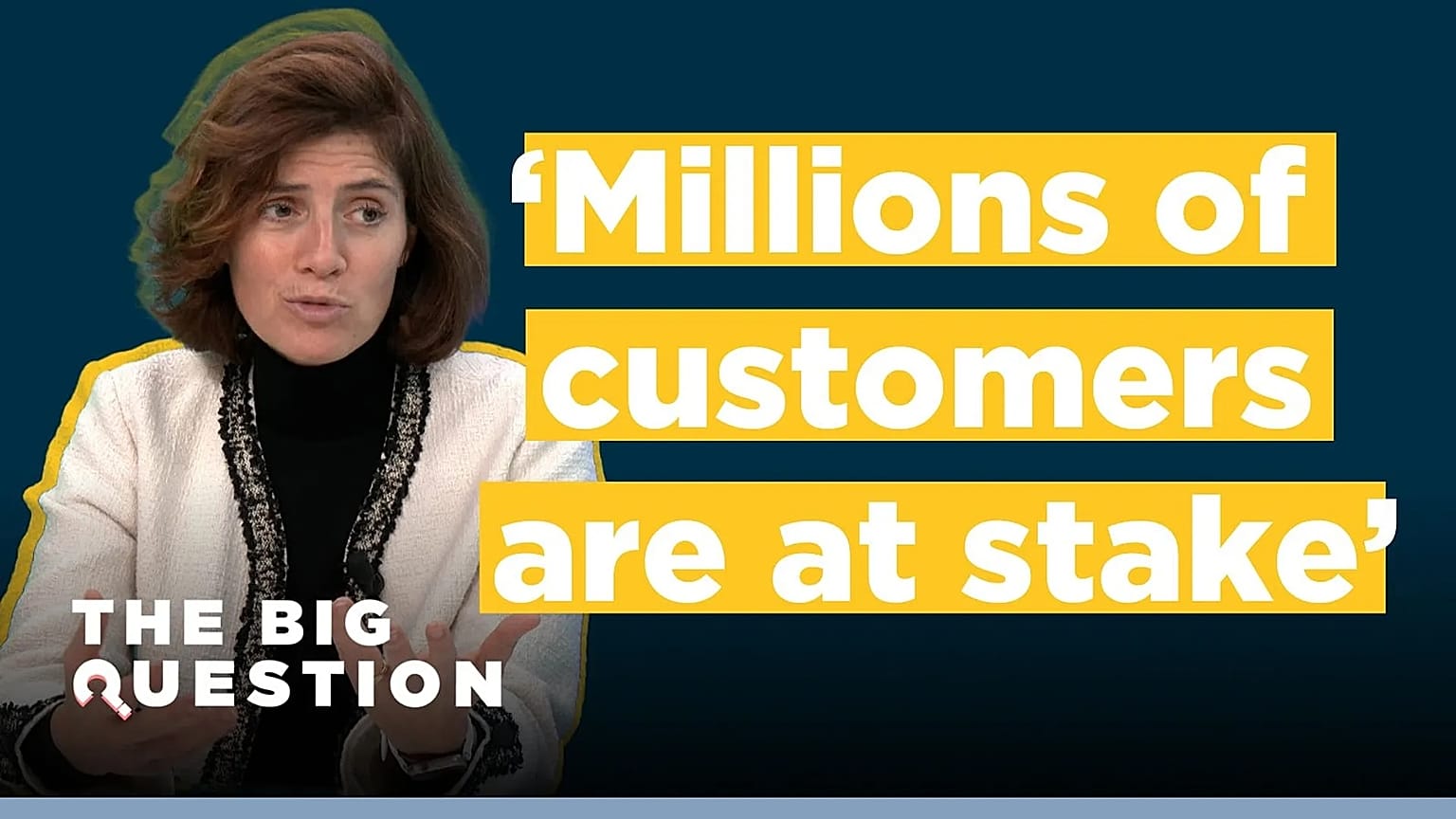














Keeping consumer prices low isn’t the only priority when firms must scale to stay competitive, said Orange CEO Christel Heydemann.
Consolidation between European telecom firms is vital to allow companies to compete with larger foreign rivals, said Orange CEO Christel Heydemann.
 ADVERTISEMENT
ADVERTISEMENT
ADVERTISEMENT
“The reality is that we've probably reached the limit of just looking at prices for consumers. We really need to take into account the ability of companies to invest in a world that's moving very fast,” she told The Big Question.
Heydemann was responding to claims that a potential takeover of rival firm SFR could result in reduced competition in the French market and higher prices for consumers.
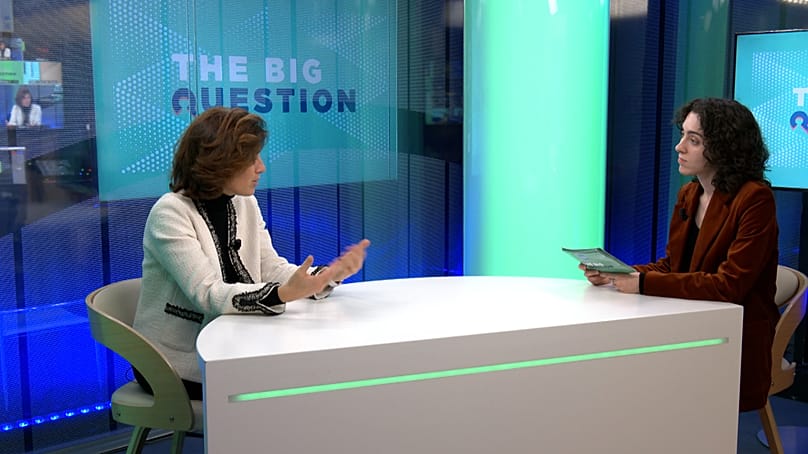
In this episode of The Big Question, Christel joined Eleanor Butler in the studio to discuss how to create growth in an already saturated market.
Is there room for Europe’s telecom companies to grow?
In October, Orange teamed up with telecom firms Bouygues and Free to make a joint bid for SFR, hoping to carve up its assets. The offer was quickly rejected by Altice France, SFR’s owner, although the consortium is working on a fresh proposal.
“It’s something we are engaged in trying to conclude, but there's no guarantee that this non-binding offer will go to an end,” she said. “What’s very important for us though is speed and timing, because … these types of transactions can’t see negotiations go on forever.”
Orange is working to secure competition authority approval for the SFR acquisition, although Heydemann noted that such procedures are always “too long and too detailed”.
The potential shake-up of the French telecom landscape comes as the EU is pushing for more business consolidation. The 2024 Draghi report notably blames market fragmentation for Europe’s lack of competitiveness, building on earlier recommendations from Italian politician Enrico Letta.
Compared to the US and China, who have less than a handful of mobile operators each, Europe’s telecom market is a disparate patchwork, made up of several smaller players.
The lack of scale means that it’s more difficult for these firms to make bumper profits and invest in infrastructure, meaning Europe is trailing behind on 5G and fibre innovation.
How can we improve telecom investment in Europe?
According to Heydemann, consolidation is essential as consumer demand for connectivity continues to grow. Cybercriminals and extreme weather events are adding to the burden on businesses, she added, as they present increasing threats to networks.
“Traffic continues to grow 10-30% every year on our networks. People consume more videos, artificial intelligence,’’ Heydemann explained.
To bolster the EU’s telecom industry, the European Commission is working on an overhaul of its current regulations, presented in the new Digital Networks Act (DNA). Originally due before the end of 2025, the framework has been delayed until January.
While Orange welcomes a modernisation of telecom rules, there has been pushback from certain member states, who argue that the DNA should be a directive rather than a regulation — giving countries more legal flexibility. Some nations are particularly wary about the call for greater consolidation, concerned about the effect on fair competition and increased costs for consumers.
“It’s normal to have this kind of resistance,” said Heydemann. “There is a huge difference in the reality of markets in every country in Europe… so we’re not saying that it's going to be one-size-fits-all.”
“That being said, the need to modernise regulation …that’s something that's true across countries,” she added.
The Big Questionis a series from Euronews Business where we sit down with industry leaders and experts to discuss some of the most important topics on today’s agenda.
Watch the video above to see the full discussion with Orange’s Christel Heydemann.