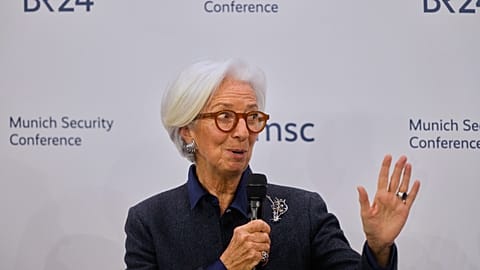















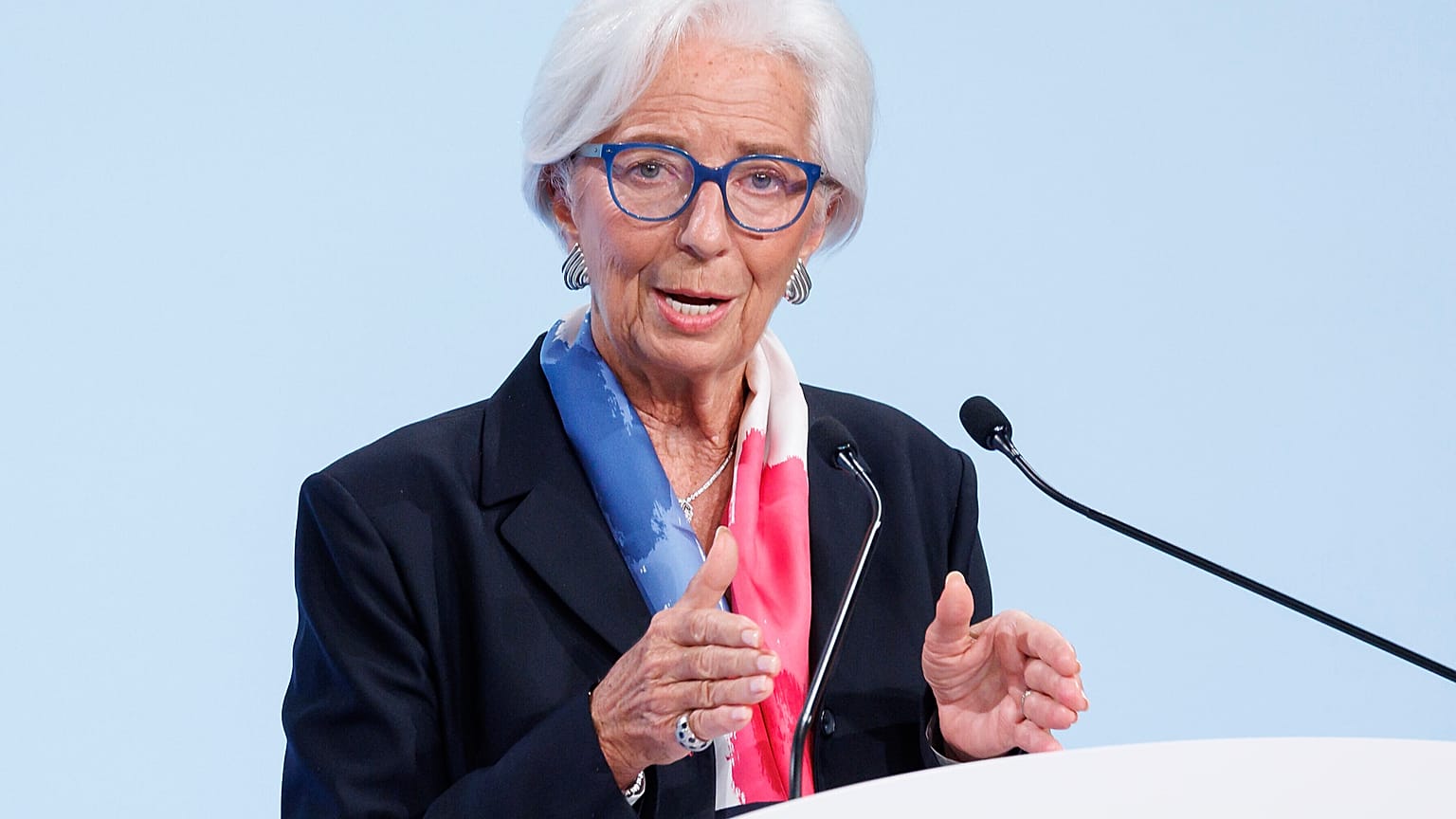













ECB President Christine Lagarde urged the European Commission to dismantle internal trade barriers, warning they stifle competitiveness.
European Central Bank (ECB) President Christine Lagarde has issued a stark warning over the European Union’s competitiveness, calling on the European Commission to urgently dismantle internal barriers that are stifling innovation, productivity, and investment across the bloc.
 ADVERTISEMENT
ADVERTISEMENT
ADVERTISEMENT
In a keynote interview with Financial Times chief economics commentator Martin Wolf on Wednesday, Lagarde said the eurozone economy had shown resilience in the face of geopolitical and economic shocks. Yet, she stressed that deeper structural reform was necessary to unlock its full potential, adding that monetary policy alone cannot achieve this goal.
“We are quite close to potential, but there’s a lot to be done in terms of improving productivity in the euro area,” Lagarde said.
Lagarde pointed to what she described as “self-inflicted tariffs” that continue to constrain the movement of goods and services within the EU.
According to ECB estimates, internal trade barriers amount to an effective tariff of 110% on services and 60% on goods traded between member states, a level she deemed “staggering”.
“We have a special art in doing that to ourselves,” she said.
“We are constraining the traffic of goods and services among member states which are supposed to be a single market. And this is what we need to fix, and we need to fix it soon.”
Lagarde warned that such fragmentation, often driven by national regulations that go beyond EU requirements, is harming Europe's capacity to compete on the global stage.
“Everybody wants to sugarcoat, gold-plate and do just a bit more,” she noted, referring to the tendency of national authorities to add regulatory burdens beyond what Brussels mandates.
A ‘Europe moment’ to tackle the existential crisis
Lagarde said that Europe remained in an “existential crisis”, but also faced a historic opportunity.
“I still believe that we are in the midst of that existential crisis, but I also think there is a Euro, and possibly a Europe, moment,” she said.
“If we are smart and fast at addressing those issues... we can turn that moment into an answer to the crisis.”
At the heart of this transformation, Lagarde pointed to the creation of a genuine Capital Markets Union, a long-standing but incomplete ambition, which she said is vital to allow European innovators to access growth financing within the continent rather than relying on US venture capital.
“It all starts with money. We have talent, we have innovators... but the key thing is for them to have access to enough financing,” Lagarde said.
She lamented the continued flow of European savings across the Atlantic, saying the EU must retain and mobilise its own intellectual and financial capital.
Lagarde did not shy away from pointing fingers at both national governments and EU institutions, urging the European Commission to act decisively in removing the obstacles to a functioning single market and an integrated financial system.
Open to joint bond issuance for defence
Lagarde expressed openness to joint European bond issuance, particularly for defence funding, echoing the EU’s historic response to the COVID-19 crisis.
“We did so for COVID because it was a matter of survival... Defence is equally a matter of survival and emergency,” she said, calling it “a perfect case in point” for common issuance.
While French President Emmanuel Macron has recently floated the idea of expanding the ECB’s mandate to include growth alongside inflation, Lagarde maintained that monetary policy alone cannot address the structural issues Europe faces.
“Would rock-bottom interest rates or QE change the barriers I was talking about? No,” she said, reaffirming the ECB’s legal focus on price stability but noting that growth and productivity are taken into account in its decisions.
Pushback from member states
Lagarde warned that despite momentum, political resistance to reforms such as the Capital Markets Union or deeper financial integration remains strong.
“There will be pushback from multiple corners… from people who say: ‘We’re very happy in our corner of Europe, leave us alone,’” she said.
The ECB's President remarks come at a critical time, as Europe confronts rising global competition, sluggish productivity, and a patchwork regulatory landscape.
Her message to Brussels was clear. The time for action is now.