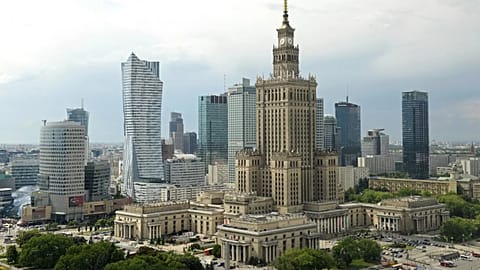






























The M&A markets in Poland, Austria, Romania and Lithuania were the most attractive for foreign capital in Central and Eastern Europe in 2025. The region attracted a record inflow despite the war in Ukraine, the slowing German economy and trade tensions.
Investors poured a record €42.5bn into mergers and acquisitions across Central and Eastern Europe in 2025, as fewer but larger transactions signalled renewed confidence in the region's economic prospects, according to a new report by Forvis Mazars and Mergermarket.
 ADVERTISEMENT
ADVERTISEMENT
ADVERTISEMENT
The value of deals rose 36% year-on-year, even as the number of transactions fell 9% to around 1,300, a shift experts attributed to a growing focus on large assets.
The standout transaction was US fund GTCR's €4.1bn acquisition of Czech pharmaceutical group Zentivathe largest foreign investment in the region by an outside investor in several years.
Experts attributed the decline in deal volume largely to external pressures, with Germany's economic struggles prompting companies and funds to take a more selective approach to dealmaking across the region.
“Germany’s economic slowdown meant that investors were holding back," noted Andrija Garofulić, CEE co-lead and financial advisory partner at Forvis Mazars.
"That spilled over into the central and northern parts of CEE,” he said.
CEE countries offer a gateway to Europe
The report shows that foreign investors remain the backbone of the M&A market in CEE. They typically account for more than 40% of the number of transactions and up to three-quarters of their value.
In 2025, the share of investors from outside the region was 43% in terms of the number of deals and 54% in terms of value.
By comparison, in North America, foreign investors account for less than one-fifth of the market.
Most of the foreign investors come from the US, the UK, Germany and France, but there has been increasing investment from within the region, according to the report.
The CEE region benefits from comparatively strong economic growth, EU membership and regulatory stability, a skilled workforce and lower operating costs than much of Western Europe.
One of the key strengths of Central and Eastern Europe is its location. Its proximity to the European Union’s 500 million consumers, its well-developed transport network and growing digitalisation attract companies from all over the world.
CEE thus remains the “gateway” to Europe for global capital.
As Garofulić puts it, "Everyone wants to be close to their customers. The Central and Eastern European region offers proximity to major markets, a skilled workforce and remains cheaper than some other regions. It makes a lot of sense to produce or own industrial plants in the CEE region."
An additional impetus is regional integration.
Albania is moving closer to EU membership, and Romania and Bulgaria have joined the Schengen area. This increases the predictability and security of investments.
Technology, health and finance at the forefront
The largest number of deals in 2025 was in the technology sector, with 20 investments.
The most targeted businesses were software companies, IT services providers and those focusing on fintech and digital infrastructure.
In terms of value, however, financial services led the way, with a total volume of €11.7 bn. The biggest transaction was the acquisition of 49% of Santander Bank Polska by Erste Group for €6.8bn.
The report highlighted five countries attracting the most M&A activity, each for distinct reasons.
Austria continues to serve as a strategic gateway between Western and Eastern Europe. The Czech Republic draws investors through its established industrial base, while Romania's fast-growing economy has made it increasingly attractive.
Lithuania stands out for its technology and fintech sectors, and Poland remains the region's largest and most sought-after market.
Poland's ascent has been particularly striking. In 2025, it became the first CEE country to record a combined GDP exceeding $1 trillion — a milestone that has opened the door to potential G20 membership.
"This sends a strong signal and contributes to promoting Poland as a rising star globally," said Adam Zohry, co-head of the CEE region and executive director at Forvis Mazars in Poland.
Private equity, meanwhile, is beginning to recover after a difficult stretch. Between 2022 and 2024, funds struggled to exit existing investments, creating a fundraising problem: without a track record to show, attracting new capital was an uphill battle.
"Private equity firms were not able to exit, so there was no track record to present to new investors. This made fundraising very difficult," Garofulić concluded.
The authors of the report are moderately optimistic. They point to rising public spending, EU funds and an improving economy.
"Public spending is high, a lot of money is coming from EU funds, and the economy is doing well. The positive attitude of the market is one of the key elements, because the money is available," Garofulić emphasised.