














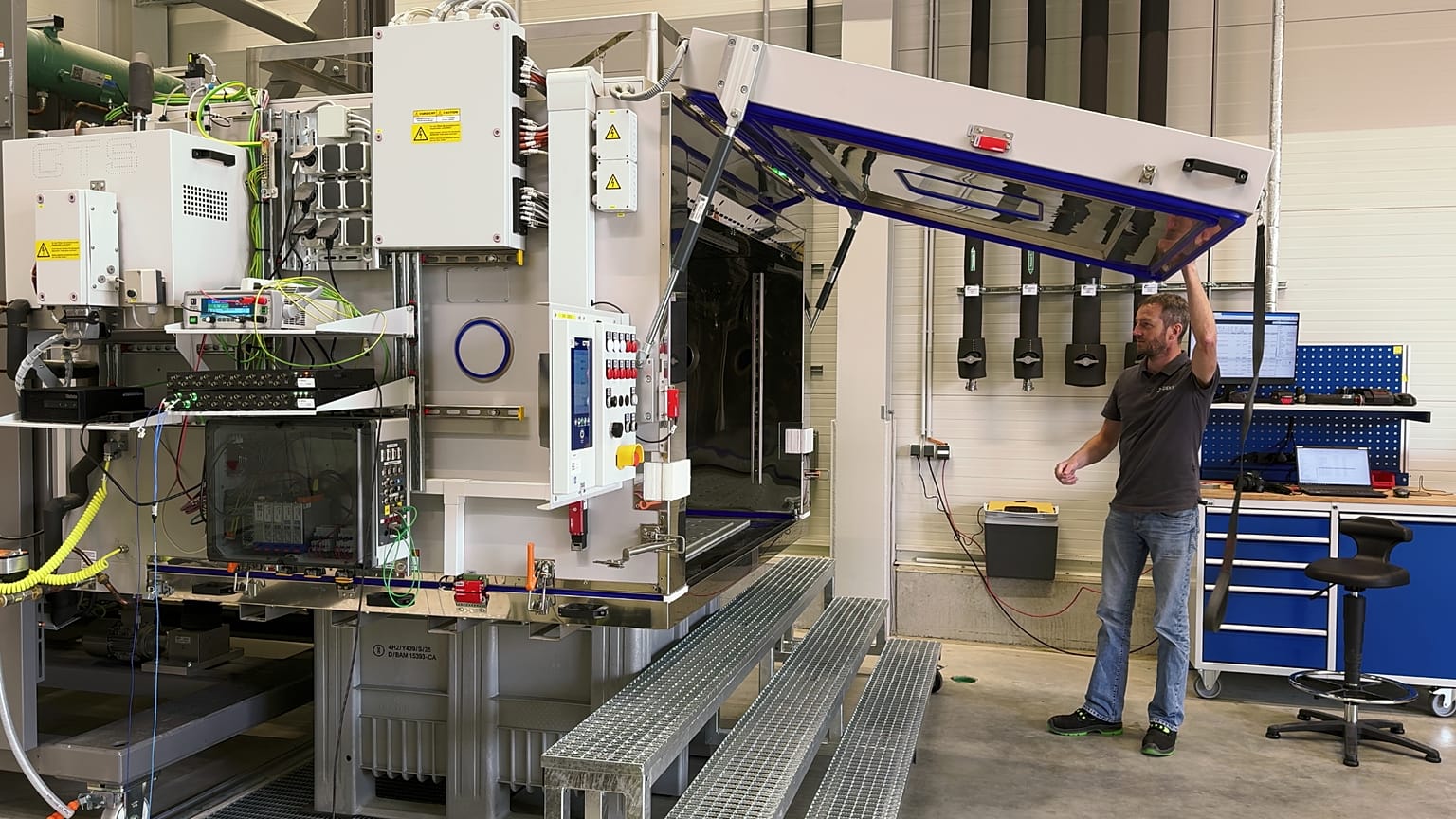













Battery ‘torture testing’ simulates car washes, sandstorms and wildfires for the benefit of the energy transition.
Eastern Germany is home to some of the world’s most advanced ‘torture chambers’. Here, water, fire, high-voltage current and even dust are used to press and squeeze, twist and strike, shake and hammer the beating hearts of the technology we use every day, like electric vehicles.
 ADVERTISEMENT
ADVERTISEMENT
ADVERTISEMENT
At Europe’s largest battery testing centre, they put batteries into every imaginable situation to see what happens. Whether they explode, survive or thrive, it’s better to find out here than in a consumer’s garage.
Batteries are subjected to extreme temperatures and full-blown sandstorms
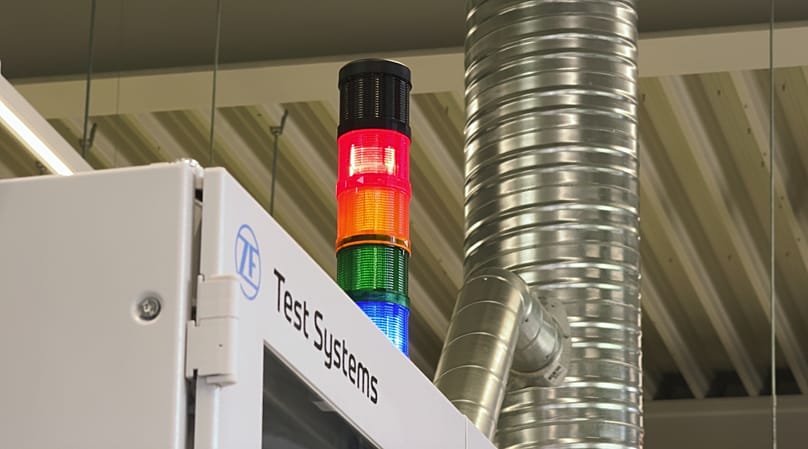
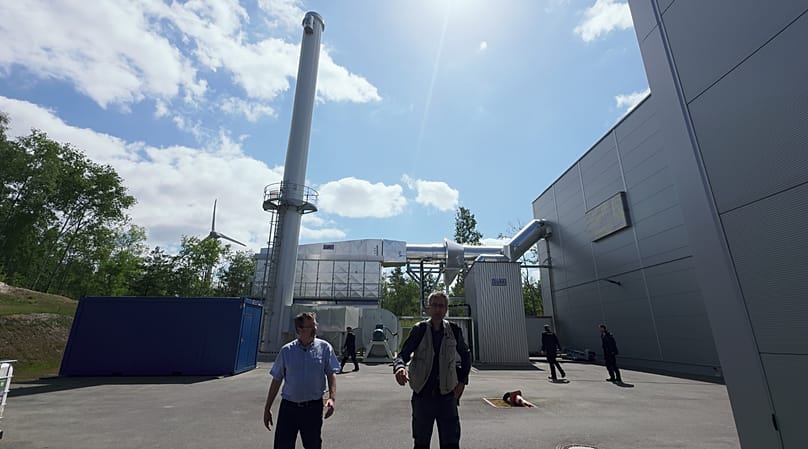
I am standing beside a long row of garage-sized boxes inside the DEKRA facility in the small town of Klettwitz in Lusatia. Each box has its own unique purpose. Head of DEKRA, Thomas Hucke, is showing me around. Thermometers and warning lights surround me – what do they mean?
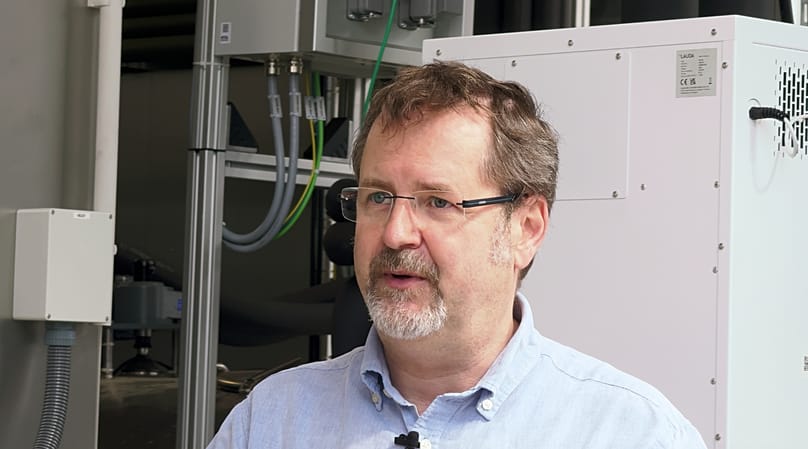
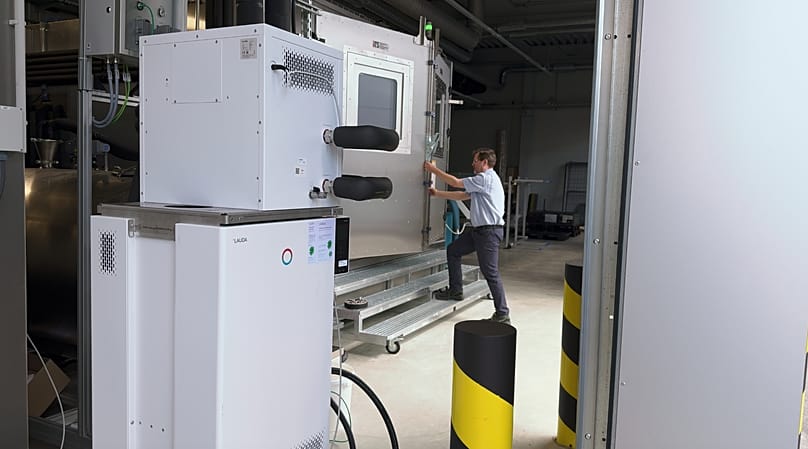
“We’re testing how battery prototypes behave at very low temperatures, or at very high temperatures. From Siberia to the Sahara,” Hucke explains. “In other words, the classic environmental conditions that a battery like this experiences over its lifetime.” He then walks over to a control panel and, with grim determination, turns it all the way to the minus max level: “Right, minus 40 degrees Celsius – let’s take it right down to the limit…”
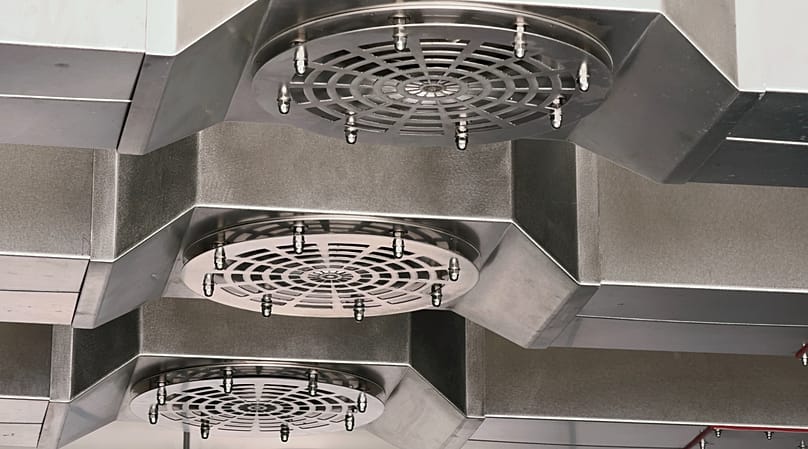
Full-blown sandstorm? No problem for Hucke and his team. If a specialised battery is to survive use in the desert, its suitability must be certified before it can be marketed and sold. For that, the DEKRA team naturally have some particularly gruelling dust chambers.
We cross an industrial road and enter a hall on the opposite side. A few staff members hurriedly push plastic crates in front of a prototype that has just been delivered to block the view. “Camera off!” they say. This is top secret.
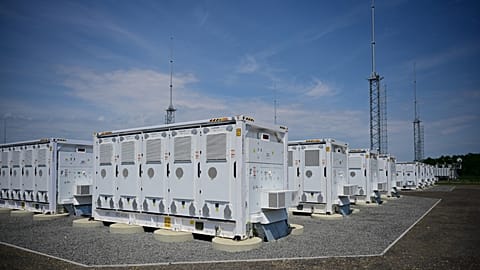
“We also test very large batteries,” says Hucke, explaining the enormous size of the test hall, “such as stationary energy storage systems, for example.
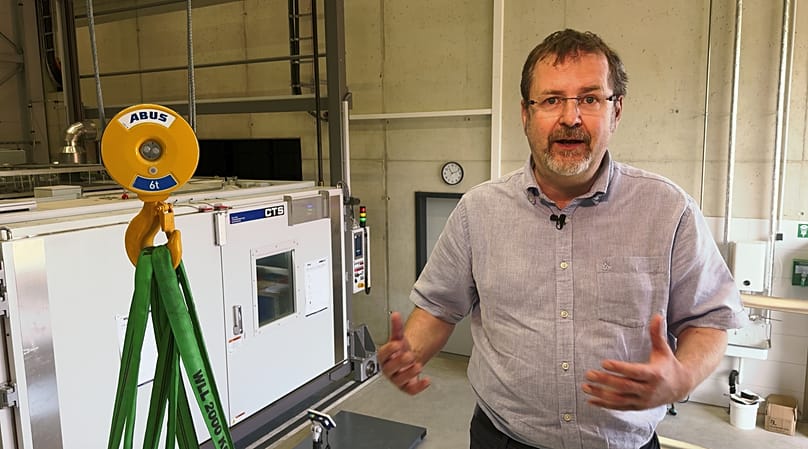
“Over there,” Hucke points to another test chamber, “we carry out vibration tests. In vehicles, batteries are usually subjected to vibrations. What happens when a vehicle drives over a curb, or when it receives a mechanical impact?” All of this is tested, documented and reported to the manufacturer. Certification is only granted once the new battery model has met all stress parameters to Hucke’s complete satisfaction.
Consumer safety is a top priority in the European Union. “The EU has drawn up a Battery Regulation which sets out the tests that must be carried out on batteries. It’s about sustainability, the value chain, and ultimately, always about safety.”
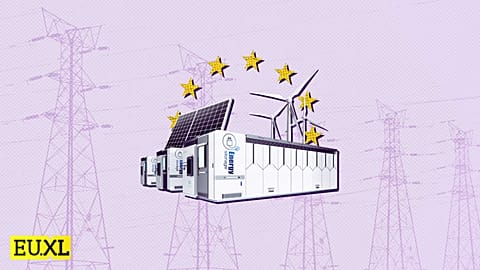
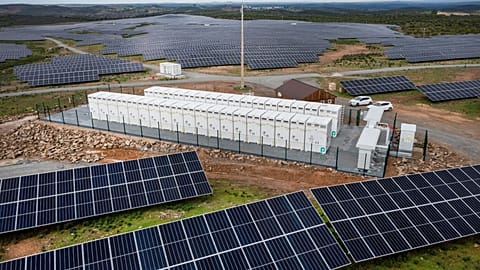
Hucke elaborates: “The energy transition isn’t just about electric mobility. At the test centre, we naturally also test vehicle batteries. But beyond that, we are increasingly testing energy storage solutions for stationary applications. These are mostly intermediate storage systems for renewable energies, namely solar and wind. That is the future.”
Batteries are crushed and burnt – to find out what happens
Hucke smiles as he leads us into the next fiery circle of battery hell.
“What happens in the event of a fire? In an accident? Or if batteries are overcharged or discharged improperly? Batteries must remain safe even in these situations,” he says. “The energy transition [and the associated electrification] must function safely and sustainably. This requires testing service providers who ensure that certain rules and standards are adhered to.”
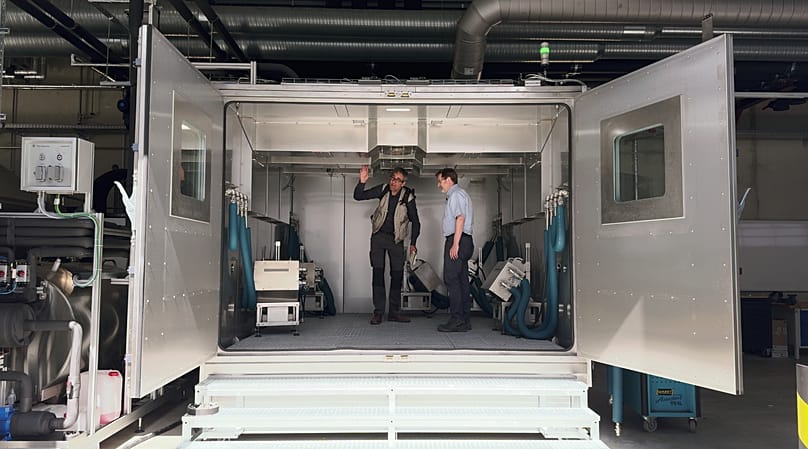
Hucke nods towards the ‘fire hall’. There, they recently tried to set an entire battery container alight. This is not an unrealistic scenario: planet-heating fossil fuel emissions are leading to increasingly extreme temperatures. Europe experienced this first-hand in a scorching summer filled with devastating wildfires and drought.
It cannot be ruled out that one day a major fire might also reach the buffer electricity storage facility at a solar or wind farm. Up to certain temperature levels, a large-scale battery storage facility must be able to withstand this.
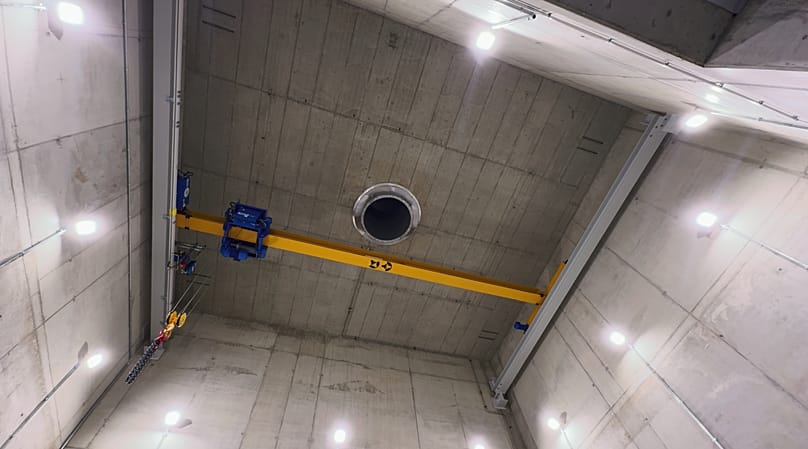
Opening a high-security airlock, Hucke leads me into a room with a cathedral-high ceiling. Massive metal blocks are firmly bolted to the floor. This is the bunker hall of the ‘crush bed’.
“We’ve got an oversized vice here,” says Hucke, where batteries are clamped to be stress tested. “The battery is squeezed – and the regulations stipulate that absolutely nothing must happen.”
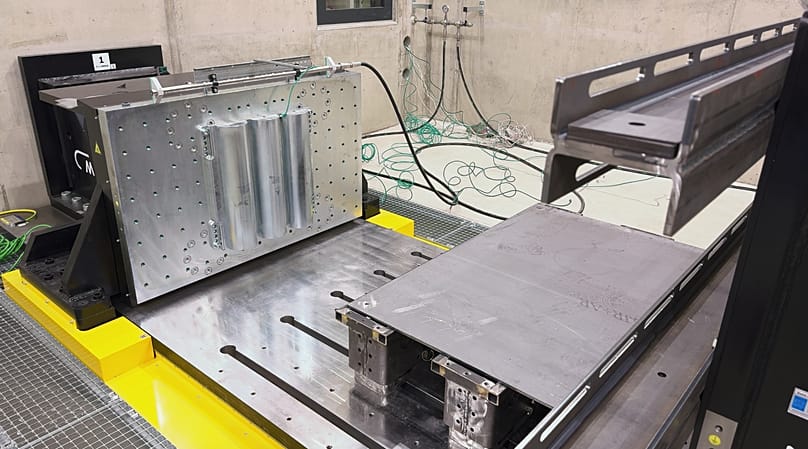
But what if it does? What if the new prototype can’t take any more, after the water, dust, heat and cold tests? What if it really does crash and explode in the crushing bed between the jaws of the steel clamps?
Hucke points to the special fixtures on the thick walls. “We have pressure relief flaps here – and outside the building, a complete flue gas scrubbing system that extracts the gases in an emergency.”
Batteries are key to a safe and sustainable energy transition
Wind and solar power are a rapidly growing source of energy in Europe. Grid constraints and the intermittent nature of these renewables means the need for flexible storage is rapidly increasing.
Battery test centres are “a key component” of the energy transition, says Hucke, ensuring that this renewable power can be stored safely.
“Standards and regulations have been in place in the automotive sector for some time now. And the same is now happening in the field of stationary battery storage solutions for renewable energies,” he tells me. “This requires state-of-the-art testing laboratories. We ensure that batteries entering service meet all safety requirements.”
What about the test centre’s own sustainability? A huge, ultra-modern battery test centre like this requires a lot of energy. “We’re expanding our solar PV systems,” emphasises Hucke, “and using stationary battery storage to ensure we can recover energy”.
The DEKRA Group also took a stand at the World Economic Forum (WEF) in Davos, joining the Alliance of CEO Climate Leaders. “In an increasingly disruptive global environment, in which the urgency and even the existence of the climate crisis is, in some quarters, being called into question once again, we emphasise the strategic importance of jointly combating climate change,” states the Group headquarters.
The DEKRA Climate Impact Programme includes internal decarbonisation and support for external climate projects that make a measurable contribution to the UN Sustainable Development Goals.