

















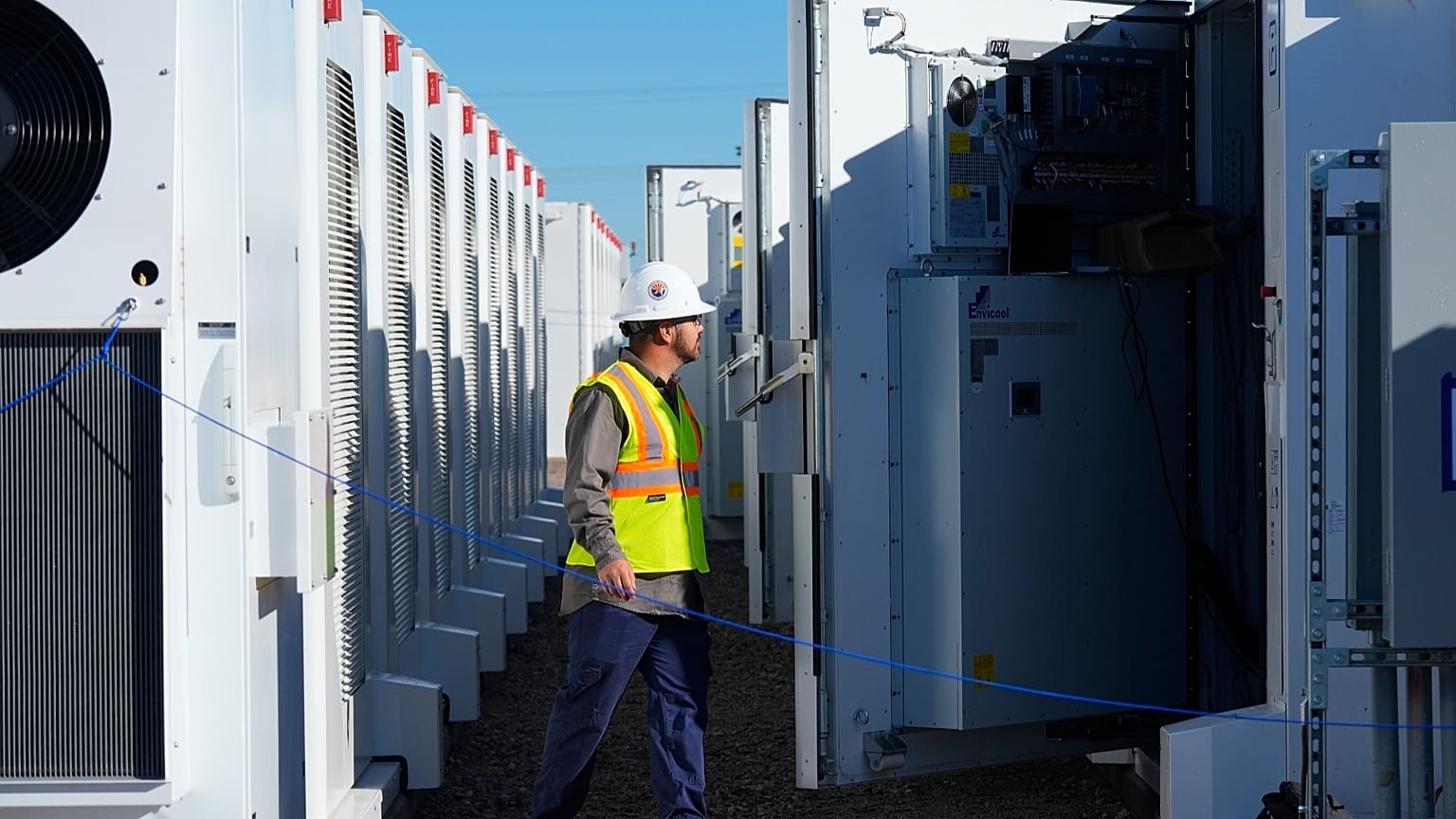













The EU's first tripartite agreement on energy storage, signed in June, puts batteries at the heart of plans to capture more solar and wind power. The technology is ready and getting cheaper, but market rules, grid delays, industrial policy and raw-material politics still hold it back.
The agreement, reached during the Energy Council on June 26, unites the European Commission, energy ministers from 22 member states, storage and renewable developers, energy-intensive industries, and financial institutions such as the European Investment Bank.
 ADVERTISEMENT
ADVERTISEMENT
ADVERTISEMENT
Signatories have pledged to deliver 30 to 35 GW of new storage capacity by 2028, 45 GW according to the underlying text. This would push storage's share of peak electricity demand from around 5 percent today to 10 percent. The EU currently has about 55 GW of storage installed against an estimated need of 200 GW by 2030.
Behind the numbers lies a problem regulators can no longer ignore. As solar and wind output has surged, so have the hours when power is cheap, negative, or simply switched off because the grid cannot absorb it.
"At the moment, we see a lot of negative prices and a lot of curtailment," said Walburga Hemetsberger, CEO of Solar Power Europe. "This is very negatively impacting the business case" for renewables, she said, adding that without batteries to stabilise it, "we will also not be able to get to our renewable goals by 2030." Storage,” she argued, is "the only way we structurally get down prices, get more resilient, and wean ourselves off fossil fuels."
Are batteries the agreement's workhorse?
Commercial and industrial battery storage is expected to roughly triple, from 9 GWh in 2026 to 24 GWh in 2028. Storage-backed power purchase agreements are meant to grow from 1.5 GW to 4.5 GW over the same period. The economics increasingly back the ambition: battery costs fell by around 93 percent between 2010 and 2024, according to IRENA. Europe installed 21.9 GWh of new battery systems in 2024 alone, an eleventh consecutive record year.
For Jacopo Tosoni, deputy secretary general of Energy Storage Europe, batteries have crossed the line from backup technology to grid infrastructure. "By 2030, we will install roughly 30 times what we were installing just five years ago," he said.
Some countries have started treating storage accordingly. Germany has created a legal category of "grid boosters," batteries classified as infrastructure that improves grid utilisation. In the Baltics, storage served as a "safety net" as the region synchronised with the continental European grid after decades of ties to Russia and Belarus.
Tosoni also pointed to projections from Aurora/Amber suggesting storage could displace up to 60 percent of gas imports by 2030, saving roughly €9 billion in gas purchases. He also cited Joint Research Centre estimates that improved storage deployment and market signals could cut grid congestion costs linked to the integration of renewables by more than 60 percent, saving € 100 billion.
Yet the agreement concedes it can only chip away at the barriers holding batteries back. Market design remains the most immediate one. In several member states, batteries are still charged network tariffs and levies both when they charge and when they discharge.
This double-counting treats them as a generator and a consumer at once. Markets often fail to reward the full "stack" of services batteries provide: capacity, balancing, and congestion relief. This leaves many projects dependent on volatile, short-term revenue.
Grid access compounds the problem.
Storage is often added to planning processes built around conventional generation. Unclear classification of battery generation, load, or something else means projects can face the same permitting and connection queues as new renewables without being prioritised as flexibility assets.
Industrial policy adds a further constraint. The EU has built an architecture of support: IPCEIs, the BATT4EU partnership, and the Batteries Regulation. But the European Court of Auditors found the bloc still isn't on track for a self-sufficient battery industry, citing a growing trade deficit and reliance on Asian cells.
Hemetsberger described the tripartite deal's limits on this front: "It is a first important signal, but it is by no means sufficient to establish a full battery supply chain in Europe." She pointed to the forthcoming Industrial Accelerator Act as the tool that "should do the trick," provided it defines "Made in Europe" narrowly enough to genuinely support EU manufacturing. She cautioned that, with the industry still nascent, deployment speed and reshoring ambitions need to be balanced rather than pursued at each other's expense.
Underneath both issues sits raw-material politics. JRC data shows the EU has near-zero self-sufficiency in graphite and low self-sufficiency in lithium, cobalt and nickel. Recycling rates remain modest, around 22 percent for cobalt, close to zero for lithium. Efforts to secure supply through the Critical Raw Materials Act and new mining or processing projects routinely run into local opposition.
The tripartite agreement is explicitly a short-term, non-binding fix, and the first of a planned series covering other sectors. Storage industry groups, including Solar Power Europe's Battery Storage Platform, are already pushing for a dedicated EU Battery Storage Action Plan to close the gap to 200 GW by 2030, a sign that, for batteries, this deal is being read less as an arrival than as a down payment.