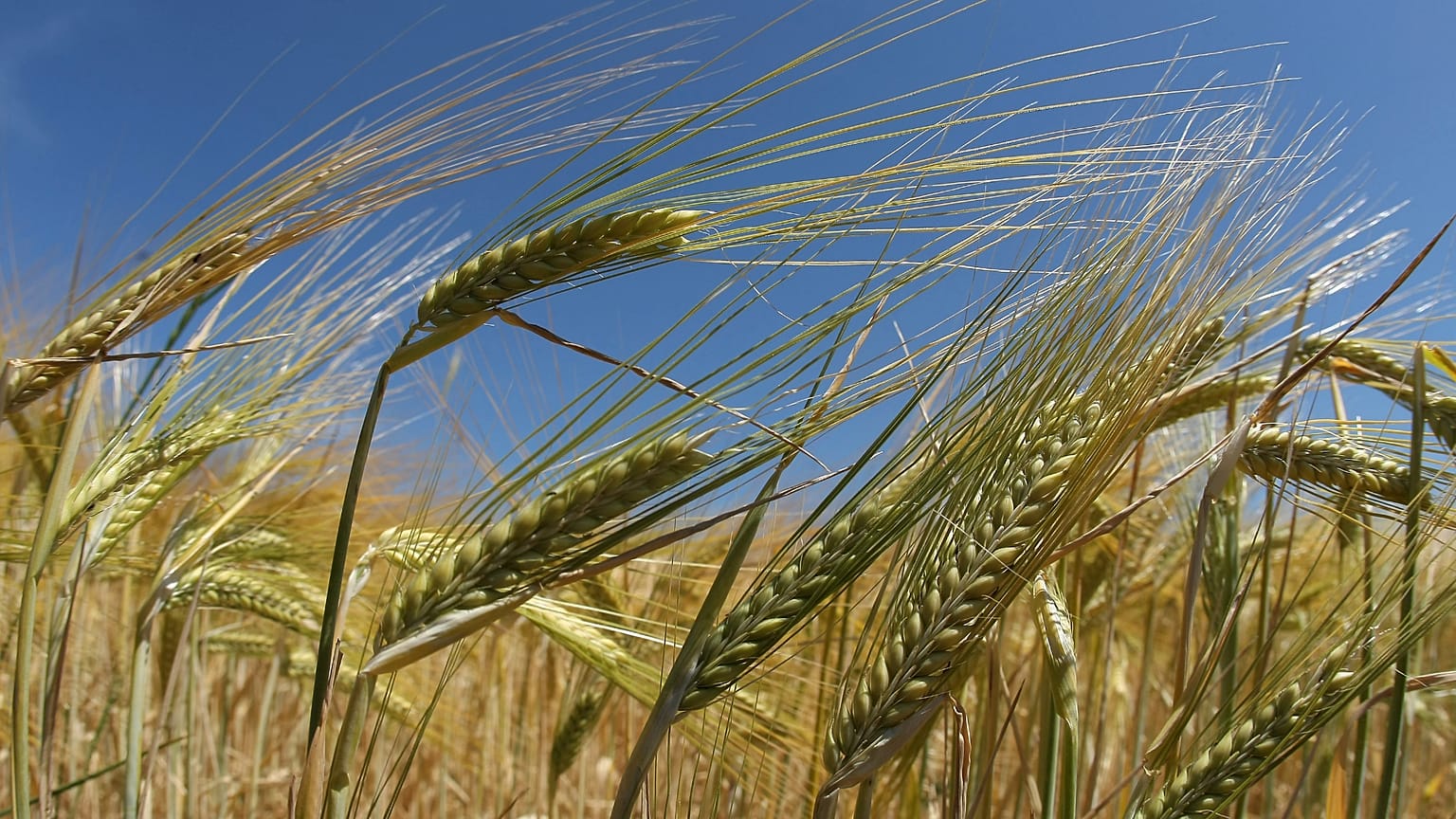













Regenerative farming could save enough wheat during drought to produce 130 million baguettes, according to a new French study.
Faced with skyrocketing costs, supply shortages and extreme weather, Europe’s farmers are in crisis.
 ADVERTISEMENT
ADVERTISEMENT
ADVERTISEMENT
With a hot summer looming, fuelled by human-caused climate change, drought is likely to take grip on the continent, further threatening food supplies and livelihoods.
New data gathered on drought-hit French farmland reveals that the most promising solution could also be the greenest one.
In a study of more than 1,200 farms across the country, early findings show that highly regenerative farms recorded an eight per cent drop in crop yields compared with 22 per cent on their least regenerative counterparts following the 2023 droughts.
The early findings give weight to an argument long touted by regenerative farming advocates that, while initial costs may be higher than conventional farming methods, it pays dividends.
Regenerative farming creates drought resilience for cereal crops
The study, carried out by Soil Capital – a B Corp that works with farmers to support the transition to more resilient and regenerative systems – in partnership with KU Leuven university in Belgium, draws on independently verified field data from 1,262 farms across 331,600 hectares in France between 2021 and 2024.
Combining information on farming practices, yields and soil conditions, it moves beyond single-farm studies and theoretical modelling to demonstrate how regenerative agriculture can help protect production.
The resilience against drought witnessed in the most detailed regional analysis was reflected in the countrywide data, particularly across France’s most widely grown crops: cereals.
Within drought-hit cereal-growing regions – which accounted for 82 of France’s 96 departments in the study period – regenerative practices reduced drought-related yield losses by at least 10 per cent in around 85 per cent of cases. Other potential drivers such as soil type were accounted for.
The study’s first academic partner, Professor Erik Mathijs, head of agricultural, food and resource economics at KU Leuven, says the dataset fills a long-standing gap in the research: “What has held us all back is the lack of robust field-level data across large geographies and multiple successive years. Soil Capital’s dataset is unusually strong in this regard.”
Soil Capital estimates that if the most regenerative practices studied were adopted across France, it would protect the equivalent of 17 weeks of wheat supply for a typical industrial flour mill during a similar future drought – enough wheat to produce approximately 130 million baguettes.
Drought causes billions in damages worldwide
The findings come after the UN’s January 2026 Global Water Bankruptcy report warned that the world has entered an era of “global water bankruptcy”. Critical water systems have suffered irreversible damage driven in part by soil degradation, while drought-related damages now exceed $307 billion (€264bn) annually worldwide.
Droughts fuelled by human destruction of the environment are projected to affect three in four people by 2050, according to the UN.
The UN Convention to Combat Desertification (UNCCD) has repeatedly identified soil restoration as central to both food security and climate resilience goals.
“Soil’s role in providing almost all our food calories, regulating water supplies, supporting biodiversity, and helping stabilise the global climate is widely overlooked and frequently undervalued,” the UNCCD states.
The European Commission estimates that soil degradation – driven by unsustainable management of land, soil sealing, contamination and overexploitation combined with climate change and extreme weather – has already cost the EU over €50 billion per year due to the loss of essential services soils provide.
How does regenerative farming protect against drought?
Regenerative farming takes a holistic approach to land management that aims to restore soil health, promote biodiversity and fight climate change by capturing carbon in the earth.
Healthy soil rich in organic matter acts like a sponge. Research by INRAE, France’s national agricultural research institute, found that soils managed with regenerative practices held between eight and 15 per cent more water than conventionally tilled soils, and produced biomass yields 15 to 20 per cent higher for the same volume of water used.
In certain types of soil, a one per cent increase in organic matter allows a single hectare to store an additional 350,000 litres of water – which also cools the planet through evaporation – according to agricultural research institution Rothamsted Research.
Cover cropping further restores organic matter by growing plants specifically to protect and improve soil health between main cash crop cycles, while crop rotation balances soil nutrients and helps deter pests and prevent disease. Reduced tillage allows earthworm activity and deeper root growth to improve water infiltration.
Conventional farming, meanwhile, with its reliance on tillage, synthetic fertilisers and monocropping, typically degrades, compacts and erodes the soil.
In Europe, 60 to 70 per cent of soils are already considered unhealthy, and more than half of the world’s agricultural land is degraded.
The EU’s Soil Monitoring Law, which came into force in 2025, sets out a framework for assessing and monitoring soil health across member states for the first time, with a goal of achieving healthy soils across the EU by 2050.
Environmental NGOs have criticised the law’s weak monitoring rules and lack of legally binding restoration targets, however, warning it stops short of the measures scientists say are needed to restore soil health.