





























The war on Iran has become a catalyst for green technology, as Europeans scramble to find less volatile alternatives to oil and gas.
The case for green energy looks stronger than ever, as the war on Iran continues to highlight the widespread risks of fossil fuel dependency.
 ADVERTISEMENT
ADVERTISEMENT
ADVERTISEMENT
Brent crude, the worldwide benchmark for oil prices, has soared more than 50 per cent since the conflict began in the Middle East, hitting $116 (around €100.92) a barrel in early trading today (30 March).
Much of the volatility has been attributed to the effective closure of the Strait of Hormuz, one of the world’s biggest fossil fuel chokepoints that carries around one-fifth of global oil supplies. That’s around 20 million barrels being blocked every day.
Europe is already feeling the consequences, with the benchmark Dutch TTF natural gas price surging around 70 per cent – putting March 2026 on course to be the highest monthly increase for European gas prices since September 2021.
As rising energy prices threaten to hit struggling Europeans, several nations have witnessed a noticeable shift to green technology.
‘Tired of being held hostage by fossil fuels’
The UK, which has historically had one of Europe’s worst uptakes, has seen heat pump sales in the first three weeks of March increase by 51 per cent compared to the same period the month before – according to energy firm Octopus Energy.
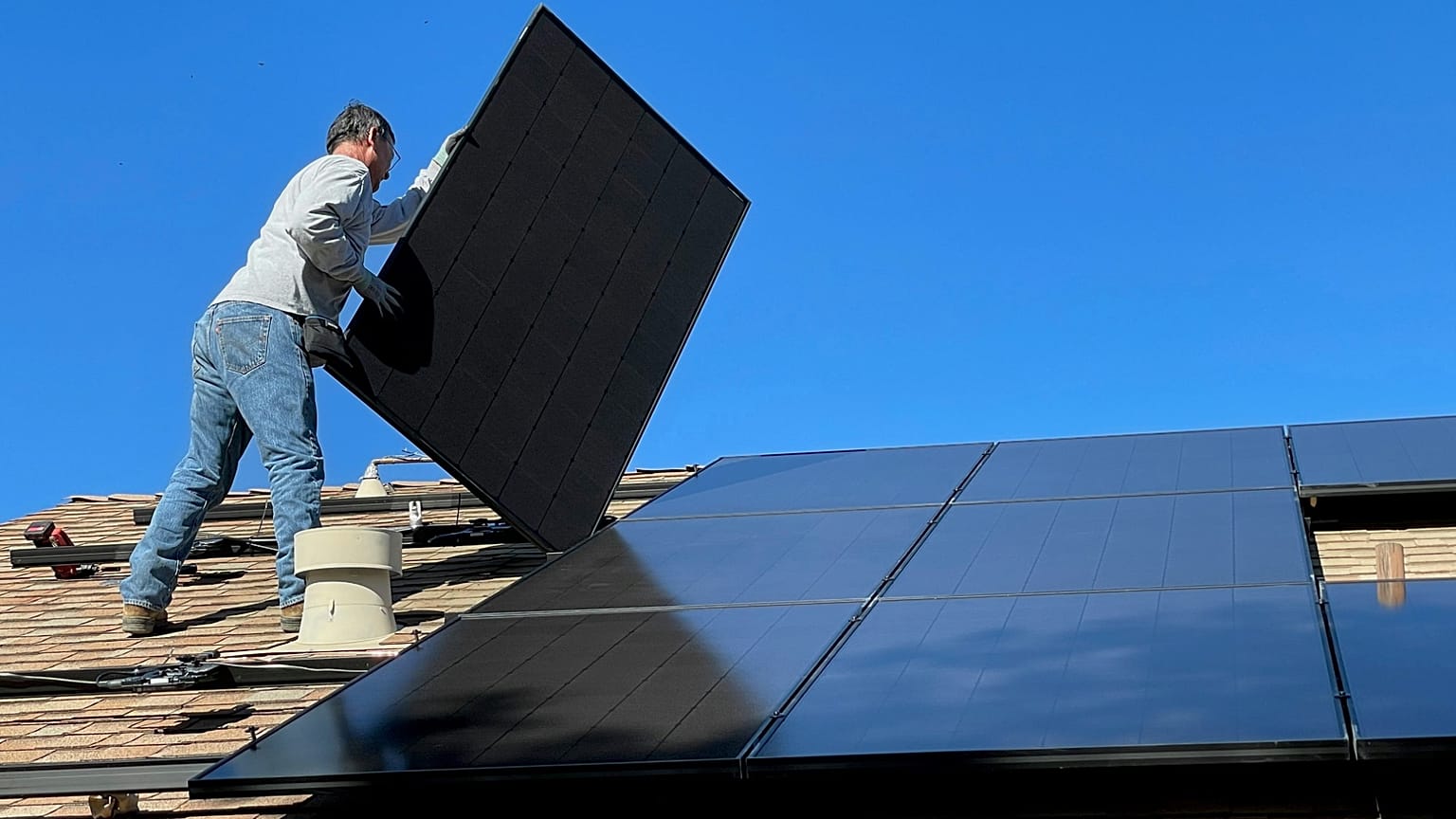
Solar sales have also increased by 54 per cent, as homeowners “supersize” systems with 12 panels instead of the usual 10, while electric vehicle (EV) charger sales have climbed by 20 per cent.
“We’re seeing a massive shift as people stop just asking and start acting. British families are tired of being held hostage by global fossil fuel prices,” says Rebecca Dibb-Simkin of Octopus Energy.
“By switching to solar and heat pumps, they are becoming their own power stations - locking in low costs and protecting their wallets for the long term.”
Accelerating the shift to EVs
European Commission data shows the average cost of petrol has risen across the EU by 12 per cent to €1.84 per litre from 23 February to 16 March.
This has triggered huge interest in Electric Vehicles (EVs), with French online used-car retailer Aramisauto witnessing its EV sales almost double between the middle of February and 9 March.
According to Reuters, Amsterdam-based Olx says customer enquiries for EVs have jumped across its marketplaces in France, Romania, Portugal and Poland, with growth “accelerating consistently week-over-week across all markets”.
In Norway, Finn.no – the country’s largest used-car marketplace – EVs have actually overtaken diesel models as the site’s best-selling fuel type.
A solar-powered transition
German renewable energy firm Enpal BV tells Bloomberg that inquiries for solar panels and heat pumps have risen by around 30 per cent since the start of the US-Israel war on Iran, while solar firm 1KOMMA5° GmbH has also reported an almost doubling of interest in solar.
In the UK, energy firm E.ON has found interest in solar rose by 23 per cent between 23 February and 1 March, and surged a further 63 per cent between 2 and 8 March.
“It’s more important than ever that we help people take control of their energy use and lower their bills,” says Chris Norbury, Chief Executive of E.ON UK.
“Consumers are showing strong interest in solar and battery as a solution, and this product adds to the savings that can be achieved by generating and storing energy at home.”
Will drilling the North Sea help lower energy bills?
Amid the boom in green technology, calls to double down on fossil fuels have gotten louder.
Earlier this month, British tabloid the Daily Express printed a frontpage story headlined ‘Get Drilling To Stop Soaring Bills’ – urging the UK to open up drilling licences in the North Sea.
However, an analysis from the University of Oxford found that a UK fully powered by renewable energy could save households up to £441 (€510) a year on their energy bills.
In comparison, maximising oil and gas extraction from the North Sea would only save households £16 (€19) to £82 (€95) per year – and this would rely on tax revenues being distributed to households to offset their energy bills.
Dr Anupam Sen, co-author of the analysis, said the idea that “draining” the North Sea would make the UK more energy secure and significantly cut household bills is “sheer fantasy”.
Multiple experts have also pointed out that oil and gas prices are set by global markets, not discounted for British consumers – and gas extracted from UK waters can be exported to the highest bidder – meaning increasing domestic production won’t significantly lower costs.
In contrast, Spain’s renewables revolution has been helping to keep energy bills low – even as gas prices soar.