




























‘Insurers walking away’ is the clearest sign unpredictable weather extremes are spiralling out of control, one expert says.
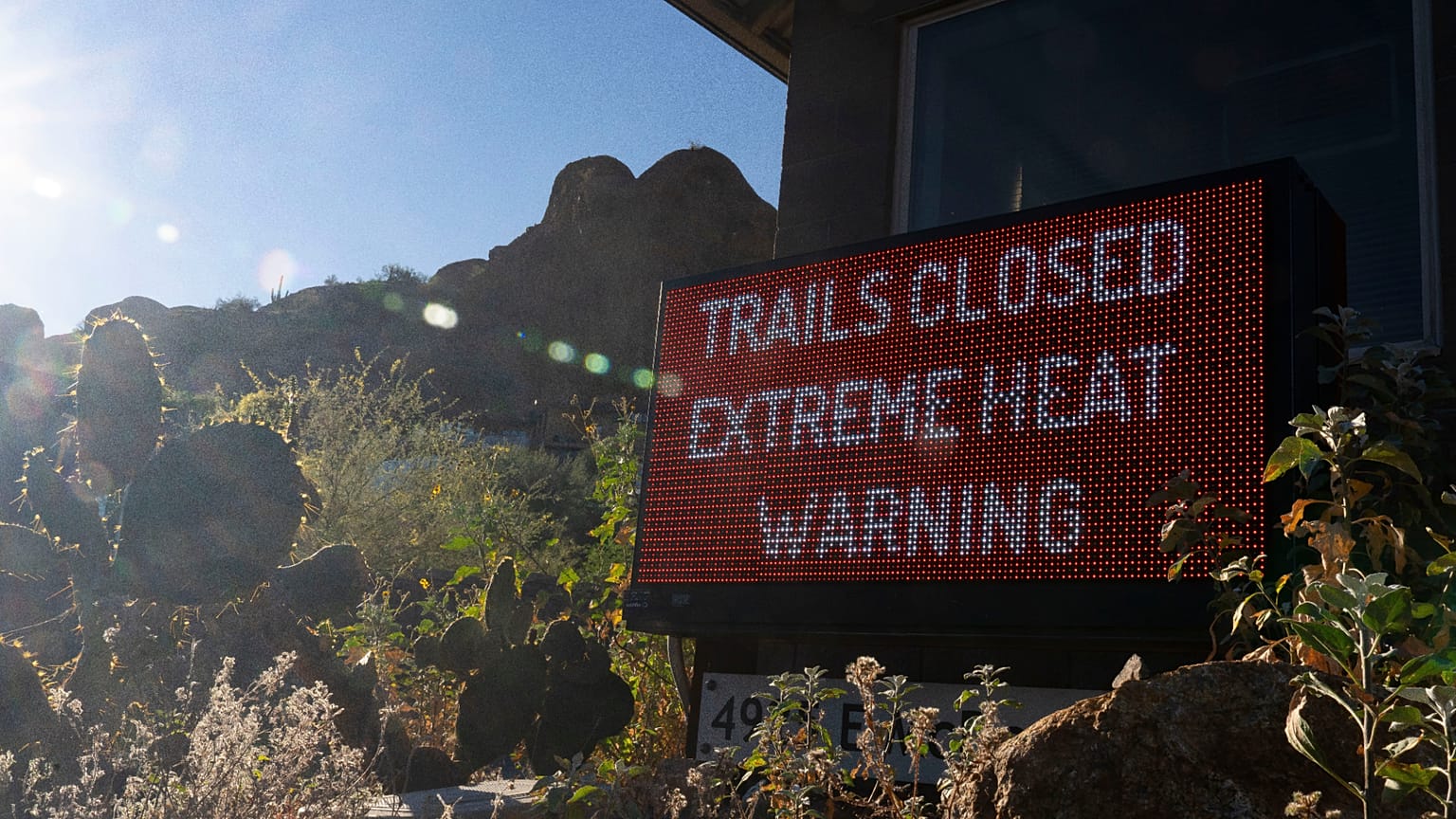
The dangerous heatwave shattering March records all over the US Southwest is more than just another extreme weather blip. It’s the latest next-level weather wildness that is occurring ever more frequently as Earth’s warming builds.
 ADVERTISEMENT
ADVERTISEMENT
ADVERTISEMENT
Experts say unprecedented and deadly weather extremes that sometimes strike at abnormal times and in unusual places are putting more people in danger. For example, the Southwest is used to coping with deadly heat, but not months ahead of schedule, including a 43.3 Celsius reading in the Arizona desert on 19 March that smashed the highest March temperature recorded in the US.
On Thursday, sites in Arizona and southern California had preliminary readings of 43C, which would be the hottest March day on record for the United States.
“This is what climate change looks like in real time: extremes pushing beyond the bounds we once thought possible,” says University of Victoria climate scientist Andrew Weaver. “What used to be unprecedented events are now recurring features of a warming world.”
'Virtually impossible without climate change'
March's heat would have been virtually impossible without human-caused climate change, according to a report released on 20 March by World Weather Attribution, an international group of scientists who study the causes of extreme weather events.
More than a dozen scientists, meteorologists and disaster experts queried by news agency The Associated Press put the March heatwave in a kind of ultra-extreme classification with such events as the 2021 Pacific Northwest heatwave, the 2022 Pakistan floods and killer hurricanes Helene, Harvey and Sandy.
The area of the US being hit by extreme weather in the past five years has doubled from 20 years ago, according to the National Oceanic and Atmospheric Administration's Climate Extremes Index, which includes various types of wild weather, such as heat and cold waves, downpours and drought.
The United States is breaking 77 per cent more hot weather records now than in the 1970s and 19 per cent more than the 2010s, according to an AP analysis of NOAA records.
In the United States, the number and average cost of inflation-adjusted billion-dollar weather disasters in the last couple years is twice as high as just 10 years ago and nearly four times higher than 30 years ago, according to records kept by NOAA and Climate Central, a nonprofit group of scientists and communicators who research and report on climate change.

Trying to keep up with extremes and failing
“It’s really hard to even keep up with how extreme our extremes are becoming,” says Climate Central Chief Meteorologist Bernadette Woods Placky. “It’s changing our risk, it’s changing our relationship with weather, it’s putting more people in risky situations and at times we’re not used to. So yes, we are pushing extremes to new levels across all different types of weather.”
For government officials who have to deal with disaster it's been a huge problem.
Craig Fugate, who directed the Federal Emergency Management Agency until 2017, says he saw extremes increasing.
“We were operating outside the historical playbook more and more. Flood maps, surge models, heat records – events kept showing up outside the envelope we built systems around. That’s just what we saw,” Fugate says via email.
He adds: “We built communities on about 100 years of past weather and assumed that was a good guide going forward. That assumption is starting to break. And the clearest signal isn’t the science debate. It’s insurers walking away.”
Fossil fuels are pushing temperatures to new highs
Climate scientists at World Weather Attribution did a flash analysis – which is not peer-reviewed yet – of whether climate change was a factor in this Southwest heatwave. They compared this week's expected temperatures to what's been observed in the area in March since 1900 and computer models of a world with climate change. They found that “events as warm as in March 2026 would have been virtually impossible without human-induced climate change”.
That warming, from the burning of coal, oil and natural gas, added between o 2.6 to 4 degrees C to the temperatures being felt, the report found.
“What we can very confidently say is that human-caused warming has increased the temperatures that we’re seeing as a result of this heat dome, and it’s going to be pushing those temperatures from what would have been very uncomfortable into potentially dangerous,” says report co-author Clair Barnes, an Imperial College of London attribution scientist.
Examples abound of high heat and extreme weather
The Southwest heatwave is solidly in the category of “giant events”, with temperatures up to 16.7 degrees Celsius above normal, says Stanford University climate scientist Chris Field.
He lists five others in the last six years: a 2020 Siberia heatwave, the 2021 Pacific Northwest heatwave that had British Columbia warmer than Death Valley, the summer of 2022 in North America, China and Europe, a 2023 western Mediterranean heatwave and a 2023 South Asian heatwave with high humidity.
And that doesn't include the East Antarctica heatwave of 2022 when temperatures were 45 degrees Celsius warmer than normal. That's the biggest anomaly recorded, says weather historian Chris Burt, author of the book Extreme Weather.
Worsening wild weather influenced by climate change isn't just super-hot days, but includes deadly hurricanes, droughts and downpours, scientists told AP.
Devastating floods hit West Africa in 2022 and again in 2024. Iran is in the midst of a six-year drought. And the deadly Typhoon Haiyan hitting the Philippines in 2013 shocked the world.
Superstorm Sandy, which in 2012 flooded New York City and neighbours, had tropical storm-force winds that covered an area nearly one-fifth the area of the contiguous United States. It spawned 3.5-metre seas over 3.6 million square kilometres, about half the size of the US, with energy equivalent to five Hiroshima-sized atomic bombs, said Yale Climate Connections meteorologist Jeff Masters.
And don't forget wildfires that are worsened by heat and drought, so recent extremes should include 2025's Palisades and Eaton wildfires, which were the costliest weather disaster in the United States last year, said Climate Central meteorologist and economist Adam Smith.
“This is due to climate change, that we see more extreme events, and more intense ones and have so many records being broken,” says Friederike Otto, an Imperial College of London climate scientist who coordinates World Weather Attribution.