



























Trump once called renewable energy a ‘scam’. Will the war on Iran make him change his mind?
Donald Trump’s crusade to steer the US away from renewable energy is being scrutinised, as the war on Iran highlights the volatility of fossil fuels.
 ADVERTISEMENT
ADVERTISEMENT
ADVERTISEMENT
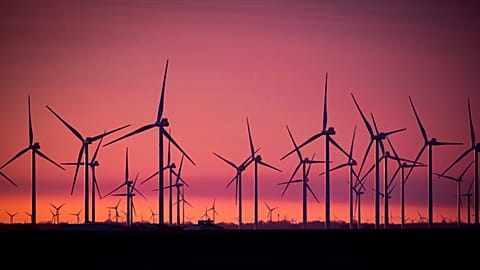
The POTUS has consistently condemned the transition to green energy. Last year, during a trip to Scotland, Trump urged Europe to “stop the windmills” – describing wind farms as a con and urging the UK to open up drilling licences in the North Sea.
At the World Economic Forum (WEF) in Davos on 21 January, Trump falsely claimed that China was selling wind turbines to “stupid people” but not actually using the technology themselves. China is home to the world’s largest wind farm, which is visible from space.
Alongside pulling out of key climate treaties and taking his “drill baby drill” attitude over to Venezuela, Trump’s administration was also found to have acted illegally in cancelling $7.6 billion (around €6.52 billion) in clean energy grants for projects in states that voted for Kamala Harris in 2024.
But as energy infrastructure gets dragged into the Middle East conflict, experts warn that the US has been left with fewer alternative energy sources – making the nation more vulnerable to supply shocks.
How is the war on Iran impacting US energy?
Brent crude, which is used as the world benchmark for oil prices, has exceeded $100 (around €86.38) per barrel several times since the war began. Much of this is down to the Strait of Hormuz, a fossil fuel chokepoint that remains effectively blocked as Iran targets traffic through it.
This 38km passage carries around one-fifth of global oil supplies, which works out at around 20 million barrels every day. Oil and gas prices are set by global markets, meaning domestic production won’t significantly lower costs for consumers.
Petrol prices in the US have surged toward $4 (€3.46) per gallon. This is a significant jump from last month, when Trump had boasted that prices were below $3 (€2.59).
“The biggest short-term losers of the war will be US consumers of oil and gas, as energy prices rise,” climate scientist Peter Gleick tells news agency AP.
Trump has called the conflict a “very small price to pay” after years of terror from the Iranian leadership. He predicts that oil prices will “drop like a rock” once the war ends.
However, American consumers are already seeing the effects at the pump, driving interest towards electric vehicles (EVs). Analysts have also warned that oil prices won’t “snap back” straight after the war ends, especially if energy infrastructure remains a missile target.
“It turns out fossil fuels have their own supply risks, and the administration has no answers,” says Tyson Slocum of Public Citizen, a consumer advocacy group.
‘No price spikes for sunlight’
In an attempt to ease pressure on prices, Trump has released millions of barrels of oil from the US Strategic Petroleum Reserve and has aimed to temporarily lift sanctions on Russian oil shipments already at sea.
According to AP, officials are also considering using the US Navy to escort oil tankers through the Strait of Hormuz. This requires negotiating with countries heavily reliant on Middle East crude to form a coalition to police the waterway.
Despite those efforts, prices remain high. Gregory Brew, a senior analyst at the Eurasia Group, says the world is currently experiencing the “largest oil supply disruption in history” that will keep energy costs soaring for the foreseeable future.
It has emboldened calls to focus on home-grown green energy like wind and solar that isn’t impacted by geopolitical conflict. Spain, for example, is already showing how heavily investing in renewables can help keep energy bills low when gas and oil prices soar.
“There are no price spikes for sunlight and no embargoes on the wind,” says UN Secretary-General António Guterres.