




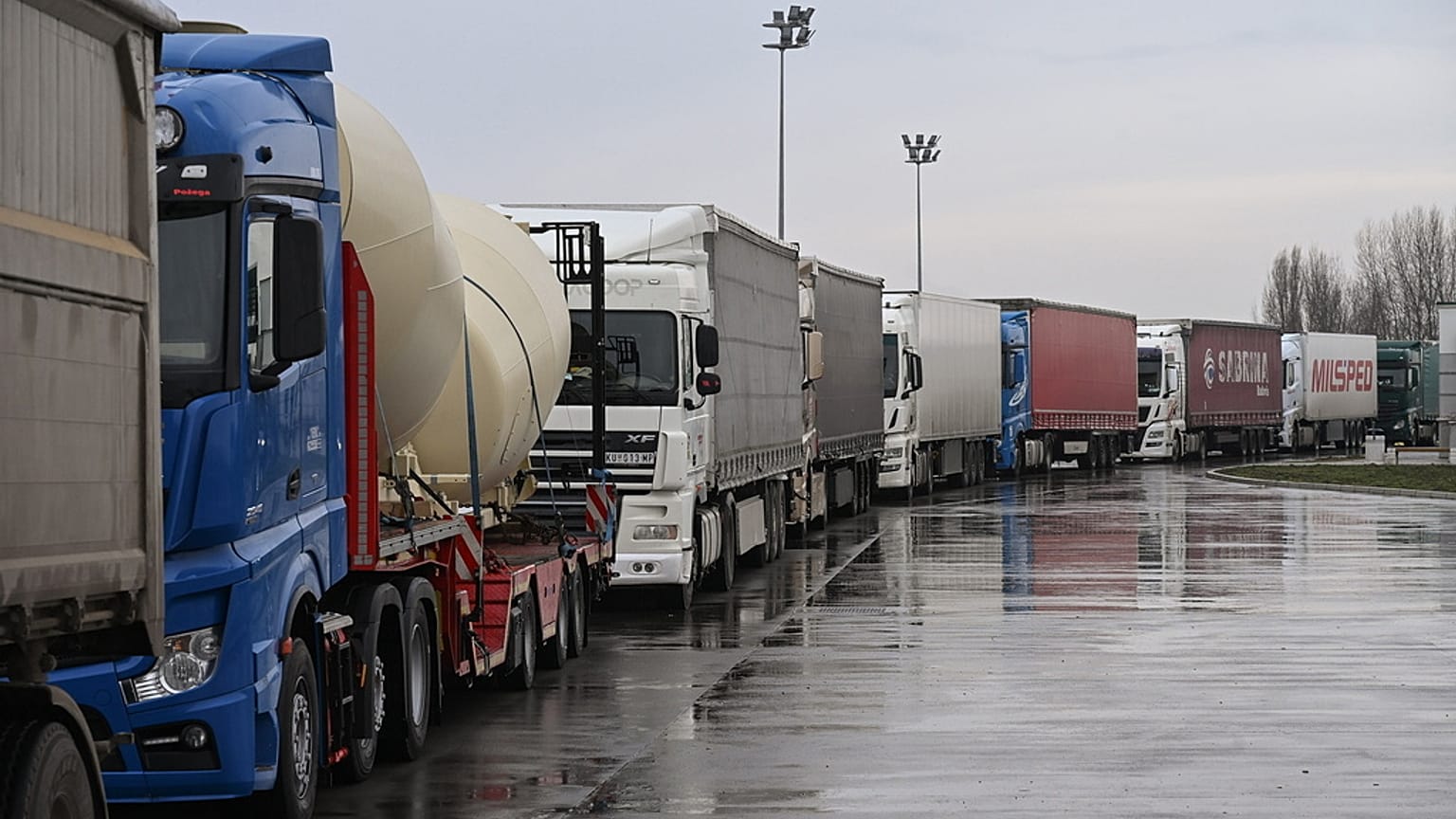














Lorry drivers from four Western Balkan countries blocked more than 20 EU border crossings to protest Schengen travel restrictions. The blockade causes €100 million daily export losses, according to officials.
Lorry drivers from four Western Balkan countries blockaded more than 20 border crossings with the European Union on Monday in coordinated protests against strict enforcement of Schengen travel limits they say threaten their livelihoods, causing an estimated €100 million in daily export losses.
 ADVERTISEMENT
ADVERTISEMENT
ADVERTISEMENT
Freight terminals in Serbia, Bosnia and Herzegovina, Montenegro and North Macedonia ground to a halt as drivers parked vehicles at border checkpoints, stopping transport through a major corridor linking the EU with Turkey and the Middle East. The blockade also affected Montenegro's Adriatic port of Bar.
"We are fighting for our companies to be competitive within the region, fighting for our employees, for our families, for our very existence," Vesko Šljivančanin, director of the Association of International Hauliers of Montenegro, told Euronews.
Marko Čadež, president of Serbia's Chamber of Commerce, said the direct damage from blocked crossings and exports from the Western Balkans amounts to approximately €100 million per day.
"That's just the damage when it comes to exports of goods. To that we must add that each production company faces penalties for undelivered goods of between €10,000 and €50,000 per day," Čadež told Serbia's Tanjug news agency after visiting the Batrovci border crossing, where more than 50 lorries blocked freight traffic.
He noted that approximately 10,000 companies export from Serbia to the EU alone, warning the figures could reach "truly large numbers."
More than 100 lorry drivers were deported last year for exceeding the 90 days they are allowed to stay in the EU, with another 100 deportations announced last week, according to Bosnia's Logistika association, which represents 47,000 workers. Nine drivers were arrested in Germany alone in the past seven days, Čadež said.
"We have reached the point where our drivers — and we ourselves — have effectively been deprived of the right to work, because our drivers are being arrested in the European Union," Mirko Ivanović, a Bosnian transport company representative, told Euronews.
Europe's bureaucratic inflexibility
The protests target the enforcement of long-standing Schengen regulations limiting non-EU nationals to 90 days within any 180-day period.
While these rules previously applied to professional drivers, enforcement has intensified since the EU began gradually implementing its Entry/Exit System (EES) in October 2025.
The electronic system records stays digitally and effectively prevents violations of the 90/180-day rule, replacing passport stamps with biometric data, including fingerprints and facial images.
Čadež said that unlike previous supply chain crises caused by the COVID-19 pandemic or the Suez Canal blockage, the current crisis stems from European bureaucratic inflexibility.
"For more than two years, businesspeople from across the Western Balkans — from Serbia, North Macedonia, Albania, Montenegro — have been united in pointing out to Europe that this is a major problem," he said.
"EU companies that produce in the Western Balkans have also pointed this out, but solutions are not being found."
He added that EU companies were now effectively blocking themselves, with European rules treating professional drivers the same as attempted migrants.
'This will have an impact and it will last'
At Gevgelija, the busiest crossing between Greece and North Macedonia, around 100 lorries bearing Macedonian flags blocked the cargo terminal. Similar scenes unfolded at border points across the region.
Drivers said they would allow medicine, live animals, ammunition and explosives through their blockades but would otherwise remain in place. They announced the protest would continue for at least seven days until their demands are met.
"We prepared by dividing ourselves into several shifts with colleagues, each lasting eight hours, so we will be on duty here throughout the night and rotating every eight hours," Dušan Anđelić of the MS Transport company from the Serbian town of Ruma told Euronews.
"We have secured food and water for the drivers waiting in the queues — the minimum basic human needs — because we are aware that this will have an impact and that it will last."
Neđo Mandić, president of Serbia's Association of Transport Operators, said the lorry drivers and transportations companies remain open to any reasonable solutions.
"If we sit down and there is good will, everything will be clear to them in five minutes. Any proposal is possible — a driver’s visa, an increase in the number of days for professional drivers, or some other solution. We are ready for anything," Mandić told Euronews.
Special visa an option?
Serbia's Chamber of Commerce proposed introducing a special visa or permit for professional drivers valid throughout the Schengen Area, increasing the permitted number of days, or exempting drivers from the EES system until a permanent solution is reached.
Serbia's Prime Minister Đuro Macut last week urged special status for regional drivers in a meeting with the EU's representative in the country, warning the problem threatened to "fully paralyse" transportation companies and damage Balkan economies.
European Commission spokesperson Marcus Lamert said Monday the bloc was aware of concerns raised by Western Balkan drivers and was closely monitoring the situation.
"The EES does not introduce new rules on the length of short-term stays in the Schengen area, but allows better enforcement of the rules," Lamert said at a press conference Monday.
Lamert noted the Schengen Agreement provided certain flexibility for cross-border workers who frequently use the same crossings, and that some professions requiring extensive movement such as lorry drivers or athletes might need to stay longer than 90 days.
"This is an issue that has our closest attention and something which is being worked on and is being thought about," he said, adding the matter would be discussed this week when the EU's visa strategy is scheduled for review.
The six Western Balkan countries are at various stages of their respective paths to join the 27-member bloc.