






























The brain helps us navigate through the world, but it also functions as a navigational system. This is the opinion of neuroscientist Prof. Christian Doeller, who has just been awarded the Leibniz Prize worth 2.5 million euros for his research.
Psychologist Prof. Dr Christian Doeller from the Max Planck Institute for Human Cognitive and Brain Sciences has students in Leipzig play computer games in a scanner to investigate how their brains work. The test subjects hold a keyboard to navigate or make decisions.
 ADVERTISEMENT
ADVERTISEMENT
ADVERTISEMENT
The neuroscientist and his teams at the Doellerlab want to find out one thing in particular: what are the most important coding principles of the brain that make human thought possible?
Doeller describes the computer game that the test subjects see on the back wall of the scanner: "They are taxi drivers, for example, and have to take a person from A to B. And while they carry out this task, they measure the coding principles of the brain. And while they perform this task, we measure their brain activity in parallel."
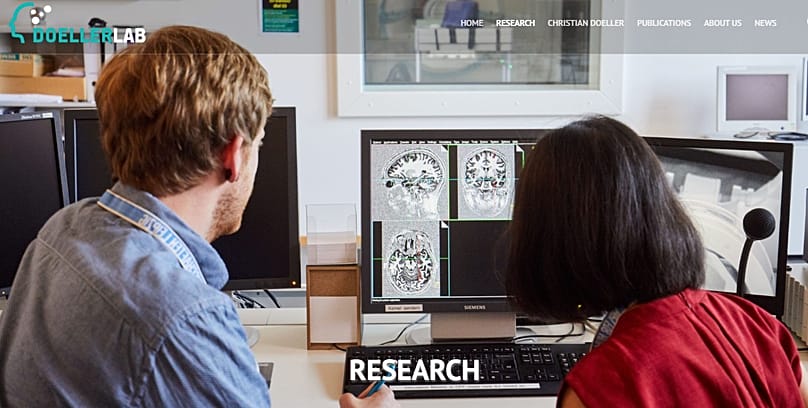
While the test subjects drive through the virtual city, their brain functions like a navigation system. "Test subjects with a high navigation performance, i.e. who navigate 10 out of 10 virtual paths through the virtual city correctly and always find the shortest route, have the highest activity."
The brain as a navigation system or a box of notes
According to Professor Doeller, the systems in the brain that help with navigation also organise memory, learning and knowledge like a navigation system. "If you remember your school days: index cards were also organised spatially to sort terms. Space is a fantastic medium for visualising things close together or far away based on similarity and dissimilarity."
The sociologist Niklas Luhmann once said that the box in which he organised his 90,000 handwritten notes was a reflection of his brain. Luhmann's box of notes is still being analysed at Bielefeld University today.
According to neuroscientist Doeller, the brain's navigation system is responsible for memorising information. "This means that whenever you use a spatial strategy to sort information, put newspaper articles in different places on your desk, etc., this navigation system is certainly active."
Long before studying the navigation system, the psychologist had his first major research success in 2010 with the demonstration of so-called grid cells. While the principle of grid cells had already been demonstrated in rodents, Doeller and his colleagues published a study in the journal Nature detecting a functional magnetic resonance imaging (fMRI) signal that reflected a test subject's position in a virtual reality environment and fulfilled the criteria for grid cell coding.
The study suggested that humans represent position and spatial perception in a way very similar to rodents.
Meanwhile, rats and mice are also confronted with virtual reality and strapped to spinning balls or spheres, as Doeller explains.
"Our big future, current, but also long-term research question is that this brain system of navigation is not only relevant for finding your way from A to B in a city, but also for performing other cognitive tasks. For example, learning concepts and building up new knowledge."
Professor Doeller and his team want to find out to what extent other cognitive functions—such as action control, decision-making, and the acquisition of new conceptual knowledge—can be explained by the core principles of their navigation system hypothesis.
2.5 million euros for new projects thanks to Leibniz Prize
With the help of modern imaging techniques such as functional magnetic resonance imaging (fMRI) and magnetoencephalography (MEG), Dr. Christian Doeller has gained crucial insights into the brain. He has just been honoured with the Gottfried Wilhelm Leibniz Prize worth 2.5 million euros.
With this impressive sum, Professor Doeller can now pursue more complicated research that he finds particularly exciting. The researcher wants to investigate how the brain processes social interaction by observing two test subjects in a joint cognitive learning process.
"It's technically very complex because the two test subjects are solving an interactive task. And, of course, the synchronisation of the two scanners is complex, while the two test subjects simultaneously perform the cognitive task in both scanners in this study," explains the neuroscientist.
The Max Planck Institute for Human Cognitive and Brain Sciences is also working on clinical studies, such as on the early stages of Alzheimer's disease or with patients suffering from Long Covid. The findings from these studies have not yet been published.