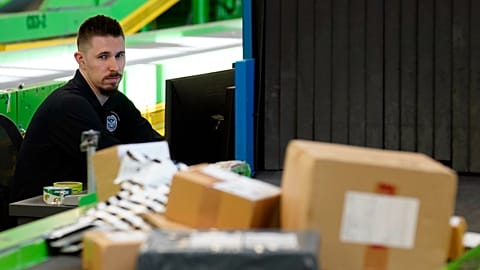
















While supermarket owners say AI-monitored CCTV cameras are significantly helping their business, critics warn the largely unregulated tech raises serious ethical and privacy concerns.
Thousands of French supermarkets are now using artificial intelligence (AI) to detect shoplifters in their stores, analysing customer movements in real time to flag suspicious behaviour to staff.
 ADVERTISEMENT
ADVERTISEMENT
ADVERTISEMENT
The technology has reportedly cut losses for many supermarkets, but it also raises questions about privacy and transparency.
The software works by analysing real-time footage from in-store cameras. When the algorithm detects suspicious gestures or behaviour, like putting an item into a bag or repeated touching of products without scanning, it sends a short video clip to employees.
“So we get an alert; it might be a simple gesture, it might be an ambiguous gesture. But the worst is concealment, often it’s concealment, or it’s hands going into bags, said Nelson Lopes, a manager of a Montreuil supermarket near Paris.
"But what works most is concealment. And when there’s concealment, everyone’s on alert, everyone’s watching the cameras," he added.
Supermarket Arul Judson recalls losing nearly €60,000 in his first year without AI, but now he says the losses have fallen by roughly half.
Meanwhile, pharmacist Latifa Gharbi in Paris pays €200 per month to enhance her cameras with AI, saving an estimated €4,000 annually and avoiding the cost of a security guard.
A legal grey area and privacy concerns
But the technology currently sits in a legal grey area. France has no specific law authorising behavioural AI surveillance in commercial spaces, nor a requirement for stores to inform customers when it is in use.
France’s data protection authority, the CNIL (National Commission on Informatics and Liberties), is clear with their stance: these cameras analyse personal data on a massive scale, and their commercial use is prohibited without a specific law.
Despite this institutional warning, the French software start-up Veesion has equipped “2,000 to 3,000 stores” across France. The CEO of the company, Thibault David, defends the tech, insisting it complies with European GDPR data rules and does not perform biometric analysis.
Many shopkeepers argue that the AI software is simply a support tool to protect their livelihoods in the face of rising theft amid a growing cost-of-living crisis.
"It’s a security measure, I imagine, for the owner. If it’s limited, the use is restricted, it’s not shared, etc. It’s like a camera, after all. So it doesn’t bother me," said Loan, a 65-year-old shopper.
With lawmakers considering proposals to create a more regulated framework for this type of public AI technology, the debate over where security ends and surveillance begins is likely to continue in the coming years.