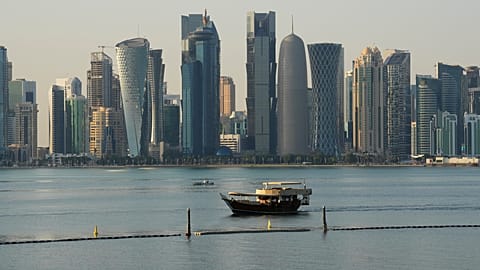






























Data centres are the physical buildings that house all the infrastructure required to power banking apps, cloud services, and artificial intelligence platforms.
Experts are sounding the alarm over fresh threats to Middle Eastern data centres, warning that this month's inaugural reported strikes signal a dangerous new trend.
 ADVERTISEMENT
ADVERTISEMENT
ADVERTISEMENT
Amazon said two of its data centres in the United Arab Emirates were hit by drone strikes on March 1 and a third centre in Bahrain was damaged by debris from a nearby strike.
Iran’s Islamic Revolutionary Guard Corps (IRGC) claimed responsibility for the attacks, telling state media that the attacks were aimed at identifying the role of these centres in supporting the enemy’s military and intelligence activities.
Analysts say these may be some of the first known physical attacks on data centres, the buildings hold all the infrastructure to power everything from banking apps to cloud services, and artificial intelligence (AI) platforms.
Amazon declined to comment further on the attacks in the Middle East, referring Euronews Next to a health dashboard. As of March 11, several Amazon services are still unavailable or disrupted for customers in the UAE and Bahrain.
Why are data centres a target?
“It’s very likely that data centres will be targeted in the future,” said Vincent Boulanin, director of the governance of AI programme at the Stockholm International Peace Research Institute (SIPRI).
Boulanin said he was not surprised that Iran had mounted attacks against data centres in the United Arab Emirates and Bahrain. Data centres power AI by providing the computer power, storage and high-speed internet needed to train the models.
“Data centres are a critical building block of AI capabilities at the national level,” Boulanin said. “From that perspective, data centres can be considered a very critical infrastructure.”
Targeting data centres is interesting due to the impact on civilians and potentially on the United States military, which could be using AI in its operations, he said. American media reported that Anthropic’s Claude was used by the US military to assist with operations in Venezuela and Iran.
The companies most at risk of air strikes are likely Big Tech companies that own ‘hyperscaler’ data centres, such as Microsoft, Google Cloud, and Amazon Web Services, if the goal is to signal the vulnerability of the systems, said James Shires, co-director of British think tank Virtual Routes.
Hyperscalers house at least 5,000 servers and can cover millions of square feet (approximately 92,900 square kilometres), according to American technology company IBM.
Data centres owned by major AI companies, such as OpenAI or Anthropic, could also be at risk if the attack aims to focus on the US military’s data processing, Shires added.
Protection ‘robust’ on the ground, not in the air
He said most data centres have “robust” protection on the ground, but few had considered the threat of state-level air strikes before these attacks.
“Once the threat model is one where there is a state belligerent firing missiles … data centres are not the highest priority for defence,” James said, noting that oil and gas refineries or water desalination plants are often more interesting targets.
Security at Amazon data centres includes guards, fencing, cameras, and intrusion-monitoring technology. The company also has fire suppression equipment and backup internet connectivity in case one of the servers overheats.
Amazon groups its data centres into “availability zones,” which physically separate data centres into one region to reduce the impact of a single disaster, according to a 2022 press release about its zones in the UAE.
Availability zones are intended to support cloud operations during physical disasters, such as floods or earthquakes, but they can also help with disruptions due to drone strikes, he added.
“If you have a drone attack maybe some service in the data centres fails to operate so the whole data centre then has to run either at lower power, or they have to take it offline altogether,” he said. “Even in that worst-case scenario, you can then migrate data processing to other facilities in the same region without too much of an issue.”
The only limit to this system is data localisation or sovereignty rules, where governments require certain data to stay within specific countries, he added.
Could agreements or missiles protect them?
There are two options for reducing the threat to data centres: creating agreements that would make it illegal to attack them during war, or improving defences, Shires said.
But the agreement route is “unlikely,” he said, if opponents are open and willing to attack critical infrastructure such as data centres.
To improve defences, Shires said data centres should be labelled as “critical infrastructure,” making them protected by a nationwide dome missile system, similar to Israel’s Iron Dome.
Israel’s system is a series of truck-towed mobile units deployed to strategic locations across the country. Military personnel analyse a detected threat at a 24-hour “battle management centre,” and decide what type of missile they will use to intercept.
Shires said surface-to-air defence systems, like components of the Iron Dome, are deployed to “extremely high value places,” such as oil and gas reserves or government infrastructure, to protect them from attack.
“So then the question is how far you would move data centres [up] on the critical infrastructure list,” he said
Another option would be to move or mount specific surface-to-air receptors next to data centres or at the right angle or location to intercept, Shires said. The position that the military would land on would depend on where they believe the threat could come from.
The United States is working on a similar national shield system to the Iron Dome, nicknamed the “Golden Dome,” by President Donald Trump, which will be able to shoot down hypersonic, ballistic and advanced cruise missiles and drones. However, no military contracts have been directly awarded for the initiative so far.
Euronews Next has reached out to the US Department of War for an update on the Golden Dome and whether it would consider putting missiles near data centres, but did not receive an immediate reply.
What comes next?
Boulanin said it’s unclear whether the drone strike on AWS data centres is considered an “escalation” of the war in the Middle East.
Under international law, civilian infrastructure is protected from direct attacks during conflict unless there is proof that it is being used to support military actions, he said.
“It’s very likely in this case that it was a pure civilian infrastructure and therefore that it was unlawful to target that centre,” Boulanin said.
The UAE could mount a legal case against the US drone strikes, Boulanin added, because it is very difficult to know what military activities, if any, the AWS centres were being used for.
A longer-term impact is likely to lead to less data centre investment in the UAE, Bahrain, and the Middle East at large.
“Investment in data centres is designed with a very long time frame, and any event like this increases the risk of that investment,” Shires said. “It really puts into jeopardy the cloud and AI strategies of the Gulf economy in a really worrying way.”
There are approximately 35 data centres in the UAE, with 42 per cent considered to be large facilities with up to 5,000 servers, according to 2025 numbers from data analysis firm Mordor Intelligence.
Before the attacks, the UAE’s data centre market was expected to more than double in profit from $3.29 billion (€2.78 billion) in 2026 to an estimated $7.7 billion (€6.5 billion) by 2031, the firm noted.
The growth is partly due to investments from American AI companies such as OpenAI and Microsoft into data centres in the UAE.
Euronews Next reached out to these AI companies to see whether the data centre attack would change their priorities in the Middle East, but did not receive an immediate reply.