
















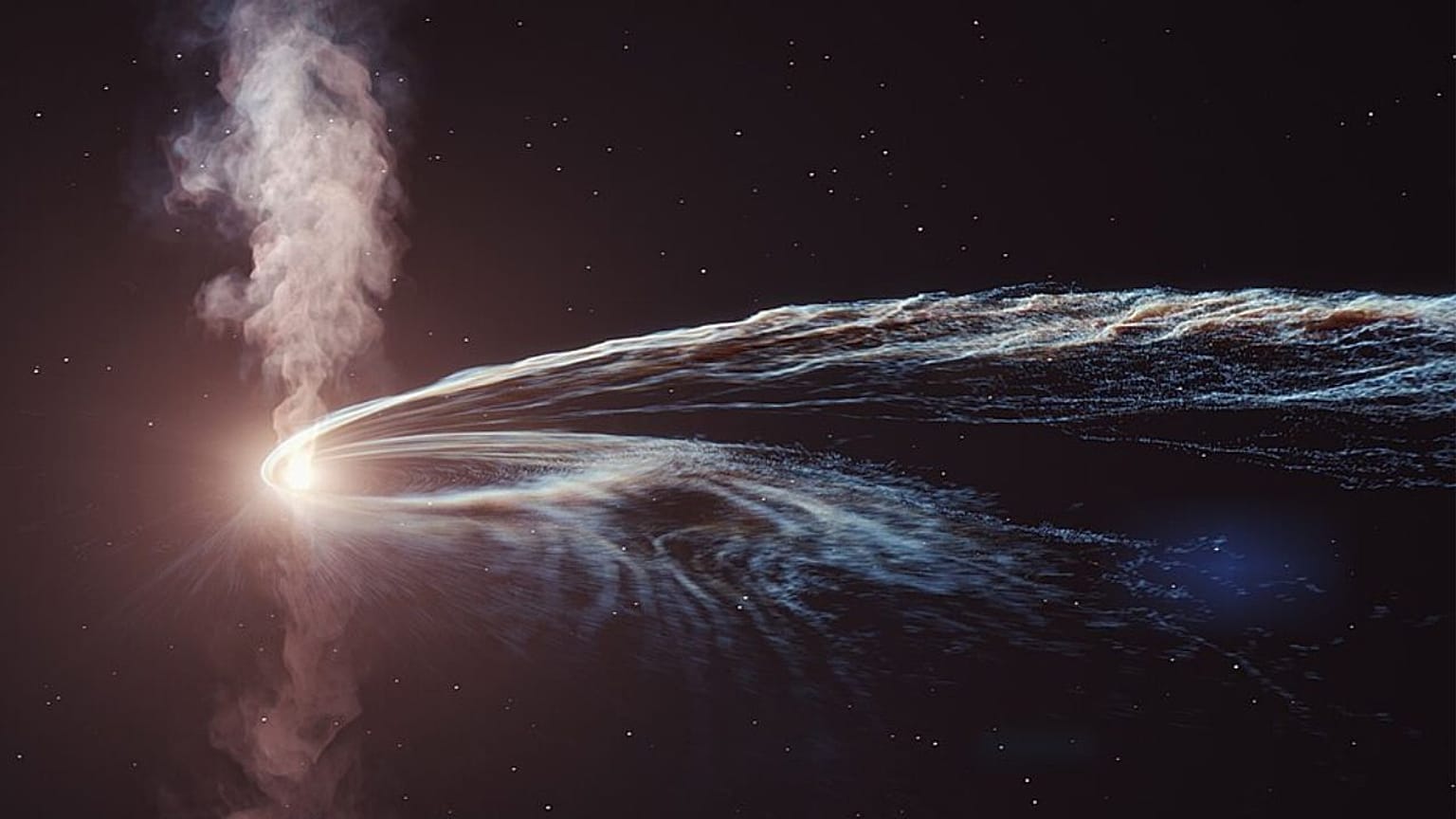













A team of astrophysicists from the University of Oregon have discovered one of the most energetic and powerful forces in the universe, potentially 100 trillion times stronger than Star Wars’ Death Star.
A supermassive black hole has been generating more energy than the Death Star in the last four years, according to new research by a University of Oregon astrophysicist.
 ADVERTISEMENT
ADVERTISEMENT
ADVERTISEMENT
This phenomenon was caused by the remains of a shredded star, which is estimated to have a significant store of energy. Scientists expect the amount of radio waves being emitted by the black hole to go strong for the next year, reaching a peak in 2027.
The jet shooting out of this newly discovered black hole is one of the most energetic and brightest forces ever to be found in the universe so far- on par with a gamma ray burst.
In popular culture terms, it is estimated to be at least a trillion times, if not closer to 100 trillion times, more powerful than Star Wars’ infamous Death Star.
“This is really unusual. I’d be hard-pressed to think of anything rising like this over such a long period of time,” Yvette Cendes, astrophysicist at the University of Oregon, noted.
The study was published in the Astrophysical Journal on Thursday.
What makes this black hole so unique?
Incidents of stars getting too close to black holes and getting shredded by their gravitational fields without going to the point of no return are quite common, known as tidal disruption events. The same gravitational factors that cause these are also responsible for the Earth’s ocean tides.
When this happens, the gravitational tug shreds a star in a process known as “spaghettification”, originally popularised by physicist Stephen Hawking.
This is when stars are extremely horizontally compressed and vertically stretched into long, thin shapes, akin to spaghetti, mainly due to the intense tidal forces around a black hole.
However, it is exceedingly unusual for a black hole to continue emitting this much energy, even several years after shredding a star.
Cendes said she discovered this specific tidal disruption event in 2018, however, she only paid close attention a few years later in 2022, when the black hole was still emitting a lot of energy in the form of radio waves.
The energy transmitted is currently 50 times brighter than it was back in 2019, with the radiation shooting out as a single jet facing one direction. The area around the black hole is also emitting very faint visible light.
This supermassive black hole has been named AT2018hyz scientifically, with Cendes nicknaming it Jetty McJetface.
Although nobody can tell for sure how high the energy emissions will go, Cendes is tracking the black hole closely.
She is also on the lookout for other black holes which might be behaving in a similar way, but could have been missed, as nobody has really paid attention to this phenomenon before.