














Dark matter is one of the greatest mysteries in physics. Here’s how scientists successfully mapped the invisible substance in the greatest detail ever.
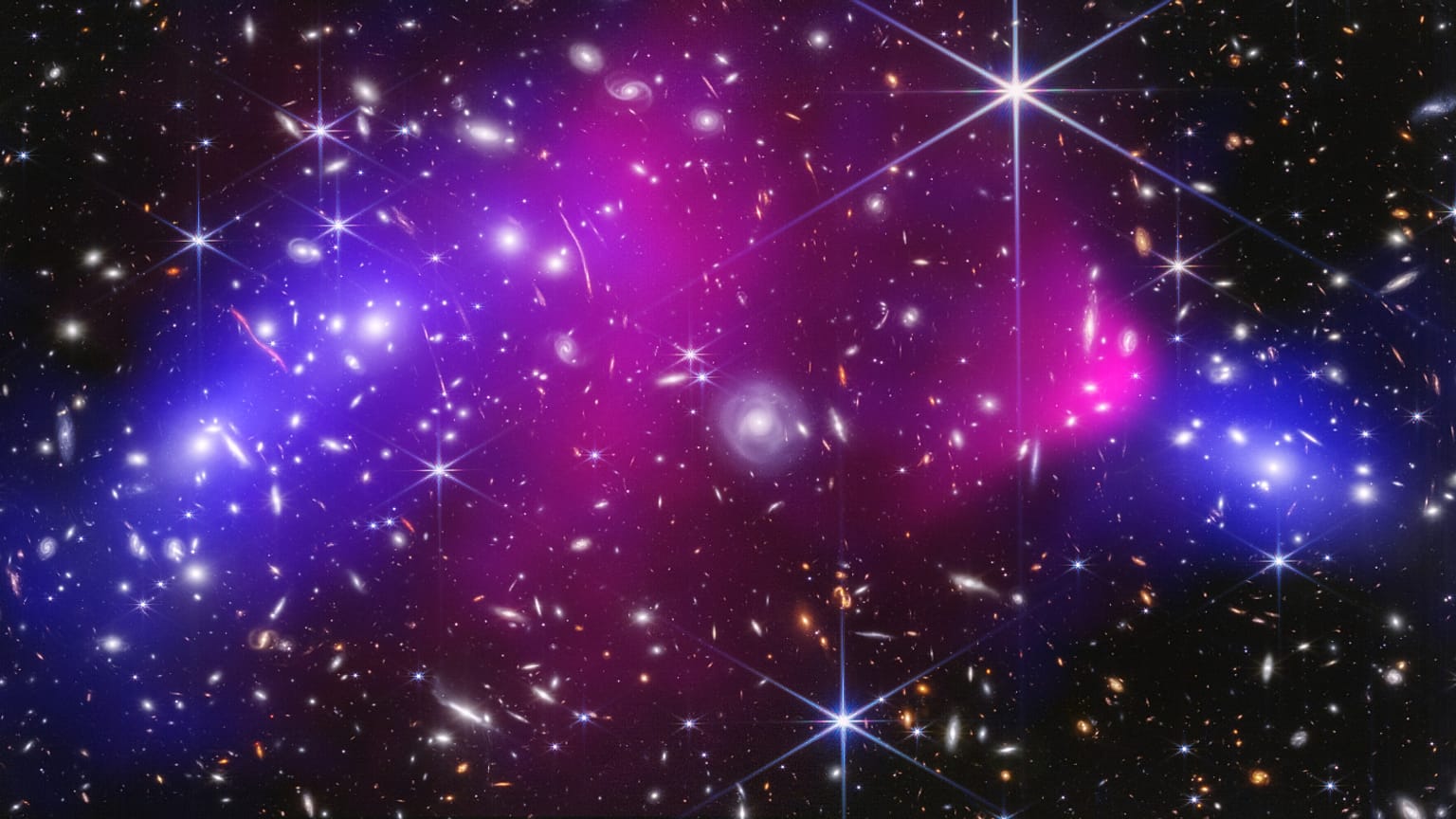
Scientists have created the most detailed map yet of dark matter using NASA’s James Webb Space Telescope.
 ADVERTISEMENT
ADVERTISEMENT
ADVERTISEMENT
Dark matter is one of the greatest mysteries in physics.
Scientists say it makes up most of the matter in the universe, but it is still not known what it's made of. It can't be seen with any telescope and doesn't emit, reflect, or absorb light.
Though it does have mass, which means it exerts gravity. This is the fact that the research team at Durham University, in the United Kingdom, used to produce the map of dark matter.
Dark matter's gravity bends light from more distant galaxies, making them look distorted. This is a process known as gravitational lensing.
By measuring the direction and strength of that distortion across nearly a million galaxies, astronomers could pinpoint where dark matter is and how much of it there must be.
“They (distant galaxies) appear warped into unusual shapes. And by looking across the galaxies, we see, ‘oh, there's one that looks like the Milky Way, there's a fuzzy blob. Oh, hang on. There's a really unusual-looking galaxy,’” said Richard Massey, a computational cosmology professor at Durham University.
“That's because it's got some dark matter in front of it. So that's how the James Webb Space Telescope can see dark matter even though it's invisible,” Massey added.
This new map confirms that dark matter is not randomly scattered but tightly connected to the structure of everything we can see, according to the research team.
The small patch of space scientists have mapped lies in the constellation Sextans. This area has been studied before, using ground-based telescopes or the Hubble Space Telescope, but never in such detail.
It spans a section of sky about two and a half times the width of the full Moon as seen from Earth.
"I would say that earlier maps were a bit like seeing the dark matter through a frosted glass,” said Gavin Leroy, a postdoctoral research associate at Durham University.
“Now, with amazing data from the James Webb Space Telescope, we are able to see the universe with a closer, clearer view of where the dark matter is,” Leroy added.
Thanks to NASA’s James Webb Space Telescope, around a million galaxies could be identified in the new map, which is twice the number of the deepest survey previously obtained by the Hubble telescope.
Researchers hope the new map will serve as a reference for future space missions.
Upcoming observatories, such as the European Space Agency’s Euclid telescope and NASA’s Nancy Grace Roman Space Telescope, will map dark matter across much larger regions of the sky.