
















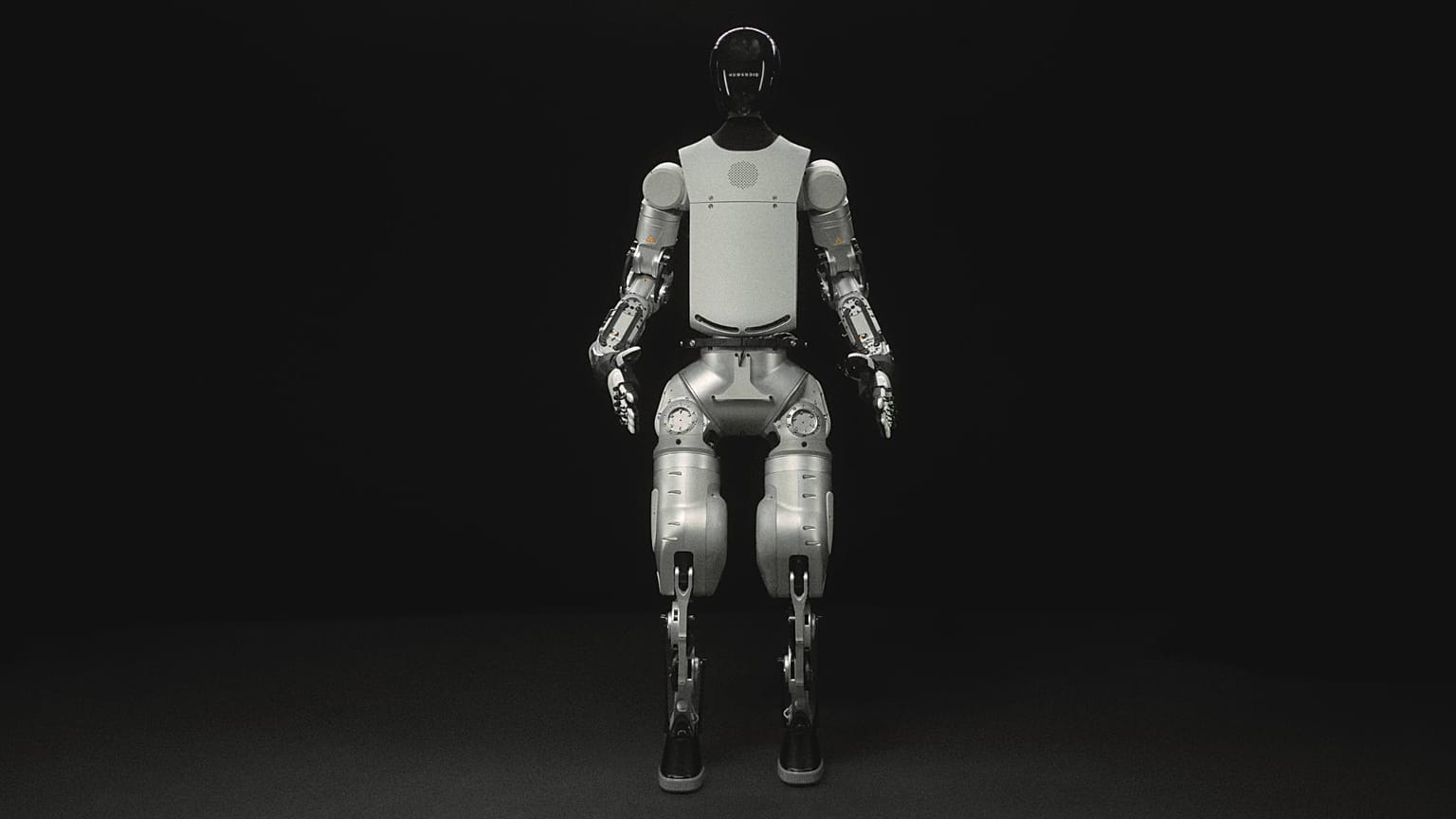














Designed for industrial, domestic and service tasks, the robot aims to address labour shortages, physically demanding work, and unpaid domestic care.
Humans spend up to a year learning to stand and take their first steps. But for one humanoid robot, it took just 48 hours.
 ADVERTISEMENT
ADVERTISEMENT
ADVERTISEMENT
HMND 01 Alpha Bipedal, developed by UK-based company Humanoid, achieved stable bipedal walking just two days after its assembly - a milestone that typically takes weeks or months in robotics.
From initial design to a functioning prototype, the robot was ready in just five months, compared with the industry average of 18 to 24 months.
Using Nvidia’s Isaac Sim and Isaac Lab, the team crammed the equivalent of 19 months of conventional locomotion training into just two days of virtual reinforcement learning.
By the time the robot stood on its own two feet, it had already absorbed millions of seconds of “experience” in simulation.
Standing at 179cm with the strength to carry 15 kilograms, Alpha is as much a feat of engineering as it is a glimpse into a near future where humanoid robots could become everyday helpers.
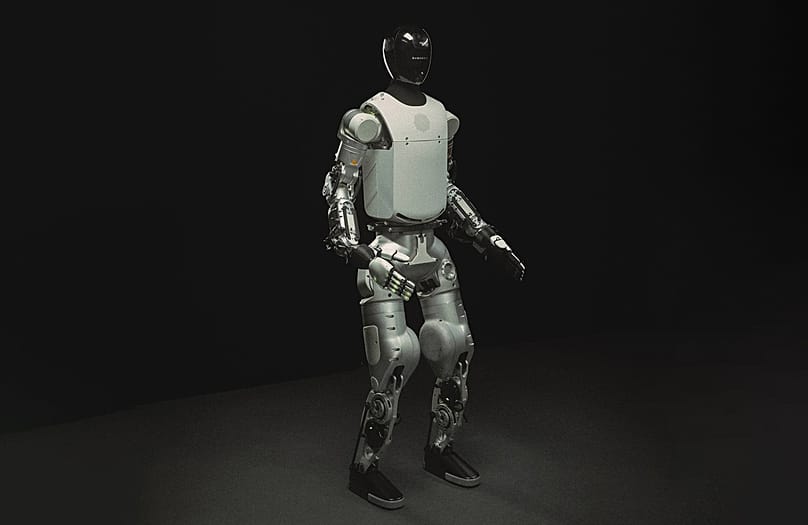
Its modular hands can be swapped for five-fingered dexterity or simple grippers, while cameras, depth sensors, and microphones allow it to perceive its environment.
"HMND 01 is designed to address real-world challenges across industrial and home environments,” said Artem Sokolov, the founder and CEO of Humanoid.
"With manufacturing sectors facing labour shortages of up to 27 per cent, leaving significant gaps in production, and millions of people performing physically demanding or repetitive tasks, robots can provide meaningful support."
In domestic environments, they could assist elderly people or those with physical limitations, helping with object handling, coordination, and daily activities, he added.
Alpha can walk straight or on curved paths, squat, hop, sidestep, run, interact with humans, manipulate objects and even coordinate with other robots. It can also rebalance itself after being pushed.
And with its modular design, the company promises that future upgrades could be as simple as swapping an arm or even changing its "clothes".