
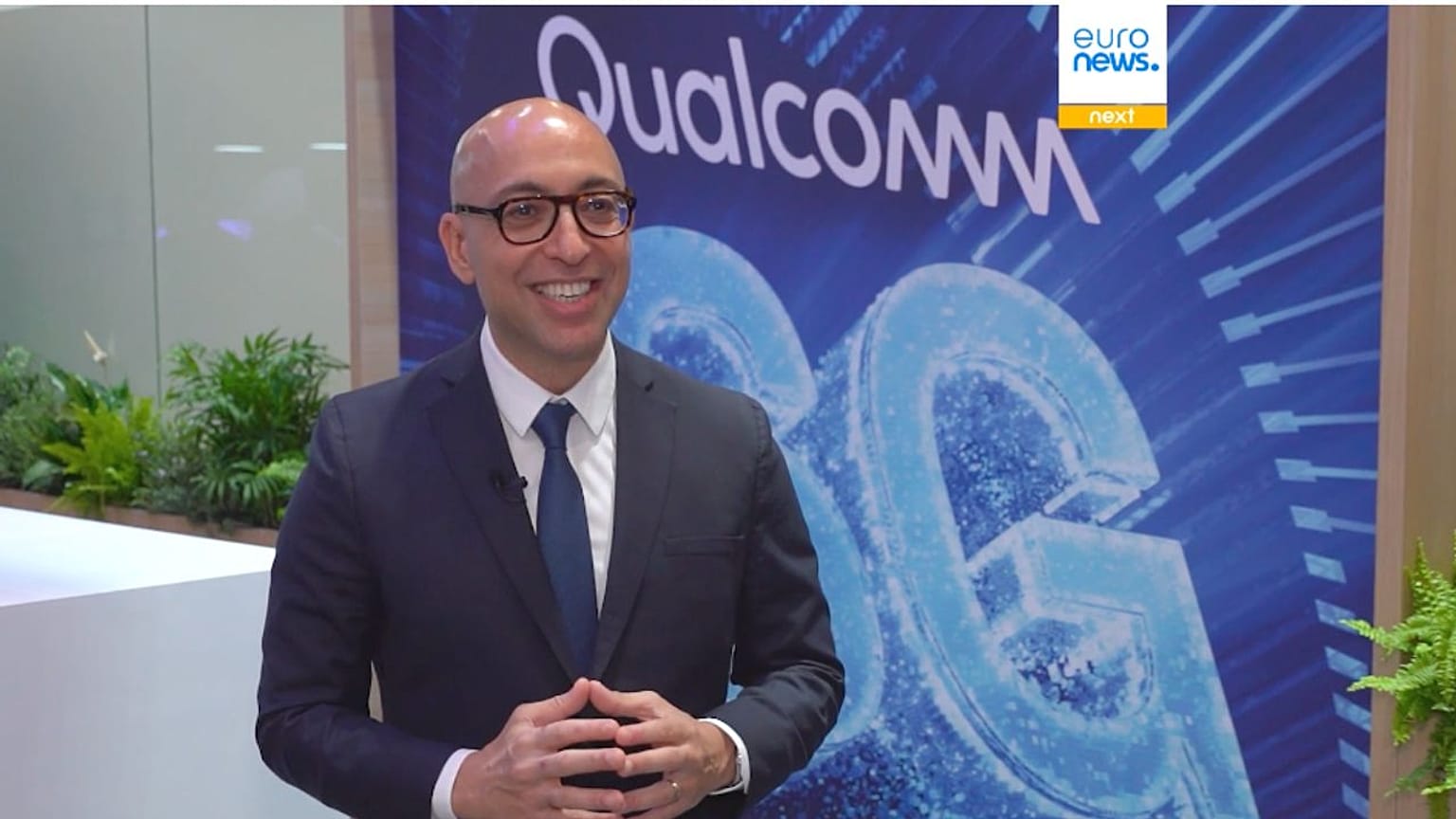














"6G is not an evolution, it's a revolution," Qualcomm's Wassim Chourbaji tells Euronews Next at the Mobile World Congress.
Semiconductor giant Qualcomm has set an ambitious 2029 date for 6G commercialisation and says the next generation of wireless is a “revolution, not an evolution,” that Europe should lead.
 ADVERTISEMENT
ADVERTISEMENT
ADVERTISEMENT
The tech company aims for 6G pre-commercial deployments beginning as early as 2028, which will be key to artificial intelligence, connectivity, and high-performance computing taking off.
"6G is not an evolution, it's a revolution, and Europe should be completely a leading continent on 6G," said Wassim Chourbaji, Qualcomm's president for the Middle East and Africa and senior vice president for government affairs for Europe, the Middle East and Africa.
Speaking to Euronews Next at the Mobile World Congress (MWC) tech fair in Barcelona, he said Qualcomm is positioning 6G as a platform for physical AI, the next wave of AI that interacts with the physical world, such as robotics and smart glasses.
Giving the example of smart glasses, he said that the video streams need to go back to the data centre, to the network to be processed and tokenised. For that, “you need a big upload and that's something 6G will enable,” he said.
Another benefit of 6G is that it introduces sensing capabilities so objects can be detected and tracked, such as cars or drones, which he said was “super important” for national security applications.
Qualcomm announced at MWC a new coalition aimed at accelerating 6G development, drawing in several European partners, including Nokia and Ericsson, as well as US companies Amazon, Google and Microsoft.
On the issue of Europe’s AI sovereignty, Chourbaji argued for a so-called “hybrid AI” model that would distribute computing across devices, edge networks, and the cloud.
'Europe can be a leader'
But he said that the AI must speak your own language and culture.
"When you're engaging today with your device, with AI, the computer understands you, speaks your language. You need to integrate large language models that are local by nature, that understand your culture," he said.
These locally embedded models will represent a practical and tangible layer of digital sovereignty, not just a policy ambition.
"We are supporting and working very hard with European governments and European industries to partner on sovereignty layers," Chourbaji said.
Qualcomm's European footprint spans R&D and engineering operations in Germany, France, Ireland, Spain, Italy, and Sweden, which the company says positions it as a natural partner for the continent's digital transformation ambitions across automotive, industrial, and defence sectors.
Though the US-based company is multinational, Europe is a key market and one with a strong history of manufacturing.
"Europe has great assets, precise manufacturing, critical infrastructure, defence, automotive and smart transportation,” he said.
“Bringing those capabilities together with 6G technology and AI, I do believe that Europe can be a leader."