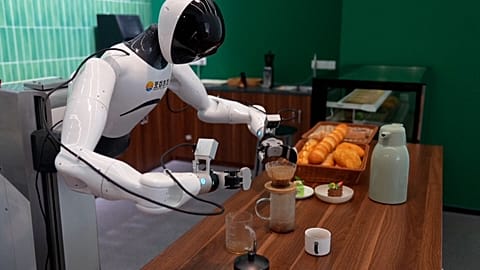





























Chinese firms like Unitree and Agibot are dominating the global robotics market.
Germany’s Chancellor Friedrich Merz was treated to a live display of humanoid robots dancing, doing backflips and boxing in Hangzhou in western China in February.
 ADVERTISEMENT
ADVERTISEMENT
ADVERTISEMENT
On his return, Merz said Germany was “simply no longer productive enough.”
The fact that humanoid robots took centre stage at the Chinese New Year celebrations showcased China’s dominance of the market at the beginning of 2026, with Hangzhou-based Unitree dominating innovation in the sector. Some 87 percent of all humanoid robots that were delivered in 2025 were made in China.
But while Unitree’s humanoid robots have attracted a lot of column inches, and eyeballs, the actual amount of robots shipped by global manufacturers is relatively modest: just over 13,000 were sold last year. Unitree is in second place,with more than 4,000 below Agibot with over 5,000. (5,168), Forbes reported.
That has not stopped investors pouring money into the sector: Barclays research in January 2026 found that the global humanoid robotics market, currently worth $2-3 billion, could reach $200 billion by 2035. It is suggested that Europe may hold a competitive edge in the supply chain due to its historical strength in engineering and automotive manufacturing.
Europe’s fight
Those in the sector aren’t so sure: Rodion Shishkov, founder of European physical AI and robotics company All3, told Euronews Next that the amount of capital available to robotics startups in Europe is a fraction of that available in the United States and China. As a result, his startup is fighting for fuel while his Chinese and American rivals have plenty in the tank.
“Here in Europe I have to fight - and I mean, literally, fight - for tens of millions of euros of investment while a similarly-positioned, similarly-developed company in the United States can obtain billions of dollars with the same effort,” Shishkov told Euronews Next.
The shortfall is even more acute, Shishkov said, because the kind of functional non-humanoid robots that All3 is developing for use on European construction projects right now are playing second fiddle - funding-wise - to much-hyped humanoid startups. This despite the fact that in many use cases- humanoid startups are far less efficient.
“You need to think of function first. If there is a huge hole to be dug, we don’t need a humanoid robot with a spade, we need an excavator. If there is a self-driving car, do we need a humanoid robot driving it, no. We need to stop starting with the shape and start with the function,” he said.
Andrei Danescu, CEO of autonomous robot and AI logistics startup Dexory, said that Merz’s trip to China “risks framing a very serious technology race as a beauty contest. The question is not whether a robot walks on two legs, it's whether it solves a real problem.
He cited collaborative arms on factory floors, autonomous logistics vehicles in warehouses, or surgical assistants in operating theatres as examples of robots that were already reshaping industries in Europe. but Danescu warned that Europe should not be complacent about Chinese investment in robotics.
The robot supply chain
“China is making serious, sustained investments across the full robotics stack, hardware, software, manufacturing integration, and other regions are moving with real urgency too. This is not a moment for complacency, for bureaucratic stillness,” he said.
Europe's robotics ecosystem is small but strong, in precision engineering, in industrial automation, in some critical applications. But strength is not the same as momentum.”
Danescu called for European regulators to provide speed-enablement and clarity on standards, on liability frameworks for autonomous systems and on public investment that matches the strategic ambition of other global players.
“The AI Act is a start, but robotics needs its own focused attention - policy, funding, strategy. We cannot regulate our way to competitiveness, but we can certainly regulate our way out of it,” he said.
Sam Baker spent a decade working with robots in industrial manufacturing settings before joining venture capital firm Planet A as an investor. He said one of the major challenges he encountered - and which is still ongoing today - is integrating robots into established workflows in industries like construction, where they need to operate alongside human employees.
In that, he said, the biggest bottleneck is safety.
“Not a lot of people are talking about itboth from a regulatory perspective and a standards perspective. How do you deploy this kind of automation - whether that is humanoids or bipedals or co-bots - that have industrial levels of strength amongst humans,” he told Euronews Next.
“There's nothing written right now that tells you exactly how you need to do it and what your safety concept needs to look like.”
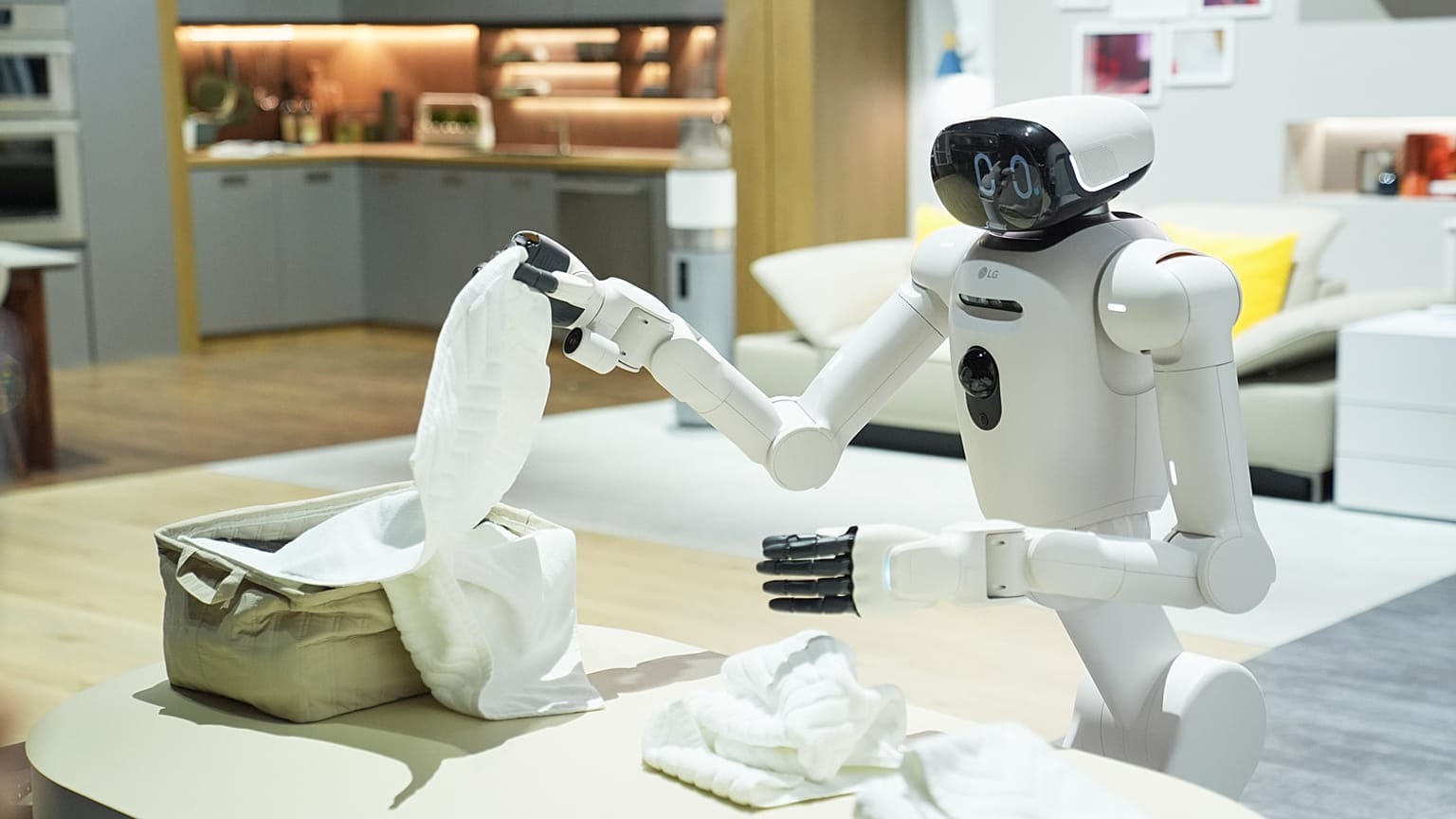
Some companies are already trialling non-humanoid robots in factory settings: BMW recently announced that it will trial humanoid robots at one of its factories in Leipzig in Germany. In a press release, the automaker said the robots would be integrated into existing production lines and could also be utilised to develop batteries and components.
The move has raised eyebrows in robotics circles, but Baker believes it is likely the right approach.
“They're not going in and saying: ‘We've definitely got this use case where we can generate this much ROI and speed up this process by X.’ They're saying: ‘OK, here's something that seems like it could work with this kind of form factor. Let's give it a shot and see what happens,” he said.
As for competition with China, Baker thinks that in terms of hardware, that ship has sailed.
“We would be naive to think that we can really achieve sovereignty and independence from Chinese hardware supply chains in robotics,” Baker said.
“I think it is an excellent time to build a robotics business in Europe. There's just a lot of white space to be filled on the intelligence and data side. And there's a lot of room for experimentation, which doesn't have to be very expensive.”