




























EU-Russia tensions collide with decades of scientific cooperation at ITER, the world’s largest nuclear fusion experiment. As fusion becomes a strategic EU priority, Brussels faces a dilemma over its continued reliance on Russian expertise and technology.
The European Union and Russia are geopolitical adversaries, with Russia under sweeping EU sanctions and its ties with the bloc severely curtailed.
 ADVERTISEMENT
ADVERTISEMENT
ADVERTISEMENT
Yet inside one of the largest international scientific collaborations in history — and the world’s largest nuclear fusion experiment — the two remain linked by a partnership forged decades ago and built to endure for generations.
While Brussels steps up pressure on Moscow over its war in Ukraine and hybrid attacks, Russian engineers and their European counterparts continue to work together on an international project called the “International Thermonuclear Experimental Reactor” (ITER), an experimental nuclear fusion machine that seeks to harness the fusion of hydrogen nuclei to generate vast amounts of energy.
Last Monday, the EU’s Energy Commissioner Dan Jørgensen visited ITER in Cadarache, France, calling the fusion device “key for our decarbonisation and energy independence goals.”
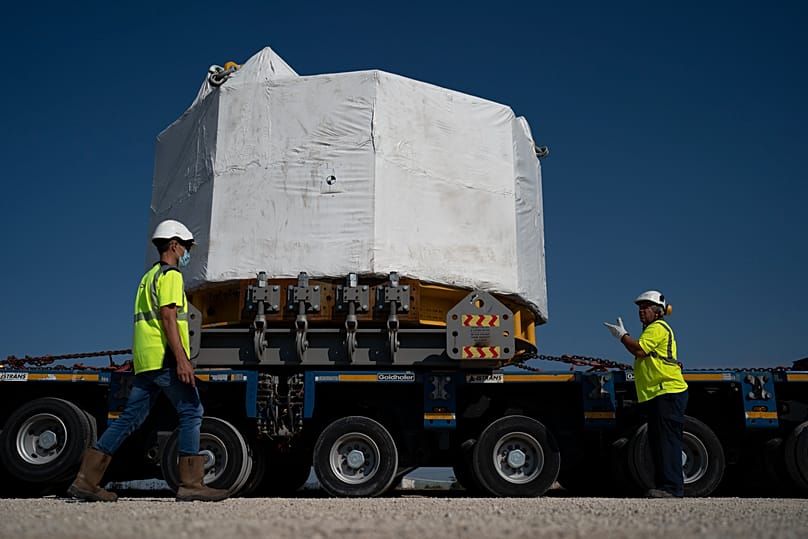
PF1 poloidal field coil and gyrotrons
Launched in 2007, ITER is a fusion machine currently under construction and the result of a collaboration among 33 nations, including Russia, China, the United States and the European Union.
The project aims to demonstrate the potential of fusion as a viable low-carbon energy source, which could contribute to the EU’s goal of achieving climate neutrality by 2050. According to ITER’s website, Europe bears “the largest portion of construction costs,” accounting for 45.6 percent.
However, while Brussels has steadily reduced its dependency on Russian energy, excluded Russian public institutions out of EU research cooperation and funding and banned Russian funding to European research organisations in response to Russia's invasion of Ukraine, Russia has never been expelled from ITER, whose rules stipulate that no member can be removed.
Instead, Russia remains a 9.1% contributor to the project and the country still provides crucial scientists and technology.
"The Russian Federation is an ITER member and participates through its Domestic Agency, Project Center ITER,” an ITER spokesperson told Euronews. “All ITER-related activities are conducted in accordance with the applicable legal and regulatory requirements.”
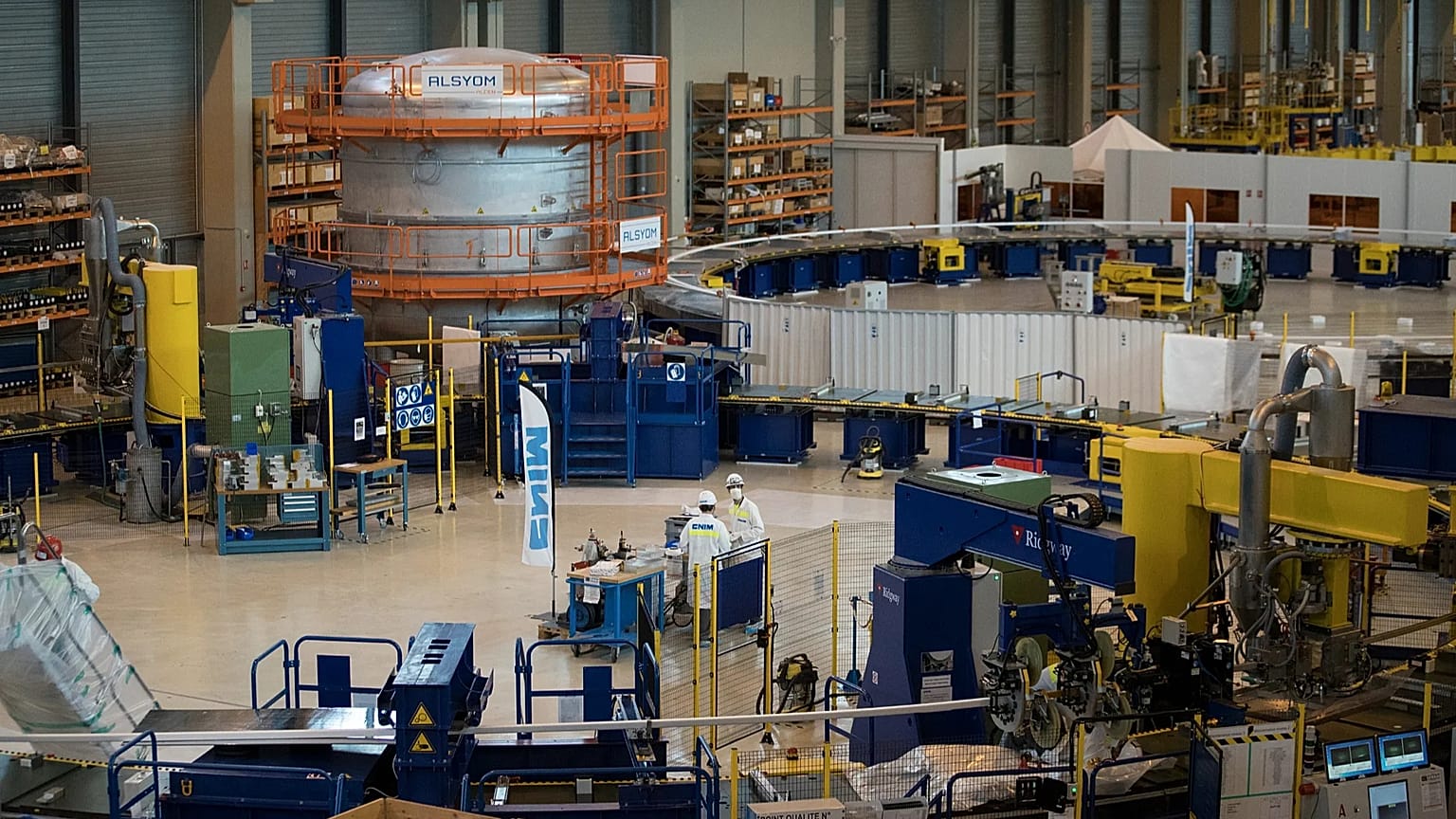
Beyond financing, Russia plays a crucial role in supplying a range of highly specialised components, including the PF1 poloidal field coil, which is used to shape and control the fusion plasma.
It also provides gyrotrons, which are powerful devices that generate high-frequency electromagnetic waves used to heat plasma in fusion reactors. Other components include “equipment supporting the power supply protection of the superconducting magnets,” and “vacuum vessel upper ports,” according to the spokesperson.
A major EU investment
Russia’s contribution takes on added significance as nuclear fusion has become a major EU investment priority. Brussels is set to unveil its own fusion strategy, after recently announcing €330 million to accelerate the sector and support nuclear technologies and skills.
The strategy, which has been delayed by one year, is expected to address governance, regulatory clarity and international cooperation with Europe’s central role in ITER at its core. Asked whether Russia’s participation in the ITER nuclear fusion programme had caused diplomatic delays among member states in reaching agreement on the future of the strategy, the European Commission has yet to respond.
But a Council document assessing nuclear energy, including ITER, dated 9 July and seen by Euronews carefully avoided any reference to Russia.
Instead, it made clear that the EU shall “continue collaboration with the ITER Organisation and partners on ITER-related activities.”
Russia’s Science Minister visits ITER
Since Russia’s full-scale invasion of Ukraine, the EU suspended Russia’s participation in flagship research programs like Horizon Europe, Horizon 2020 as well as Euratom and Erasmus Plus.
Other major European scientific institutions like the world-renowned physics research center CERN suspended Russia’s Observer status in 2022 and made clear it would “not engage in new collaborations with the Russian Federation.”
But despite the broader freeze in scientific ties, ITER signed a cooperation agreement in June with Russia’s Kurchatov Institute covering scientific information exchange, research programs and training.
Russian and European officials have also continued high-level contacts around the project. In July, Russian Science Minister Valery Falkov visited the ITER site in France, accompanied by a large delegation.
Supporters of ITER’s collaboration with Russia argue that the project is a decades-long endeavour requiring specialised knowledge, huge industrial supply chains and international collaboration. In addition, the project was designed on the assumption that scientific cooperation could survive political changes.
"The poloidal field coil system, for example, includes contributions from Europe, Russia and China, requiring components and technologies from different national supply chains to be integrated into a single machine system," ITER's spokesperson said.
Alongside their commitment to ITER, several countries are conducting national initiatives to develop the knowledge and technologies needed to operate nuclear fusion systems over the next two decades.
Recent research from the European Parliament suggests that progress in technological development since ITER's foundation in 2007 "might pave the way for the technology to be ready for industrial use in the second half of the century".
Science can’t 'trump geopolitics'
But the issue of the EU’s reliance on Russia over nuclear fusion and ITER has raised concerns in Brussels.
In 2025, three MEPs asked EU Commissioner Jørgensen in a written question whether the EU plans to “phase-out dependence on Russian participation in ITER.”
In a public letter, Jørgensen replied that ITER's founding rules don't allow members to be kicked out, only for members to withdraw voluntarily.
For Andrea Wechsler, one of the signatories of the letter, the Commission's response "did not provide a convincing political strategy for dealing with Russia's continued participation in the governance and technological ecosystem of ITER."
"I believe the Commission should reassess the issue and explain how these new forms of institutional cooperation are consistent with the EU's broader policy towards Russia," she told Euronews. "We need a comprehensive security and strategic review of Russia's involvement in ITER and a clear plan to ensure that no new technological dependencies are created."
The concern is also shared by some NGOs. Sehila Gonzalez de Vicente, global director of fusion energy at climate NGO Clean Air Task Force, argued that international cooperation has been central to fusion energy's progress, but that may no longer occur on the same global scale.
"(Scientific) collaboration is likely to become more concentrated among trusted allies and partners, while countries and companies seek to protect commercially sensitive technologies and maintain a competitive advantage in the emerging fusion industry," Gonzalez de Vicente told Euronews.
While Wechsler said she opposes the “isolation of Russian researchers, students or scientists”, she maintained that the scientific nature of strategic technology cooperation should not make it geopolitically neutral.
"I would not interpret the continuation of the project as evidence of a consensus that science should simply trump geopolitics," she added.
The European Commission didn't reply to a Euronews request in time for publication.