


















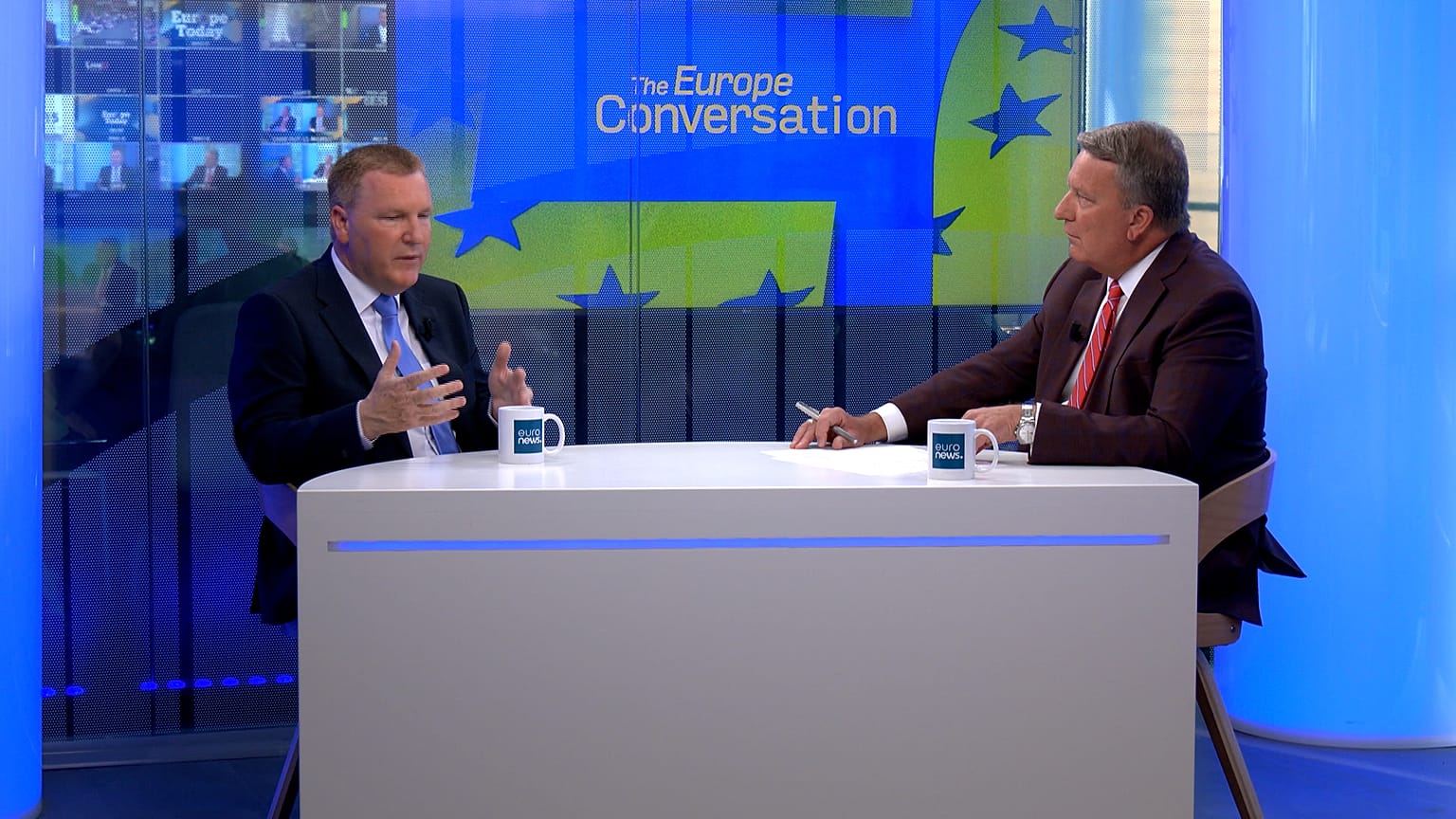














In a wide-ranging interview with Euronews, the EU Justice Commissioner dampened hopes that the frozen Hungarian EU funds could be disbursed any time soon.
Hungary's new government should push through reforms, including on the rule of law, for its own good and to benefit its citizens, not just to unlock frozen EU funds, Michael McGrath, the EU’s Commissioner for Democracy, Justice and the Rule of Law, told Euronews.
 ADVERTISEMENT
ADVERTISEMENT
ADVERTISEMENT
The country's Prime Minister Péter Magyar will meet European Commission President Ursula von der Leyen on Friday. He is seeking to unlock €10 billion in recovery funds, blocked over longstanding concerns about judicial independence, corruption and democratic backsliding during former leader Viktor Orbán’s years in power, ahead of an August deadline.
McGrath stressed, however, that implementing reforms is not merely about satisfying Brussels but about restoring rights and opportunities for Hungarians themselves.
“It's not that they need to do this for the EU. They need to do this for themselves and for the Hungarian people so that they can enjoy the rights and benefits and freedoms and privileges that European Union membership confers on people,” he said on Euronews' flagship programme The Europe Conversation.
He specifically cited Hungarian students who lost access to parts of the EU’s Erasmus exchange program because of governance concerns linked to public foundations established under the previous government.
“The sooner we can fix these things, the better, so that the life experience of ordinary Hungarian citizens is improved. That is what this is all about,” the commissioner noted.
Complex path ahead
McGrath said Brussels is ready to support Hungary’s new government in its transition to introducing the necessary reforms. He did, however, caution that restoring full rule-of-law standards will take time.
“There will be challenges for sure, and there will be complexity, and it’s not possible to do everything overnight,” he said.
“What is important is that we see a sustained commitment to the rule of law and to introducing the necessary reforms in Hungary, and indeed undoing some of what was done in recent years.”
The comments come after the election victory of Prime Minister Péter Magyar, whose government has pledged to repair relations with Brussels and reverse key elements of Orbán-era governance that repeatedly put Hungary at odds with the European Union.
Under Orbán and his party, Fidesz, who were in power from 1998 to 2002 and from 2010 to 2026, Hungary was repeatedly accused by the European Commission, the European Parliament, and international watchdogs of democratic backsliding and erosion of the rule of law.
This included concerns over judicial independence, media and academic freedom, corruption, public procurement and minority and LGBTQ rights.
McGrath said the Commission is encouraged by the new government’s engagement with Brussels, pointing to ongoing high-level contacts. He himself is travelling to Budapest next week to meet Márta Görög, the country’s justice minister.
“Good progress is being made, and we will support Hungary on their path to restoring the rule of law in the interests of its citizens,” McGrath said.
Inevitable turnover
The transition, however, is already raising constitutional and political tensions inside Hungary.
Magyar has publicly called on several senior officeholders appointed during the Orbán era, including the country’s president, to resign, and has threatened constitutional changes if they refuse.
Asked whether such pressure was legitimate, McGrath said political turnover after a dramatic electoral shift was unavoidable, but emphasised that due process and individual rights must be respected.
“It is inevitable when you have such a seismic change in the political landscape of a country that there will be personnel changes,” he said.
“What is important is that due process is always followed and that the rights of every individual citizen, including those serving in public office, are respected.”
He added that the Commission is closely monitoring developments in Hungary as part of its broader annual rule-of-law review covering all EU member states. The next report is expected in July.
The new Hungarian government is also considering constitutional amendments that would limit future prime ministers to two terms — a move widely seen as aimed at preventing Orbán from returning to power.
But the commissioner declined to comment directly on the proposal, saying electoral rules and constitutional arrangements remain primarily a national matter.
“When it comes to electoral politics and the conduct of elections, it is a national competence,” the commissioner said. “We respect the competence of member states to make decisions of that nature.”
Hungary’s political transformation is being watched closely across Europe as a test case for whether democratic institutions weakened during years of populist rule can be rebuilt from within — and how quickly Brussels is prepared to reward reform with restored funding and political support.