

















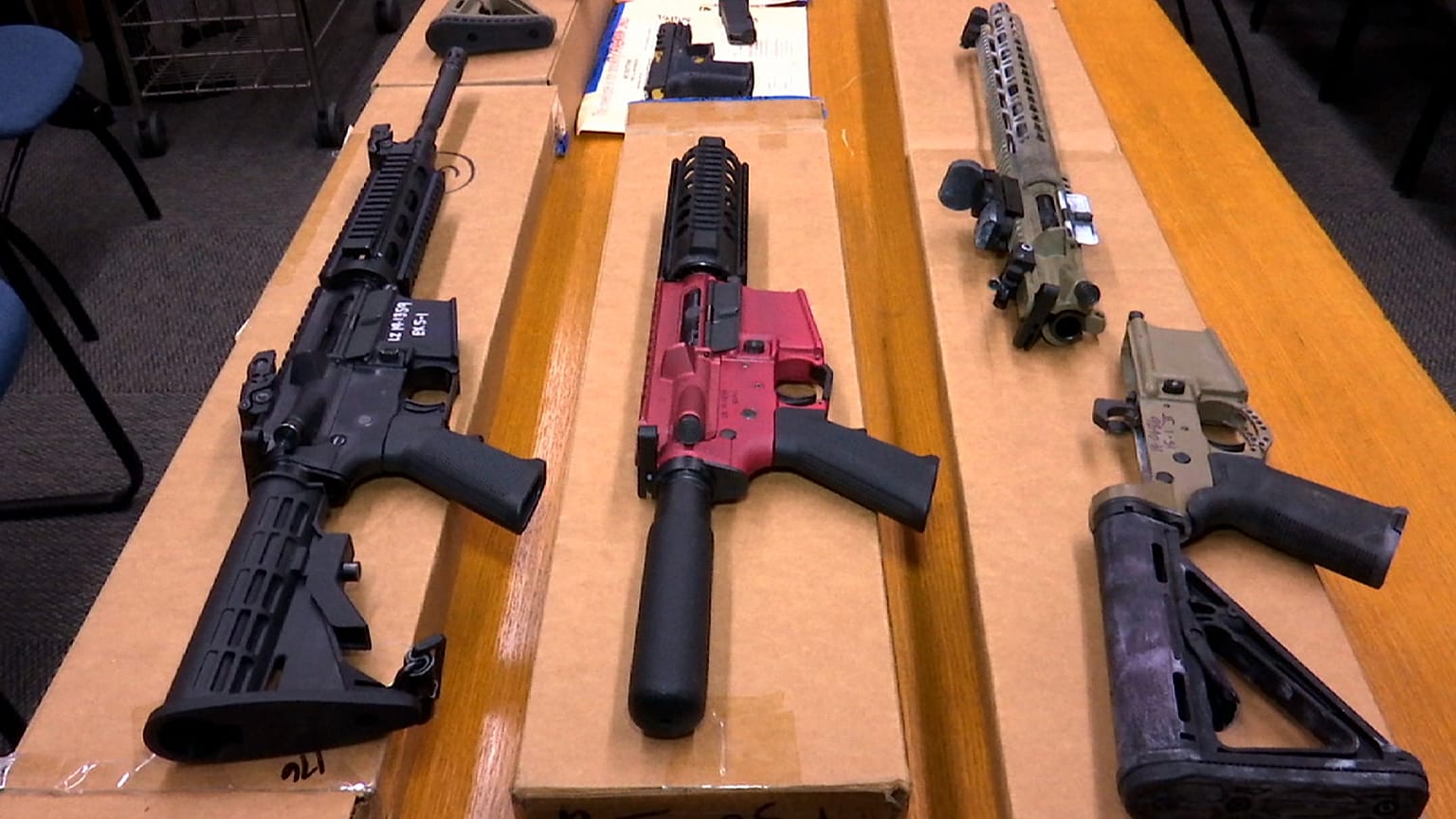














New technologies and conflicts can lead to a surge of illicit firearms reaching the EU. The Commission argues this new directive is well-timed to prepare the bloc.
The possession, manufacture and trafficking of illicit firearms could soon carry prison sentences ranging from two to eight years across the entire European Union, under a new proposal unveiled by the European Commission on Thursday.
 ADVERTISEMENT
ADVERTISEMENT
ADVERTISEMENT
The draft directive presented by the EU executive in Brussels plans to harmonise how firearms-related offences are defined and punished across the 27 member states. It argues that the divergent national rules have created loopholes that criminal networks exploit when operating across borders.
The creation, acquisition, possession or dissemination of 3D-printed firearm blueprints would for instance carry a maximum prison sentence of at least two years; the possession of illicit firearms and their essential components would carry a five-year jail term; while trafficking and manufacturing offences would be punishable by eight years behind bars.
According to the Commission, some 620,000 firearms are currently lost or stolen across the EU fuelling terrorism, organised crime and gang violence. About 1,300 lives are stolen annually by firearms violence across the 27 member states.
The Commission warns that the threat is evolving rapidly, driven in part by technological developments such as 3D printing and by weapons flows linked to conflicts and instability beyond the EU’s borders. These dynamics, it says, require a more coordinated and forward-looking response.
Magnus Brunner, the commissioner for internal affairs and migration, told reporters the EU needs to get ready because "there are a lot of wars going on".
"We have to prepare (for) what happens with the weapons, with the illegal weapons afterwards," he said, citing Russia's ongoing full-scale invasion of Ukraine and efforts to bring a war to an end.
"We see the evidence from former wars, like let's have a look at the Yugoslav war 30 years ago as we still find weapons there, or the police still find weapons there from that war, so that shows that is really a problem we have to tackle," he said.
The inclusion of 3D-printing blueprints reflects growing concern among security officials that digital files can be shared and reproduced with relative ease, enabling the covert production of untraceable weapons. By criminalising the illicit handling of such blueprints, the Commission hopes to close what it sees as a gap in existing legislation.
Commission Executive Vice-PresidentHenna Virkkunen, responsible for Tech Sovereignty, Security and Democracy, emphasised also that "strong enforcement of the Digital Services Act is also very key to tackling illegal weapons online."
"We are in fact proceeding at full speed on this front. Just last week we also opened formal investigations on Shein and their systems to limit the sale of illegal products," she said, adding that some weapons such as knuckle dusters were among the illegal items the EU executive detected on the platform.
Beyond penalties, the directive seeks to strengthen operational cooperation between member states. Each country would be required to establish a National Firearms Focal Point to coordinate investigations, facilitate the tracing and seizure of trafficked weapons, and serve as a contact point for cooperation at international level.
The Commission is also proposing new measures to improve data collection and criminal analysis. Member States would have to record a minimum dataset for firearms seized by law enforcement, including basic details such as model and type, in order to better estimate the scale of illicit trafficking and identify trends, such as the entry of decommissioned weapons from conflict zones.
In addition, governments would be required to compile and share statistical data every five years on investigations, prosecutions, convictions and penalties related to firearms offences. According to the Commission, this will provide a clearer EU-wide threat picture and enhance monitoring and public awareness.
The proposal now moves to the European Parliament and the Council for negotiation.