




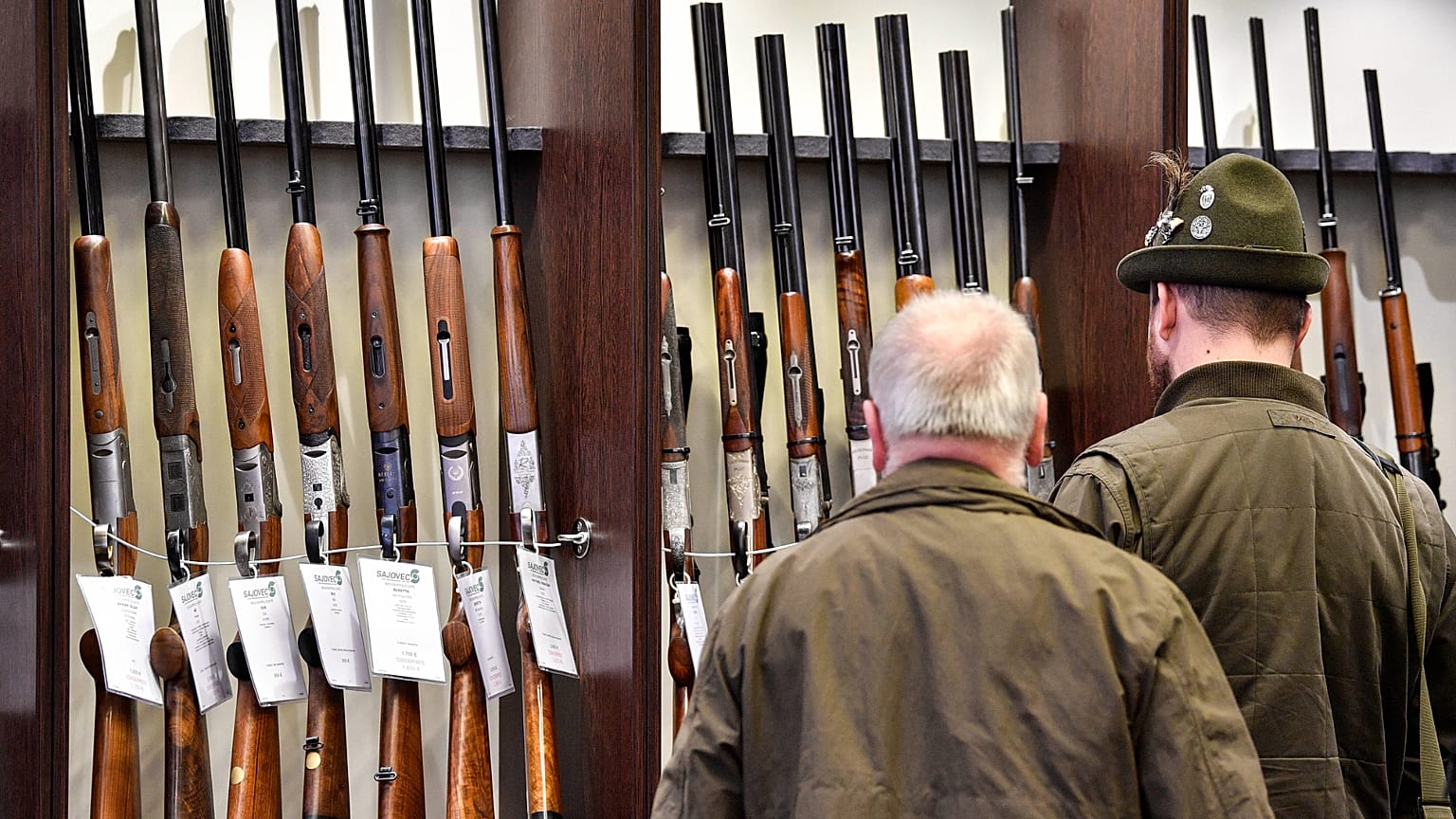













Europe doesn’t have a strong “gun culture,” but maintains strict regulations. Still, as a major global producer and exporter of weapons, the regulation of ownership, licensing and enforcement remains the responsibility of individual EU countries.
With the 2026 Munich Security Conference taking place on Friday, 13, and Europe's ongoing efforts to produce ammunition and achieve defence industrial autonomy, its gun industry takes centre stage.
 ADVERTISEMENT
ADVERTISEMENT
ADVERTISEMENT
EU leaders are set to debate the need for permanent, Europe-based production of essential weapons and munitions. But a production increase brings new risks. Exporting firearms in the bloc involves a complex interplay between EU-wide rules and sovereign national regulations, creating loopholes that raise security doubts.
Without public oversight, weapons can be sent to "neutral" third countries with weak regulations, which then re-export them to conflict zones.
Within the EU’s borders, countries deal with the emergence of “ghost guns”: non-traditional firearms, specifically 3D-printed guns (3DPFs) and "80% lowers”, made from isolated parts. In 2019, the Halle Synagogue attack saw a man kill two people with a 3D-printed gun.
In parallel with the Munich Security Conference, the Global Initiative Against Transnational Organised Crime (GI-TOC) will host discussions on the growing appearance of smuggling networks, many of which traffic firearms, and measures to counter hybrid attacks that often utilise illicit weapons or small-scale weaponry to destabilise European security.
A patchwork of EU and national regulations
The EU’s regulatory framework restricts civilian gun ownership and sets minimum standards for gun circulation within the single market. The rules define permitted types, technical standards, traceability requirements, movement within the EU, and procedures for import, export, and transit with non-EU countries. However, these standards are not supranational, so most firearms policy is still decided by individual member states.
The European Commission first proposed the Firearms Directive in 1991 to integrate firearms into the single market while safeguarding public safety. In 2015, the EU updated and tightened EU-wide weapon controls following the Paris terrorist attacks, introducing common standards to ensure deactivated firearms stayed inoperable.
A further update in 2021 brought in new rules for traceability, improved cross-border information systems and bans on certain semi-automatic firearms for civilians. Enforcement, however, still varies by country, largely depending on available resources and cyber-investigation capabilities.
Three-dimensional printed firearms are a growing political concern. While the 2021 revision of the Directive makes these weapons illegal, it does not clearly ban owning or sharing digital blueprints. This gap lets traffickers exploit differences in national laws.
With no follow-up legislation included in the 2020-2025 EU Action Plan, the European Parliament warned of a decline in firearms traceability and urged the Commission to regulate these increasingly dangerous so-called "silent weapons”. A revision of the Firearms Directive is expected by 2026.
Brussels’ planned recast of the Firearm Directive, the ongoing implementation of the 2020-2025 EU Action Plan on firearms trafficking, and the Parliament and Council’s 2025 regulation to close loopholes in firearms trade show the EU’s ongoing efforts to tighten the EU-wide rulebook.
The Commission also plans to introduce a central, secure electronic licensing system between 2027 and 2029 to improve weapon traceability and help member states share information on denied authorisations. Separately, discussions are underway on broader restrictions on the use of lead in hunting, sports shooting and other outdoor activities.
Lobby groups, major gun makers, and gun owners in countries with stronger gun cultures, like Sweden or the Czech Republic, have opposed more EU regulation.
They argue that stricter rules limit legitimate civilian use and hurt national traditions. The Czech Republic had already filed complaints about excessive EU gun restrictions in 2017.
Owning a gun in the EU: where is it legal?
Under the EU Firearms Directive, weapons are divided into three categories.
Category A firearms, such as automatic weapons and certain military-style arms, are banned for civilian use, though all EU member states can grant special authorisations under strict conditions. The Czech Republic is known for the most permissive laws, including permits for concealed carry. Austria, Poland, and Finland are also among the least restrictive
Category B firearms, including most handguns and semi-automatic rifles, are restricted and need individual authorisation.
Category C firearms, mainly hunting rifles and shotguns, are allowed but must be registered, especially in countries with strong hunting traditions like Finland and Sweden.
Semi-automatic weapons are only legal within certain limits, and deactivated firearms must meet EU standards. Replicas and imitation firearms are usually not covered by EU law, so national authorities regulate them. This is why they are strictly controlled in countries like the United Kingdom but widely sold under consumer laws elsewhere.
Gun ownership is limited to licensed individuals such as hunters, sport shooters, and recognised collectors. All must demonstrate a legitimate purpose, pass background and medical checks, and comply with strict storage and traceability rules. France and Italy have especially structured licensing frameworks.
In practice, national implementation varies. A semi-automatic rifle that is legal for sport shooting in the Czech Republic or Austria may be banned in neighbouring member states.
Regulated nationally, traded across borders.
Gun control in the EU is mostly handled at the national level. Each member state decides how to apply EU rules, license private gun ownership, handle illegal possession, enforce laws and how cultural or institutional rights are protected.
At the same time, the firearms industry operates across borders. Under EU treaties, weapons are treated as goods, allowing licensed manufacturers to sell across the single market.
This creates tension between public security, which falls under national police and constitutional authority, and EU harmonisation.
The result is a hybrid system: Brussels defines baseline rules for production and circulation, but political control over civilian access and enforcement stays national. This structure produces legal and operational gaps, allowing weapons to move legally across borders while oversight remains uneven.
Differences in licensing rules, magazine limits, deactivation standards and export checks have been exploited. For example, civilian firearms bought legally in one country can be trafficked into another, while military weapons exported under national permits may later be misused.
"Ghost guns" made of lone parts
Online sales and cross-border transport further complicate tracking weapons once they leave their country of origin. According to the Europol 2025 Serious and Organised Threat Assessment report, criminal networks are increasingly using e-commerce platforms to sell parts and avoid traditional customs checks.
The result? “Ghost guns”, one of the main issues the EU sought to tackle through their Firearms Directive. These are privately made firearms that lack serial numbers and manufacturer markings, which makes them impossible to trace through traditional registration and tracking systems.
While EU law generally criminalises the possession of such weapons, it does not comprehensively regulate the digital blueprints, online files, or semi-finished components used for their production. Because of this, individuals can legally get 3D-printing design and import unfinished parts that only become illegal once assembled. This loophole, alongside inconsistent enforcement, limited data collection, and cross-border online trade, allows these illegal weapons to enter circulation and remain invisible to the authorities.
Additionally, the tech keeps advancing and making the problem worse: 3D printers and CDC machines have made it even easier and cheaper to produce functional firearms outside of regulated supply chains.
Everybody wants EU guns
Europe's gun industry covers small arms and light weapons (SALW) made for individuals or squads. It does not include heavy equipment like tanks, fighter jets, or ships, which Europe still mostly sources from allies. Currently, 64% of major arms imports to NATO members in Europe come from the US.
In 2025, the EU’s total SALW production was estimated at 4 to 5 million units, including 2.5 to 3 million civilian or sporting firearms and 1.5 to 2 million military or police weapons. Ammunition production rose sharply, with manufacture of artillery rounds reaching around 2 million, up from 300,000 in 2022. Arms manufacturers expanded their factories by 7 million square metres across 150 facilities, roughly triple the industry’s peacetime rate.
Five main European production hubs account for most of the bloc’s small arms output, underpinning Europe’s position as a major global exporter.
In Italy, Beretta Holding reported €1.668 billion in revenue in 2024. Germany’s Heckler & Koch reported €343.4 million, while Belgium’s FN Browning generated €934 million the same year. Austrian firm Glock reported revenue of €670.32 million in 2024, and the Czech Republic’s Colt CZ Group sold 633.739 firearms in 2024.
These firms are oriented toward global markets. Based on 2024-2025 financial disclosures, the group estimates that 55% to 65% of total revenue comes from exports outside the EU. Their main buyers are the US, Saudi Arabia, the UK, Egypt, and Qatar.
This raises issues with transparency. The European Court of Auditors has warned that “increasingly pacey and complex money flows" in EU defence funding are surpassing existing oversight systems, adding that "audit independence and timeliness" have become a challenge in 2026.