




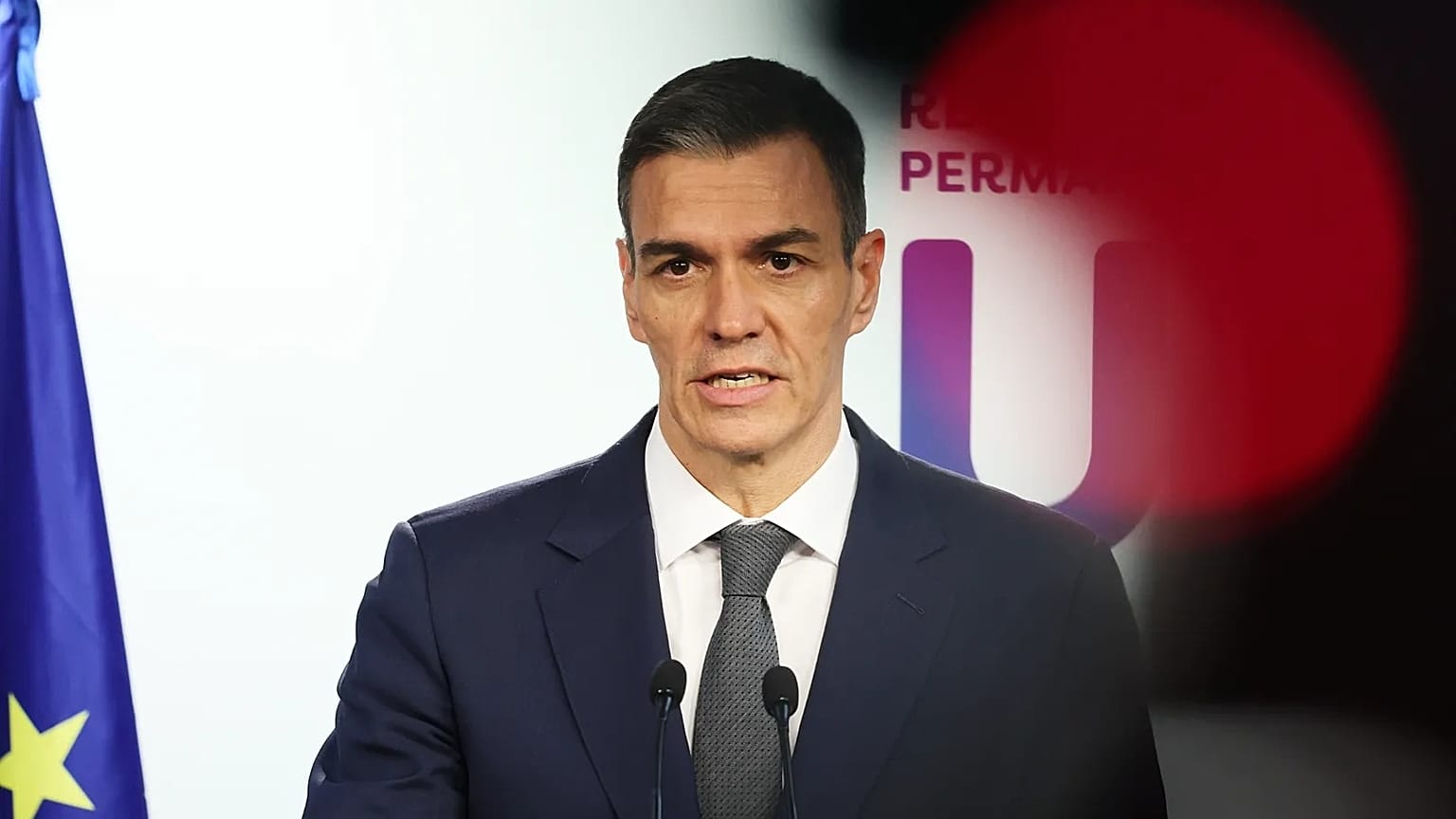














The decision by the Spanish government to provide legal status to about half a million undocumented migrants has raised severe disapproval in Brussels, according to officials who spoke with Euronews on condition of anonymity.
The European Commission has strong reservations about the Spanish government's announcement that it will grant legal status to about 500,000 irregular migrants, three EU officials told Euronews, worried it could conflict with the European Union's current policy.
 ADVERTISEMENT
ADVERTISEMENT
ADVERTISEMENT
The decision was announced at the end of January and affects people who have entered the country before 31 December 2025. To be eligible, undocumented foreigners must have been living in Spain for at least five months, or have asked for asylum before the end of 2025.
The new decree will provide beneficiaries with a one-year residence permit and the right to work in any sector everywhere in Spain, to strengthen the government’s objective of “economic growth and social cohesion”, Migration Minister Elma Saiz told the Spanish public broadcast RTVE at the time.
The move by Prime Minister Pedro Sánchez's government has met with disapproval in Brussels.
“It is not in line with the European Union's spirit on migration,” one of the EU officials told Euronews. Another pointed out that a massive regularisation risks sending a different message compared to the one that the EU is currently communicating outside Europe to deter irregular migration.
According to sources in Brussels, one of the main worries concerns the possibility that with their new status, the regularised migrants would be able to travel across Europe for a maximum of 90 days every 180 days. The worry is that this could result in some people trying to take up residence in other EU countries without permission.
EU Commissioner for Internal Affairs and Migration Magnus Brunner will address the European Parliament on the issue on Tuesday afternoon, during a debate titled "Spain’s large-scale regularisation policy and its impact on the Schengen Area and EU migration policy".
Asked about Spain's decision in January, Brunner offered no judgment, saying that it is a national responsibility.
EU hardens line on migration
Spain's choice seems to be cutting across most other European countries' attempts to reduce access to international protection for non-EU nationals and increase the number of returns to countries of origin.
The EU's latest legislation is also meant to deter illegal migration by adopting a stricter asylum policy in hopes of increasing the expulsion rate of irregular migrants.
The change of the "third safe country" concept expands the range of circumstances under which an asylum application can be rejected as inadmissible, enabling EU states to deport asylum seekers to third countries with which they have no link.
The first list of "safe countries of origin" for the purposes of asylum, which includes Bangladesh, Colombia, Egypt, India, Kosovo, Morocco, and Tunisia plus all the candidate countries to the EU except Ukraine, will speed up the asylum process, as the applications of migrants who are nationals of one of these countries will be assessed in fast-track procedures.
Both these legislative changes are expected to be definitively approved by the Parliament on Tuesday.
Another law proposed by the Commission, called "return regulation", will allow the deportation of irregular migrants to third countries unrelated to their origin as long as they have bilateral agreements in place with EU countries.
A consistent part of the EU Pact on Migration and Asylum, approved during the previous mandate and now being implemented, focuses on border procedures and their digital management, as well as harmonising the same rules for all external Schengen borders.
Civil society organisations, including Amnesty International, Save the Children and Human Rights Watch, have repeatedly condemned the EU for reducing access to asylum and disregarding the protection of human rights in border procedures.