

















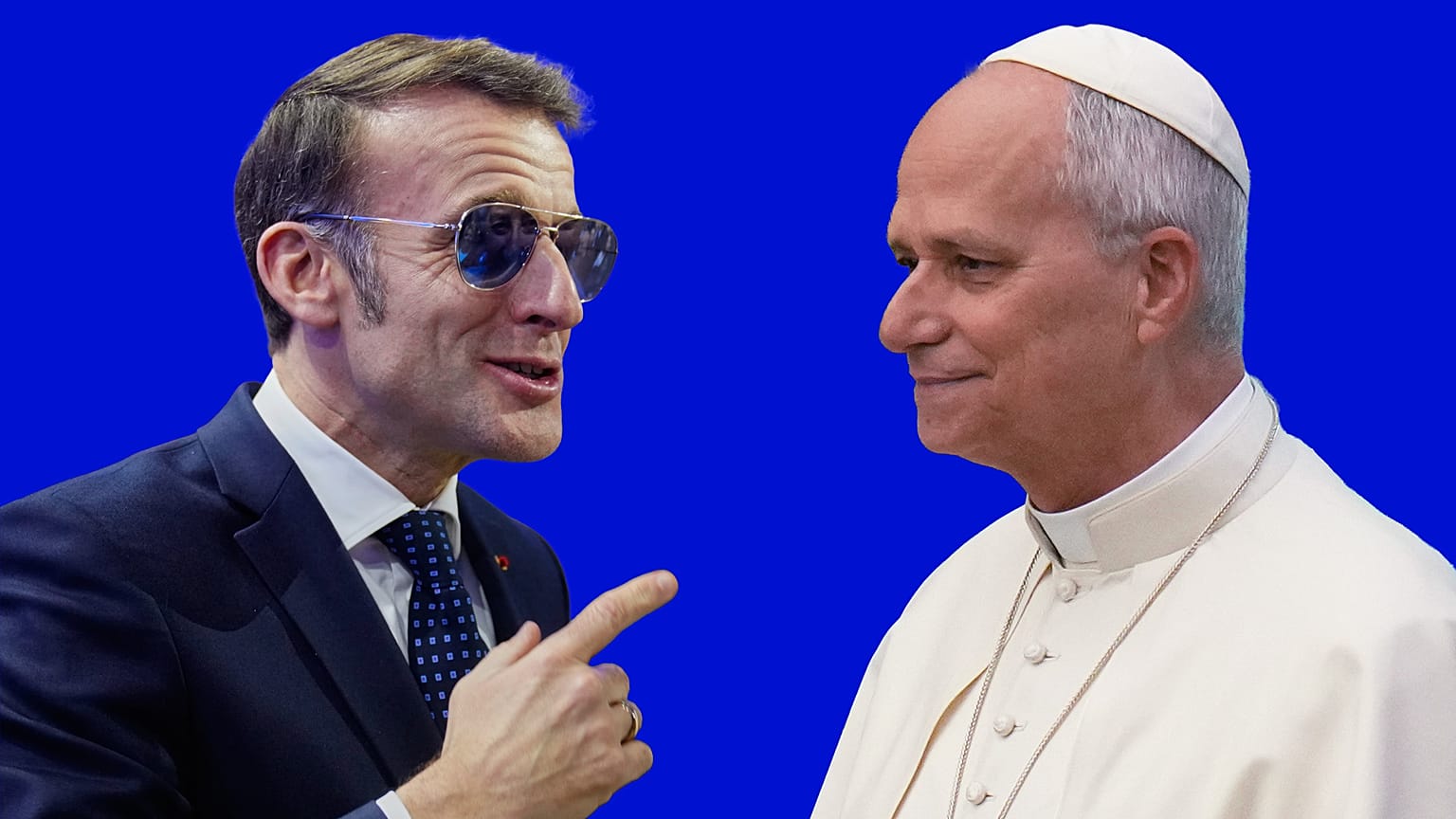














A clash over Notre Dame's windows and a proposed assisted-dying law are among the alleged reasons Pope Leo XIV did not want to see the French president.
Emmanuel Macron went viral last week for the iconic sunglasses he wore at the World Economic Forum in Davos, but the French president was also subject to viral claims of a different kind amid the geopolitics.
 ADVERTISEMENT
ADVERTISEMENT
ADVERTISEMENT
Various posts on X, including some that were seen and shared thousands of times, claimed that Pope Leo XIV cancelled a meeting that he was due to have with Macron in early January, over his disapproval of the Notre-Dame cathedral's new stained-glass windows.
Pope Leo XIV also called the change a "travesty", according to one post, and allegedly criticised a proposed assisted dying law in France, which has since stalled in the Senate amid pushback from conservative and religious groups.
The pope will allegedly remove the archbishop of Paris from his seat in Notre-Dame, because the cathedral is the "property of God" rather than the state, and says the atmosphere between France and the Vatican has become "detestable" and "unhealthy".
Furthermore, the post claimed that Pope Leo XIV is displeased that France has become "anti-American".
However, none of these dramatic and seemingly unrelated claims is true. France's Ministry for Europe and Foreign Affairs clearly rejected the claims in its own post on X, stating that the meeting is still being arranged.
In a tongue-in-cheek response, it said that aligning Pope Leo XIV and the president's agendas "remains one of the greatest mysteries", and that they would get a nice photo out of it when it happens.
The Vatican has said more or less the same thing, explaining that efforts to schedule a meeting are ongoing and that none of the issues raised online are a reason for the delay.
What's the deal with Notre-Dame's windows?
One thing that is true is the controversial nature of Notre-Dame's new stained-glass windows.
Following the 2019 fire that destroyed much of the iconic cathedral, new windows were proposed as part of restoration efforts, designed by Claire Tabouret in a contemporary style.
They share the story of Pentecost, which celebrates the Holy Spirit descending upon the Apostles, Mary, and the first followers of Jesus Christ. The theme was selected by the Archdiocese of Paris
The windows depict biblical events such as a strong wind filling the room where Jesus' followers were gathered, the tongues of fire resting on their heads, and their new, Holy Spirit-given power to speak different languages and spread the Gospel to all nations.
Nevertheless, critics argue that the old windows, designed by 19th-century architect Eugène Viollet-le-Duc, don't need replacing, as the originals survived the fire and only require cleaning and minor restoration efforts.
Others say that removing Viollet-le-Duc's windows undermines the architectural and historical integrity of Notre-Dame. Some have even taken legal action, claiming that replacing intact historical windows violates the Venice Charter, which promotes the preservation of historic monuments.
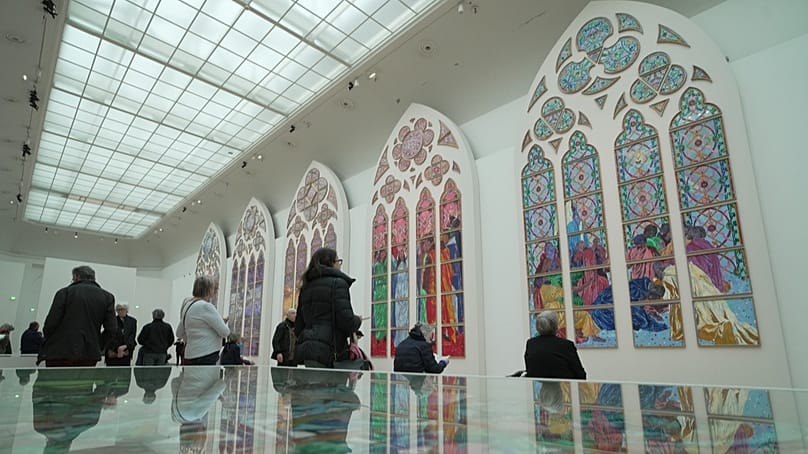
On the other hand, supporters say that the new designs represent Notre-Dame's rebirth and reference traditional biblical stories in a contemporary style, with Tabouret telling the Associated Press that she is aiming for harmony with the works of Viollet-le-Duc.
"One of the requirements that also really stuck with me and made me want to be part of this was that they wanted the work to be figurative and to be understood by everyone without explanation," she said.
"And I think that a great power of figurative painting or art in general is that it can be understood beyond language. And it echoes the theme of Pentecost, where everyone can understand each other despite what language they are speaking."
The six new windows are currently on exhibition at the Grand Palais in Paris before they are moved to decorate the cathedral's nave.
France's assisted dying law
As for the other main issue mentioned in the false X post, a proposed assisted dying bill has indeed caused political deadlock in France.
The French Senate recently rejected Article 4 of the bill, which aimed to define how and when patients could access medically-assisted dying.
Interestingly, both socialists and conservatives voted together to block the bill, with the former criticising a recent amendment that they said undermined the original intent to legalise euthanasia, and the latter seeing the bill as too permissive.
Religious groups have also pushed back against the proposed law, advocating for more palliative care as an alternative to assisted dying.
France's bishops' conference in particular expressed concern over the vote on the law, and Pope Leo XIV gave a sermon to French pilgrims in June, emphasising the value of life "even in its last hour" just weeks after the French National Assembly adopted the bill in its first reading.
The pontiff has not, however, explicitly said anything about the bill and neither has he cancelled a meeting with Macron over it.
With ongoing discussions about safeguards, conscience clauses for healthcare professionals and eligibility conditions, for now, the law's future is uncertain: it will be sent back to the National Assembly for further amendments before returning to the Senate.