




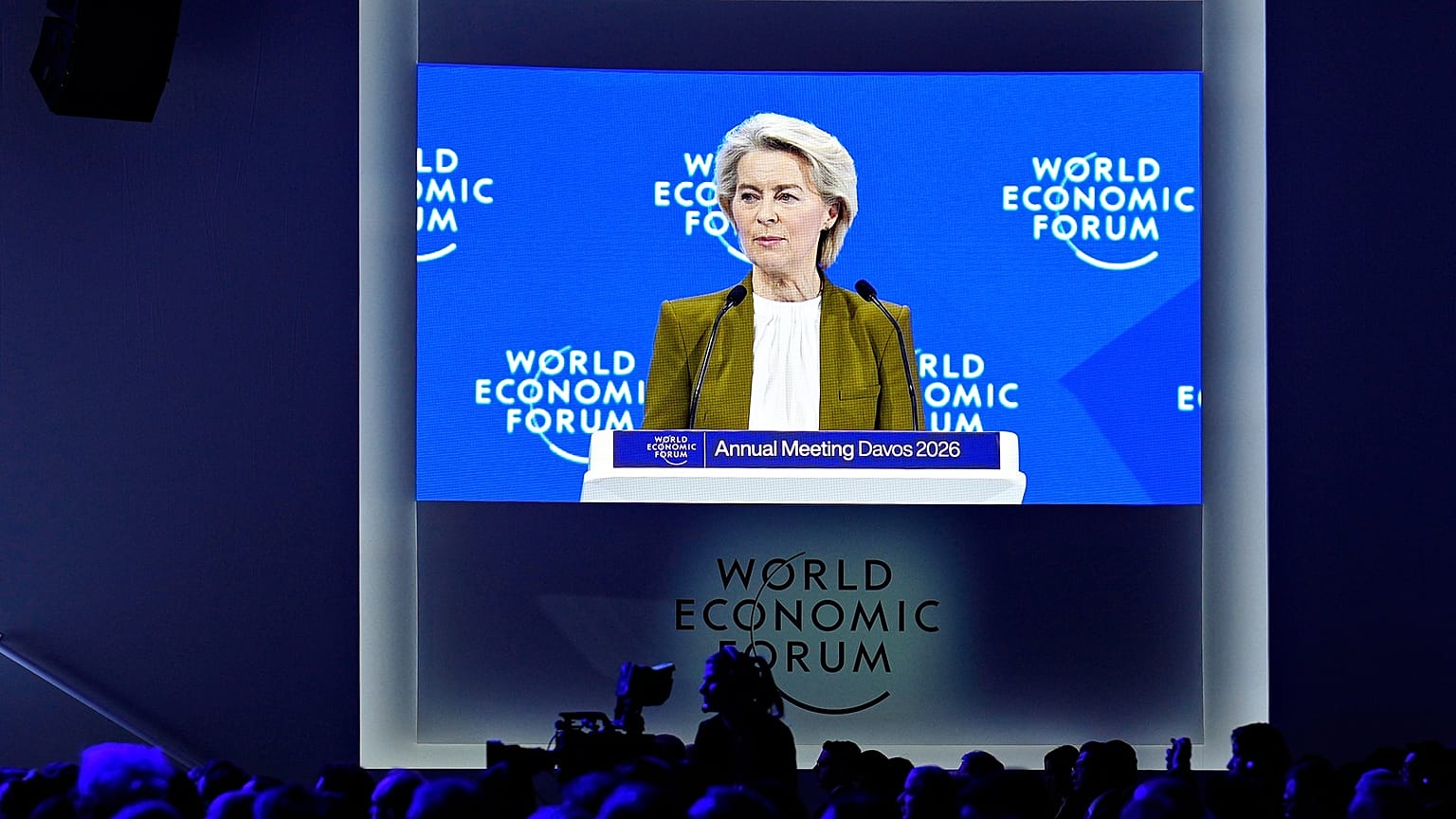













As Donald Trump promotes his expansionist foreign policy, upending the transatlantic alliance along the way, Ursula von der Leyen called on Europe to seize the moment and achieve greater independence.
With the transatlantic alliance on the verge of collapse, European Commission President Ursula von der Leyen stepped onto the main stage of the World Economic Forum in Davos, Switzerland, to make the case for "European independence", arguing the powerful shifts shaking the global order should be treated as a catalyst for good rather than a cataclysm.
 ADVERTISEMENT
ADVERTISEMENT
ADVERTISEMENT
"That geopolitical shocks can – and must – serve as an opportunity for Europe. And in my view, the seismic change we are going through today is an opportunity, in fact, a necessity to build a new form of European independence," she said.
"This need is neither new nor a reaction to recent events. It has been a structural imperative for far longer."
Although this is not the first time von der Leyen has called for greater autonomy, her speech in Davos took on a new meaning against the backdrop of the extraordinary crisis pitting the two sides of the Atlantic against each other.
United States President Donald Trump's threat to impose a 10% tariff on eight European nations, all NATO members, to strong-arm the sale of Greenland, a Danish territory, has upended 80 years of alliance and fuelled serious fears of an irreversible fracture.
Trump's tariffs will kick in on 1 February unless the Europeans, who are betting on diplomacy to de-escalate, can convince him to change his mind.
"We consider the people of the United States not just our allies, but our friends," von der Leyen said, striking a balance between a conciliatory tone and an assertive one.
"Plunging us into a dangerous downward spiral would only aid the very adversaries we are both so committed to keeping out of our strategic landscape. So our response will be unflinching, united and proportional."
Trump has so far shown no signs of giving up on his annexation agenda. Overnight, he posted a digitally altered picture of last year's meeting with European leaders, including von der Leyen, at the White House. In this new version, Trump sits next to a map depicting Greenland, Canada and Venezuela as US territory.
In a back-to-back post, Trump portrayed himself placing the American flag on Greenland, which is described as "US Territory Est. 2026".
The images are yet another reflection of what Trump calls the "Donroe Doctrine", an agenda he has promoted since the successful operation earlier this month that removed President Nicolás Maduro of Venezuela from power and shocked the entire world.
Trump later said the only principle guiding his foreign policy was his "own morality".
In Davos, a picturesque Swiss city traditionally associated with multilateralism and laissez-faire economics, von der Leyen attempted to counter Trump's heavy-handed, unilateralist worldview with her own vision of an independent Europe open to the world.
She hailed the recent free trade deal that the bloc concluded with Mercosur (Brazil, Argentina, Paraguay and Uruguay), which brings together more than 700 million consumers, as proof that a "new Europe is emerging".
"We are choosing fair trade over tariffs. Partnership over isolation. Sustainability over exploitation," she said. "We are serious about de-risking our economies."
More trade deals are in the works with Australia, the Philippines, Thailand, Malaysia, the United Arab Emirates and India, she added.
"Europe wants to do business with the growth centres of today and the economic powerhouses of this century," she said to applause in the room.
"From Latin America to the Indo-Pacific and far beyond, Europe will always choose the world. And the world is ready to choose Europe."
Von der Leyen went on to list a series of initiatives, ongoing and upcoming, to make the EU more attractive to investors, more nimble at scaling up businesses and adopting disruptive technologies, and more self-reliant on energy, security and defence.
At one point in her speech, she admitted that talking about "European independence" was once met with scepticism and reservations, as the abstract concept was often linked to protectionism and isolation. But now, she said, the "unthinkable scale of the change" experienced by the world has fostered a "real consensus" in its favour.
"Europe must speed up its push for independence – from security to economy, from defence to democracy," she said. "The point is that the world has changed permanently. We need to change with it."