




























This week's key events presented by Euronews’ reporters Romane Armangau and Peggy Corlin.
Key diary dates
Monday 1 December
NATO Secretary General Mark Rutte will meet with Denys Shmyhal, Minister of Defence of Ukraine, at NATO Headquarters in Brussels
 ADVERTISEMENT
ADVERTISEMENT
ADVERTISEMENT
Tuesday 2 December
EU Health Ministers council meeting on Critical Medicines Act Wednesday 3 December European Commission proposal of the Environmental Omnibus and the Economic Security doctrine
European Parliament's Committee on Civil Liberties, Justice and Home Affairs (LIBE) votes on migration
Thursday 4 December
EU Transport Ministers council meeting
Friday 5 December
EU Telecommunications Ministers council meeting: Conclusions on European Competitiveness in the Digital Decade
In Spotlight
Good morning, everyone.
Peggy Corlin here reporting from Brussels with your weekly EU policy lookahead.
The European Commission will unveil on Wednesday its long-awaited doctrine on economic security to make the union stronger in a rapidly changing world.
In barely a year, world trade has splintered under nationalist pressures: Donald Trump has slapped heavy tariffs on EU imports as Beijing tightened its grip on strategic exports, from rare earths to chips.
Yet the doctrine will map out a strategy to deal with these emerging risks adding the the work the Commisison has carried since 2023 when it first launched an economic security roadmap - from fragile supply chains to the weaponisation of economic dependencies.
Brussels has anchored its economic security strategy on three pillars: boosting EU competitiveness, diversifying the supply chain to counter weaponisation of critical materials, and partnering with the broadest possible range of countries to advance shared security interests.
One key tool is the “Anti-Coercion Instrument".
Adopted in 2023 and designed to counter coercion through economic means, the ACI has never been used despite growing pressure from both the US and China. What constitute coertion? What makes a threat serious enough to launch the ACI, also referred to as the nuclear option for trade? And how would it be implemented?Let's hope the Commission’s doctrine finally bring some clarity.
It will also be challenge as the EU looks to shield itself from these threats without falling into protectionism. A road the Commission has refused to take.
Newsmakers
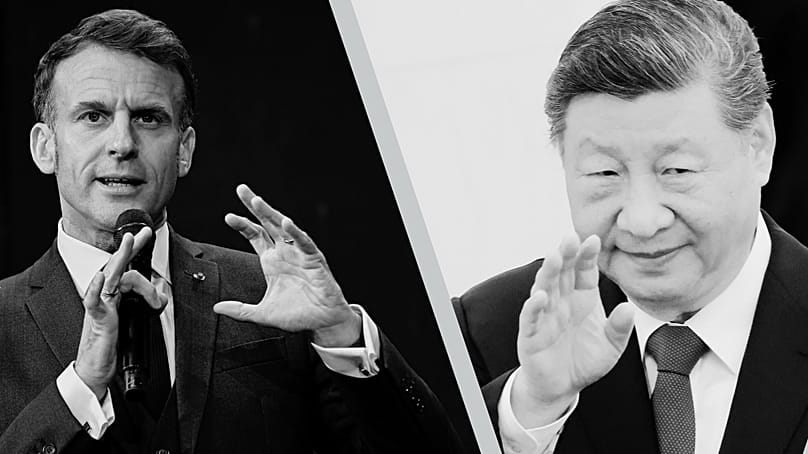
Macron expected in Beijing for state visit. Is he the voice of the EU?
French President Emmanuel Macron will land in China on Tuesday for a three-day state visit, where he is expected to not only to discuss France’s partnerships but also the relation between Beijing and Brussels.
Macron will meet President Xi Jinping for what Paris describes as a “strategic dialogue” aimed at rebalancing economic ties between the two bocs and will urge Beijing to engage in fair competition. EU-China relations are strained by a widening trade deficit (€305.8 billion in 2024), mounting disputes over exports from pork and dairy, and a competition for tech and chips.
The EU has become collateral damage from the US-China trade conflict. Beijing is using its quasi monopoly of rare earths to pressure competitors by restriting export licenses. For the EU, securing the supply of these rare earths is critical to keep key sectors like automotive alive.
The French leader will also press China over its role in the Ukraine war, reminding its position as a permanent member of the UN Security Council, and the commitment the world peace that comes sitting the council. Beijing has been accused of supplying a vital lifeline to Moscow, including 80% of the components needed to manufacture weapons.
Taiwan is also likely to feature in the talks amid tensions between China, Japan and the United States in the region. Macron says Europe must be treated as a strategic partner by Beijing - but will China listen?