

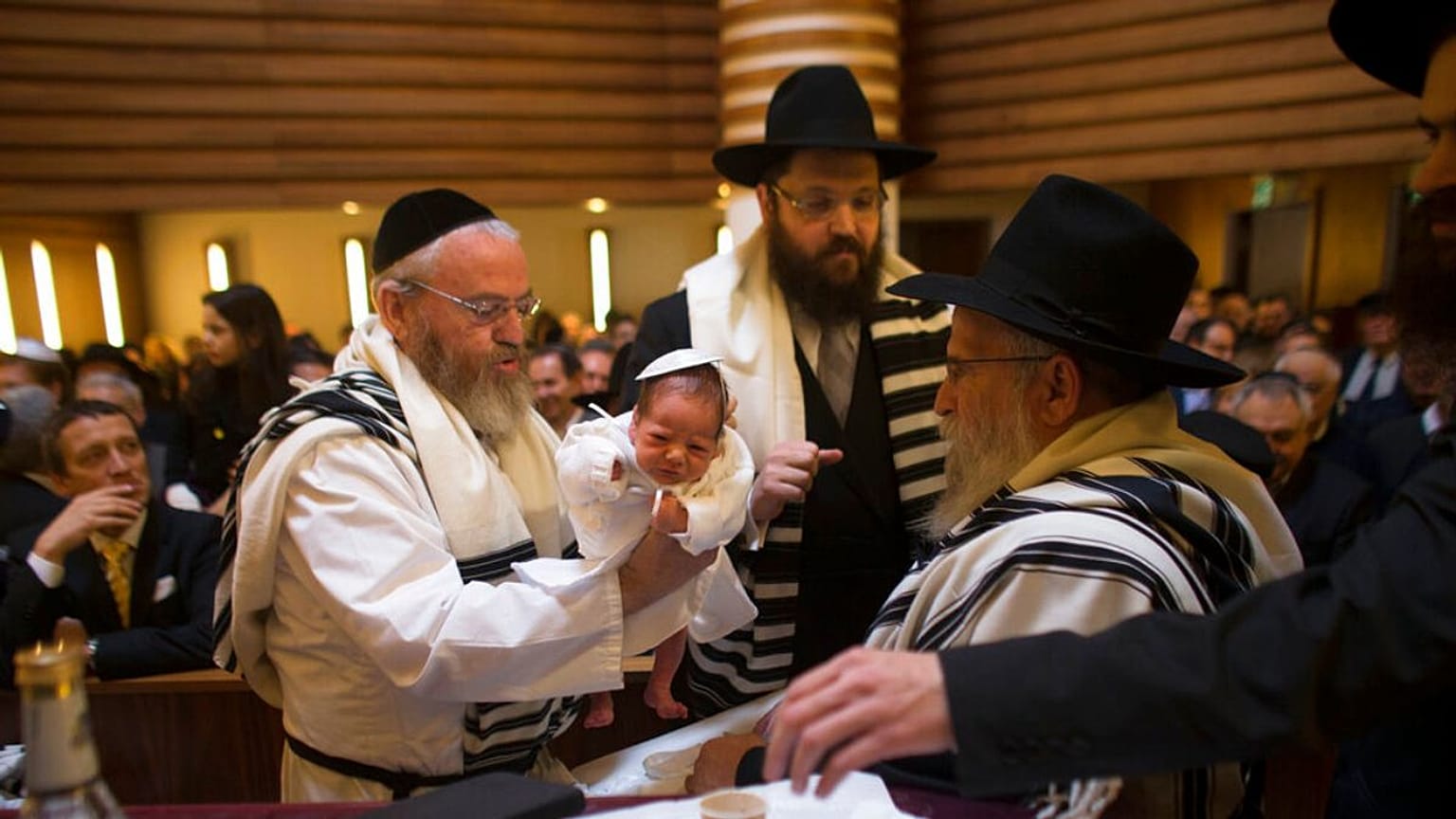













An investigation into three mohelim in Antwerp has prompted a diplomatic row between Brussels and Washington. What are the rules in Belgium, and further afield? And how has the religious community responded?
After US Ambassador to Belgium Bill White accused his host country of antisemitism over its laws regulating circumcision, the Belgian government found itself embroiled in a very public argument.
 ADVERTISEMENT
ADVERTISEMENT
ADVERTISEMENT
White’s criticism was sparked by a judicial case dating back to May last year, when Antwerp police conducted searches at the homes of three mohelim – people who conduct circumcision based on Jewish religious rites – suspected of performing the practice without the involvement of a licenced medical professional.
“In Belgium, the law strictly stipulates that only doctors can carry out circumcision or any such operation,” Dirk Devroey, professor of family medicine at the Brussels-based VUB university, told Euronews.
In addition to cultural or medical reasons, circumcision is a foundational religious practice both in Judaism and Islam. While in Islam, circumcision can be carried out by trained medical practitioners, circumcision in Judaism, known as Brit Milah or bris for short, traditionally must be performed by a specially trained mohel.
While most mohelim are either doctors or rabbis – or both – they are expected to receive rigorous training in the specific way circumcision is done as required by the Jewish faith.
According to Jewish tradition, a boy must be circumcised eight days after birth. During bris, the mohel slides an instrument over the foreskin, as close as possible to the glans, before removing the foreskin with a scalpel.
While supporters of the practice say that circumcision according to religious rites tends to be less painful and less invasive for the newborn compared to the medical one, critics have questioned whether all medical procedures are closely followed if a licenced medical professional is not present.
“(Circumcision can be) dangerous when done in non-sterile conditions and without anaesthesia,” Devroey said. “The pain may pass, but the possibility of infection is there, and in some cases, part of the penis is lost because of this.”
The question of who should do the practice has also caused a stir within the Jewish community in Belgium.
Moshe Friedman, the Antwerp rabbi whose complaints led to the investigation in question, told Flemish public broadcaster VRT NWS there were cases of children who were infected with major diseases as a result of ritual circumcision. In some cases, he claimed, children have died.
Rabbi Menachem Margolin, chair and founder of the European Jewish Association, refuted these concerns. “It is done by trained professionals who undergo very serious training,” he told Euronews.
“It's very important that the authorities check that everything is (done properly),” Rabbi Margolin said.
“But to speak about something that has taken place over 4,000 years, and which millions of children have been through – my father did it to me, and I did it to my children – you are basically saying: ‘We do not trust that you look after your children’,” he pointed out.
Euronews reached out to the public prosecutor’s office regarding evidence to back Rabbi Friedman’s claims. It confirmed he had filed a civil action complaint, but that it was previously declared inadmissible by the court. "An appeal may still be pending."
It added that, separately, a judicial investigation is underway into "illegal circumcisions", focusing on medical procedures performed by men who were not doctors.
Euronews also contacted Belgium’s Public Health Services to ask whether it had obtained reports from hospitals regarding infections in infants or related deaths. "The FPS Public Health does not have any figures on this type of complication," a spokesperson said.
Meanwhile, some in the Belgian Jewish community fear the investigation into the Antwerp mohelim could lead to a de facto ban on bris.
What does the law say?
For now, there is no legal ban on non-medically necessary circumcision on boys in any other European country. Iceland in 2018 made headlines as it considered becoming the first country to ban it, but the legislation has not yet passed into law.
Many countries impose similar rules to those of Belgium, requiring circumcision to be carried out by trained professionals. Others require anaesthesia, or the most effective pain relief possible. Scandinavian countries have in the past called for a minimum age to be set to get boys’ consent.
The absence of a ban is in part due to concerns that circumcision will then be performed in a non-medical setting. However, Nicolas Maubert, co-chair of Droit au Corps, an association engaged in prevention, argued that this is more down to political and religious pressure.
“As soon as a country attempts to ban circumcision, religious and/or American pressure is exerted, as is currently the case with Ambassador Bill White,” Maubert told Euronews.
He referred to Germany, where a Cologne court ruled in 2012 that circumcising young boys for religious reasons amounts to bodily harm and that it is illegal, causing outrage among Jewish and Muslim groups.
Following this outcry, Germany’s government and opposition parties drafted legislation confirming that the practice was legal.
In 2013, the Council of Europe (CoE) generated controversy by adopting a non-binding resolution expressing concern over violations of children's physical integrity and calling for regulation to ensure medical, non-painful practices.
This faced backlash from religious groups, leading to clarifications that it was not a binding ban.
Concerns over religious freedom
For faith-based communities, talk of tightening legislation or imposing bans touches on an existential right.
“We are talking about the freedom of religion, which the entire democratic world decided to respect,” Rabbi Margolin said.
“Any attempt to put limitations on this clearly sends us a very strong message (that they want to) harm our very basic rights. Of course, this is something that we cannot tolerate.”
One person in the Belgian Jewish community, who wished to remain anonymous, questioned how far this approach goes.
“If someone says children should be able to choose for themselves when they turn 18, then I ask that person every time: so you're telling me that as a parent, I can't make any decisions for my child?”
This could be interpreted as “the state knowing better,” according to him. “And that is a very, very, very dangerous precedent.”
He also questioned why the debate has received so much attention, given that it only concerns “around 500 to 700 boys” per year being circumcised.
However, for Devroey, the discussion in Belgium, which he dubbed “one of the world champions in circumcision,” goes beyond religion and boils down to the actual practice regardless of someone’s faith.
“Almost nowhere else is circumcision performed as much as in Belgium, and very often unnecessarily,” he explained, adding that around 26,000 circumcisions are performed per year. “Only 1% of those circumcisions might actually be necessary.”
As for those choosing circumcision for their children for religious reasons, Devroey said they were “free to have their own religion,” but that his concern is about consent.
“Wait to perform circumcision (until) the person is an adult, or at least old enough to be able to judge for themselves. Then they can choose that religion,” he said.
Meanwhile, according to Rabbi Margolin, if the Belgian government is concerned about the health of Jewish children and the worries of the Jewish people more broadly, it should approach the community to discuss these directly.
“We have really serious issues that are real issues. And circumcision, and the hygienic level of the mohelim are absolutely not part of them,” Rabbi Margolin said.