












Ferries in certain European cities are responsible for more toxic air pollution than all the cars in those cities, a new study warns.
Fossil-fuelled ferries are choking European ports, as experts call for a rapid transition to electrification.
 ADVERTISEMENT
ADVERTISEMENT
ADVERTISEMENT
Ferries play a vital role in connecting Europe’s islands with the mainland, and are often seen as an environmentally friendly alternative to flying. However, many vessels are old and polluting – exposing locals to toxic air pollution.
A new study by NGO Transport & Environment (T&E) has found that in 2023 alone, 1,043 European ferries emitted 13.4 million tonnes of CO2. This is the equivalent of 6.6 million cars over a year.
In port cities such as Barcelona, Dublin and Naples, ferries are responsible for more toxic sulphur oxide pollution (SOx) than all of the cars in those cities, the study warns.
Sulphur oxides are air pollutants that can trigger respiratory problems, worsen asthma and contribute to acid rain and fine particulate pollution.
Which European ferry ports are the most polluting?
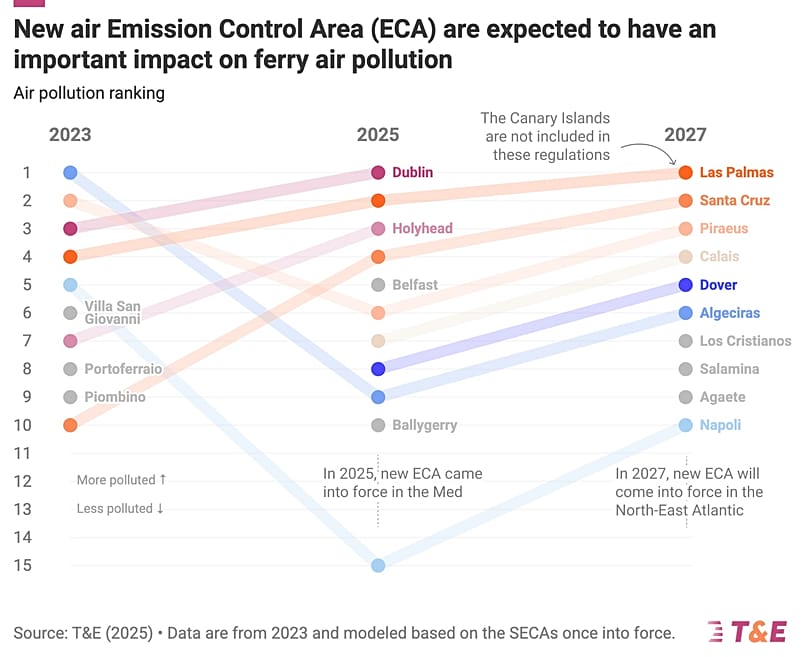
Dublin, Ireland, is currently the most polluted port city in Europe when it comes to ferry-related SOx exposure, followed by Las Palmas in Gran Canaria and Holyhead in Wales.
However, this is set to change next year, when new emission control areas will come into place and limit air pollution from maritime fuels in the North-East Atlantic. As the Canaries are not included in these regulations, Las Palmas is slated to emit the most air pollution in 2027, followed by Santa Cruz in Tenerife.
Barcelona is the highest CO2-emitting ferry port in Europe, with ferries here also pumping out 1.8 times more SOx than all of the city’s cars – despite restrictions already in place in the Mediterranean.
As of 1 May 2025, the entire Mediterranean Sea is designated a Sulphur Emissions Control Area, requiring ships to reduce fuel sulphur content from 0.5 to 0.10 per cent. These measures were put in place to slash air pollution and enhance air quality in coastal areas.
Is electrification the solution?
T&E found that the average age of ferries in Europe is 26 years, highlighting the need for a “clean renewal”.
The report states that electrification and hybridisation could cut ferry CO2 emissions by up to 42 per cent, improve air quality in port cities and reduce operating costs. At least 60 per cent of Europe’s ferry fleet could run on battery power by 2035, with many routes already cheaper to operate as electric today.
In Sweden’s Stockholm, a hydrofoil electric ferry trial has been found to slash emissions by up to 94 per cent and cut travel times from 55 minutes to roughly 30 minutes.
The main barrier to scaling up electric ferries is charging infrastructure, but T&E argues that the challenge is “smaller than assumed”.
“57 per cent of ports would only need small chargers below 5MW to support electric ferry operations,” the study adds.
‘Connect communities, not pollute them’
“Ferries should connect communities, not pollute them,” says Felix Klann of T&E. “Too many ferries are burning polluting fossil fuels, pumping toxic air into Europe’s port cities.”
Klann argues that electrifying Europe’s ferries could “dramatically” cut emissions and bring a “breath of fresh air” to millions of people. He adds: “Electric ferries are already cheaper to run on many routes, and more will become cost-competitive in the coming years.
“With the average age of ferries in Europe at 26 years, now is the time for a clean renewal.”