














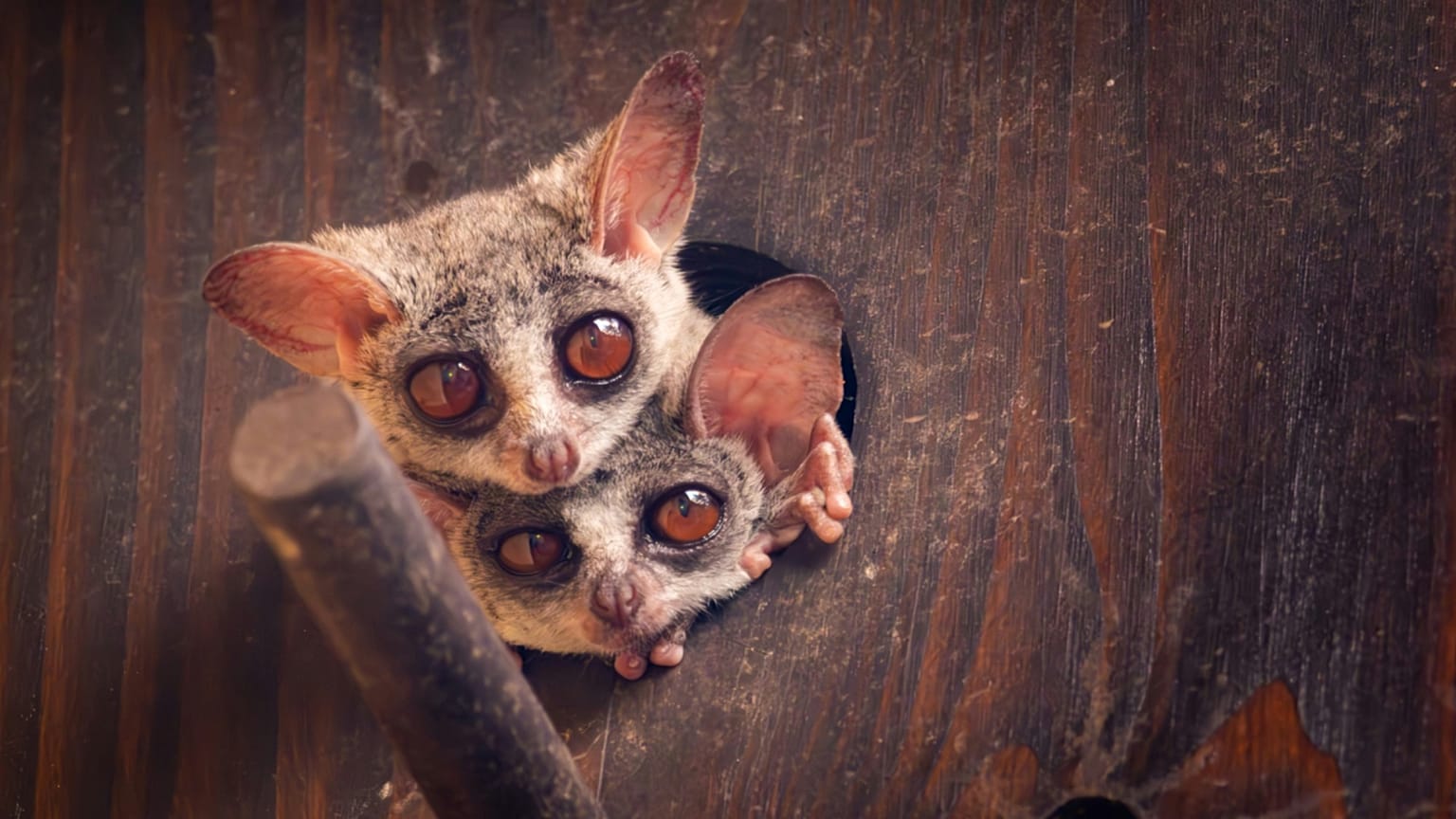













Once common, bushbabies are dropping in numbers, but researchers say two key conservation efforts could help them recover.
Scientists are advocating for “canopy bridges” to be built to help bushbaby populations recover from the impacts of deforestation.
 ADVERTISEMENT
ADVERTISEMENT
ADVERTISEMENT
Renowned for their huge round eyes and pointy ears, bushbabies were once ubiquitous in South Africa, gaining a notorious reputation for sneaking into towns to steal pet food from bowls and begging tourists on safari for scraps.
However, researchers Frank Cuozzo and Michelle Sauther, who first travelled to South Africa to search for the ‘unusual’ primate in 2012, have started to notice a disturbing trend. They kept on coming across dead bushbabies that had either been killed on roads or mauled by dogs.
Why are bushbabies ‘near threatened’?
In January 2026, the Endangered Wildlife Trust (EWT) redesignated thick-tailed bushbabies from a species of ‘least concern’ to ‘near threatened’. While this category isn’t as severe as ‘endangered’, researchers say it indicates populations are likely dropping at a concerning rate.
“Human threats are everywhere, for all species,” says Cuozzo, a scientist at the Lajuma Research Center in South Africa.
“But we’ve been able to document that the human threats facing bushbabies, including deforestation and habitat loss, are increasing.”
Thick-tailed bushbabies spend most of their lives in trees, living off acacia gum. But as humans clear vast swathes of forest for agriculture and suburban housing, bushbabies are being forced to enter residential areas in search of food.
Using satellite images, researchers calculated that the habitats where the primates live are shrinking by about 3.6 per cent per decade, which is faster than the average loss for natural areas in the region.
In one example around 200 kilometres north of Pretoria in South Africa, bushbabies have seemingly vanished following the installation of an upriver dam, which dried up the primates’ favourite forest.
Previous studies have also shown that the illegal pet trade, road traffic and dog attacks might be taking a much larger toll on bushbabies in South Africa than experts first predicted.
Could canopy bridges help bushbabies recover?
Cuozzo and Sauther are now encouraging locals not to feed primates or leave pet food out at night, to prevent bushbabies from venturing into human settlements where they are even more vulnerable.
To stop the issue of roadkill, researchers are now advocating for “canopy bridges”. These rope-based crossings will allow bushbabies to cross roads without risking being hit by cars.
Canopy bridges have been deployed across the world, including deep inside the Amazon, to help protect species and limit their exposure to human-built infrastructure such as roads.
WWF says canopy bridges are a “key mitigation measure” for wildlife such as porcupines, sloths and monkeys whose territories have become “fragmented by linear infrastructure”.
“A single road can isolate an animal from shelter, feeding resources and potential mates, hampering daily life and dividing species into distinct subpopulations, which can diminish genetic diversity,” the organisation states.
However, researchers point out that there is “so little money” available for conservation, that even constructing a simple canopy bridge can take time.
“The more we learn about a creature, the more we can spend that money in a way that’s really effective,” they add.
Ultimately, without an end to deforestation, the thick-tailed bushbaby risks slipping deeper towards extinction.