














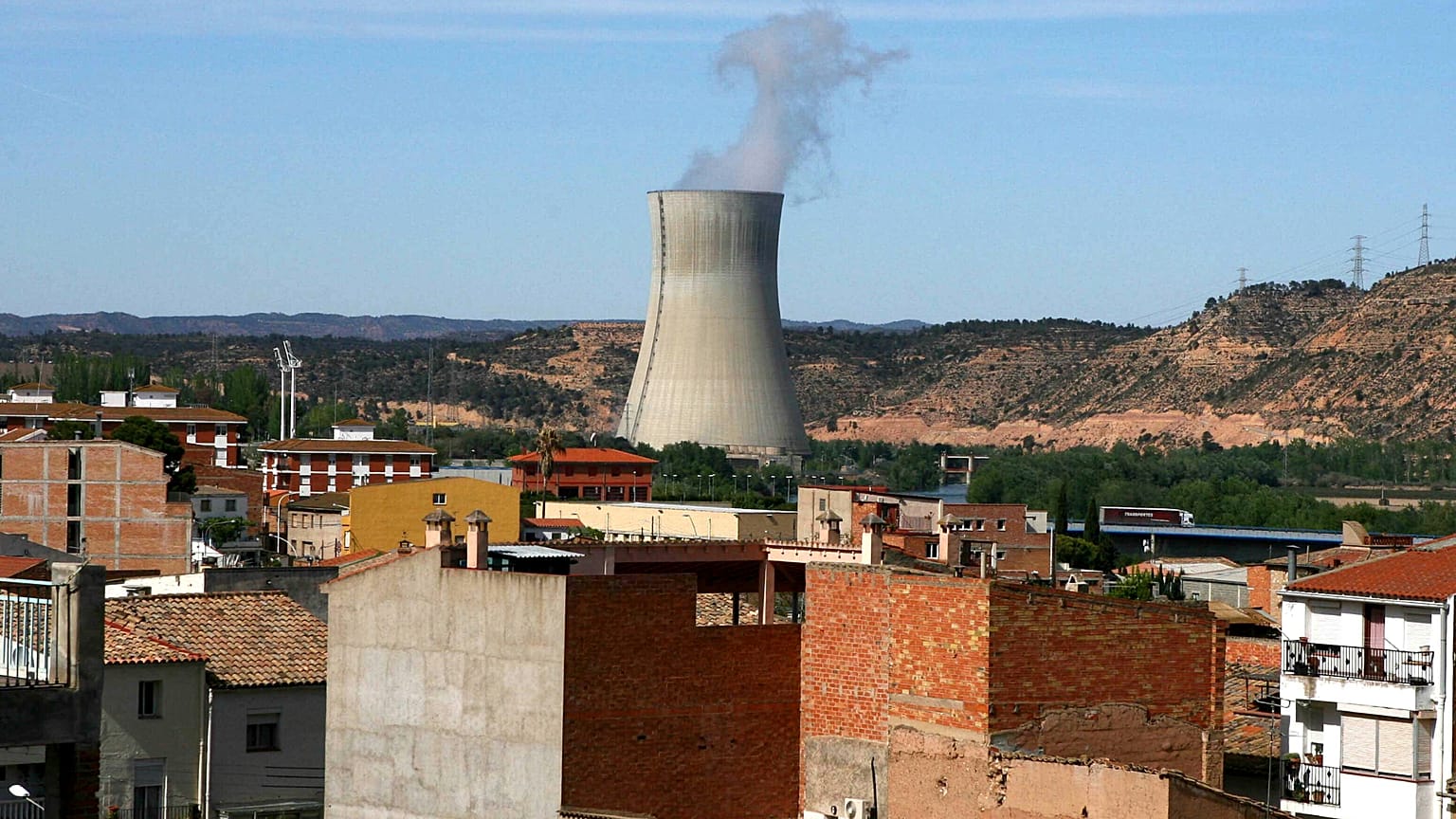













Portugal has been investing in renewable energy but nuclear has been largely neglected.
The European Union has touted nuclear energy as a sustainable alternative for achieving climate neutrality. But not all member states are keen on the idea.
 ADVERTISEMENT
ADVERTISEMENT
ADVERTISEMENT
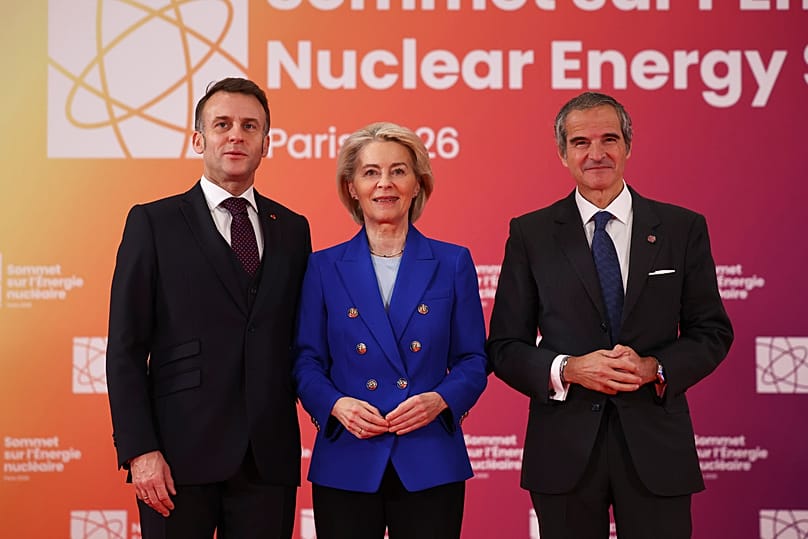
On 10 March, the President of the European Commission, Ursula von der Leyen, spoke at the nuclear summit organised by France and the International Atomic Energy Agency (IAEA) in Paris, saying that "Europe has made a strategic mistake by moving away from a reliable and affordable source of energy with low emissions."
Von der Leyen also announced that she would mobilise €200 million for nuclear energy, at a time when Europe's concerns about its dependence on oil and gas imports are growing, following the US and Israeli attacks on Iran.
In the 1990s, the EU relied on nuclear energy for a third of its electricity production, but now "that share is close to 15 per cent", said Ursula von der Leyen.
Is nuclear power a blind spot in Portugal's energy mix?
Portugal has no nuclear production or reactors. The Minister for the Environment and Energy, Maria da Graça Carvalho, spoke out against nuclear in November last year, saying that "it's not suitable for a country like Portugal", according to Jornal Económico .
She also argued that without in-house production technology, such as that of countries like Spain or France, producing this type of energy is very expensive and renewable electricity remains "simpler and cheaper".
In an interview withEuronews, Bruno Soares Gonçalves, president of the Institute of Plasmas and Nuclear Fusion, countered by pointing out that, before making any decision on the use of nuclear energy, it is necessary to assess what solutions the country has to guarantee "cheap energy", taking into account "the consumption prospects for the coming years".
With regard to von der Leyen's statements, the physicist highlights the importance of nuclear energy for energy sovereignty and decarbonisation, but regrets that "it's necessary to reach the point we've reached today for Europe to start recognising the strategic error of repeatedly disinvesting in nuclear energy over the years."
Bruno Soares Gonçalves points out that the lack of investment in this energy alternative has contributed to the "loss of knowledge and skills" and that countries like China "are clearly ahead in this race towards new generation nuclear power".
The energy transition has been a widely debated topic, and the challenges and doubts about the best way forward remain in focus.

Should Portugal invest in nuclear energy?
For Bruno Soares Gonçalves Gonçalves, the solution may involve combining various forms of energy production. "It could be renewables, batteries and gas to guarantee availability", or "renewables plus nuclear, offset by dams", he suggests.
"There is no single solution. Renewables exist and are there. We can discuss the current dependence on China, which produces more than 80 per cent of solar panels, but apart from that, they [renewables] are part of the portfolio. They can't be the only source," he argues.
The researcher believes that the government needs to carry out a 'Total System Cost Study' to define the way forward.
In October last year, the Secretary of State for Energy, Jean Barroca, on the sidelines of the Portugal Renewable Energy Summit 2025, announced that this analysis of the costs of the electricity system would be carried out this year. "It's important to see the system as a whole and not just the unit value of integrating or building each energy source into the grid," the physicist argues.
"I think that, as has happened in other countries, the solutions for nuclear are competitive, but we need to plan ahead," says Bruno Soares Gonçalves.
According to Eurostat, in a report published at the end of January this year, in 2024 the 12 EU countries with nuclear electricity generation would generate 649,524 gigawatt hours (GWh) of electricity, which represents an increase of 4.8 per cent compared to 2023.
Nuclear power stations accounted for 23.3 per cent of total electricity production in the EU.

France is the largest nuclear producer in the EU. Until 2021, Germany was one of the major producers, but it shut down its nuclear energy production in April 2023.
Nuclear power requires high investment
Bruno Soares Gonçalves recognises that if the Portuguese government wanted to start including nuclear production in its energy portfolio, the process would be lengthy, requiring legislation and specialised training.
"Nuclear requires a large initial capital investment, and that's also a difference compared to renewables," he says. "In the United Arab Emirates it took around 12 years for the first reactor to be built," he recalls, emphasising the high level of investment made.
However, for the researcher, "it's not enough to say that renewables are cheap to install" because the 'levelised cost of electricity' doesn't capture the full system costs, such as the need for grid upgrades, maintenance, or backup power when the wind isn't blowing or the sun isn't shining.
The longevity of the devices that generate or store energy is also one of the factors to consider. "Wind and solar renewables have a lifespan of around 20 years, while a current nuclear power station can operate for 40, 60 or even 80 years," he emphasises.
On the other hand, "nuclear has an advantage: it provides electricity, on average, 90 per cent of the time". In other words, "the capacity factor of a nuclear power plant is 90 per cent", a coefficient of firmness that, he explains, "in renewable energies is much lower".
Firm energy makes it possible to guarantee the availability of electricity when needed, "which may have been one of the problems during the blackout we had last year", he recalls.
"It's important to have energy that isn't intermittent, that doesn't depend on atmospheric factors," he explains. "In Portugal, the capacity factor for wind is around 22 to 24 per cent; for solar it's 17 per cent, because obviously there's no sun at night or during the day."
Small nuclear reactors are a cheaper place to start
At Tuesday's nuclear summit, the president of the European Commission announced that she intends to "stimulate the development of small nuclear reactors" and that this "new technology will be operational by the early 2030s".
The president of the Institute for Plasma and Nuclear Fusion said that "it is certainly easier to start with an investment in SMRs [Small Modular Reactors] which allow for faster construction, with lower capital costs" and, from there, to scale up the investment in a phased manner.
The physicist also pointed out that even if Portugal "doesn't choose to have nuclear energy", it should try to be involved in other ways. "For example, in the production of components, or even the production of purified salt for molten salt reactors, one of the solutions that has been shown to be promising."
'Nuclear fusion': Simulating the sun could be the future of energy
Decarbonisation is one of the European Union's major goals for 2050. Under the European Green Deal, the region aims to achieve climate neutrality.
"Considering the entire life cycle, nuclear energy is the form of energy production with the lowest CO2 emissions: around 5 to 6 grams per kWh," says Bruno Soares Gonçalves.
Current reactors work on the basis of nuclear fission, but several projects have been developed in the area of nuclear fusion, although it doesn't yet produce electricity commercially.
In 'fission', heavy atoms are used, such as uranium and plutonium, which are split, releasing energy that is converted into heat and then electricity. In 'fusion', the nuclei of light atoms such as deuterium and tritium are brought together.
Bruno explains that this process tries to replicate what happens inside the sun, through fusion by magnetic confinement, with the heating of the plasma, which involves temperatures of around 150 million degrees Celsius.
"The ultimate goal is to heat water to produce steam and turn a turbine. It's a very elaborate way of heating water," he says, smiling.
Challenges of and investment in nuclear fusion
'Fusion' promises decarbonised energy, with abundant fuel and low levels of radioactive waste. However, tritium – one of the fuels – has a half-life of 12.6 years, which makes availability difficult.
"If I have a kilo of tritium today, in 12.6 years I'll have half a kilo and in 25.2 years I'll only have 250 grams, which isn't brilliant as a choice of fuel," says Bruno Soares Gonçalves. "The solution is to produce tritium from lithium in the reactor walls. It's a process with some technological challenges and one that still requires significant work to develop."
In September 2025, the European Commission launched a proposal for the Euratom "Research and Training Programme" 2028-2032 for the next long-term budget. The proposal is aimed at research and training in the field of nuclear fusion.
Alongside other European projects such as the European Competitiveness Fund (ECF) and Horizon Europe, the aim is to invest more in fusion development.
The European Union wants this programme to maintain Europe's global leadership by accelerating research.
The president of the Institute of Plasmas and Nuclear Fusion, a research unit of the Instituto Superior Técnico, considers investment in research to be very important and recalls that countries like the United States of America and China are already a step ahead.
"China has also invested heavily in nuclear fusion. At the moment it's building a large reactor that will come into operation next year, called BEST, which aims to test and qualify large components for a future nuclear fusion reactor to demonstrate electricity production. And they are progressing very quickly," he comments.
Nuclear fusion developments in Europe and beyond
Portugal, like all European countries, is part of the European Nuclear Fusion Programme, which focuses its activity on the development of the International Thermonuclear Experimental Reactor (ITER), which is being built in the south of France, more specifically at the Cadarache research centre, for inauguration in 2034, and on research, through the EUROfusion Consortium.
"ITER wants to produce 10 to 20 times more energy than it consumes. And then they can already produce more energy. They're not going to produce electricity yet, but they're going to demonstrate that the technologies as a whole can produce energy and sustain it for a significant amount of time," explains Bruno Soares Gonçalves.
"There are other projects and there is a lot of investment, especially private investment, in the United States. There are also other machines that promise to achieve significant results in the coming years, also with the aim of producing more energy than they consume," he says.
Nuno Loureiro, the Portuguese physicist murdered in the United States, ran a laboratory at the prestigious Massachusetts Institute of Technology, specialised in fusion energy and believed that there would be many developments in a few years.
Bruno Soares Gonçalves therefore argues that "it makes sense to invest in nuclear fusion" because the expectation is that it will be possible to "produce energy at competitive prices and with abundant fuel".

Fukushima and Chernobyl: Fears and myths about nuclear power
With regard to the fears and 'urban myths' associated with nuclear power, Bruno argues that it's important to "have a discussion based on facts".
One of the arguments used against nuclear energy production is that Portugal is in a seismological zone, and Fukushima is often cited as an example.
"All the Japanese power stations, including Fukushima, stopped automatically and safely when the earthquake struck. What happened was that there was a tsunami, and the plant's nine metre high retaining walls fell below the height of the wave, which reached around 15 metres. And the auxiliary generators that were supposed to keep the reactor cool were in the cellars and were submerged. The cause of the accident was, above all, the poor sizing of the retaining wall and the positioning of the auxiliary generators," he explains.
Bruno emphasises that "a lot has been learned from Fukushima" and that research and the development of technologies have led to much stricter regulations.

Chernobyl, on the other hand, "was a reactor that didn't have a containment building", which "is not representative of today's reactors".
As for radioactive waste, Bruno Soares Gonçalves recognises that "it is dangerous waste", but maintains that today "we know how it should be managed".
"The first myth is that the amount is astronomical," he says. "If all the electricity you consume over 80 years was produced using nuclear energy, the waste would fit into a third of a soft drink can. If you were American, you'd need the whole can, because they consume 2.7 times more electricity than we do."
"The second myth is that the waste isn't treated and is abandoned, like a viscous green liquid, as in The Simpsons, which doesn't correspond to reality," he says.
He explains that the waste goes through a cooling process and is then stored in solid concrete and metal containers, and can remain on the plant's premises or be sent for deep geological disposal.
When will nuclear fusion become a reality?
"If you ask private companies in the United States, some of them will tell you that it's only a few years away," says the president of the Institute for Plasma and Nuclear Fusion.
"Personally, given the challenges we still have to face, I think we still have a few years of development ahead of us. I'd say we're between 10 and 20 years away from having the first prototype producing electricity for the grid," he says.
It sounds like a long time, but two decades will fly by. You only have to think that in the early 2000s, wind energy in Portugal was still in its infancy and that the big growth happened mainly between 2005 and 2012, when most of the wind farms were installed. Today, the country leads Europe in the production of electricity from renewable sources.
The great lever was investment. Bruno Soares Gonçalves believes that investment attracts more investment.
"The process can be accelerated if there is more investment and that's why it's also important for governments to invest in research, materials and talent," he urges.
"The Institute for Plasma and Nuclear Fusion, which I lead, is actively involved in the European Nuclear Fusion Programme. We have projects in ITER and a very significant participation in the Fusion Programme. Last year we signed €100 million in ITER contracts with Portuguese industry," he says.
Portugal has thus become the fifth European supplier to ITER. "We're the biggest of the little guys," he laughs. "We're ahead of Spain, France, Italy and Germany."

Is Portugal likely to invest in nuclear?
Despite the promise of this field, Bruno believes that successive governments are "politically afraid" of promoting a discussion on the subject and that, on the other hand, the investment time needed to achieve results is longer than the political cycles.
"Results go beyond a political cycle and obviously require investment. What we're seeing above all is rapid investment, which can be visible, inaugurated and with a ribbon-cutting as quickly as possible, keeping a number of players reasonably satisfied in good time," he criticises.
The physicist is waiting for the study that the government has promised for this year, but he also fears that the tragedies associated with the storms, which caused a lot of damage to the network, could influence what has been promised. "I don't know exactly if it will still be prioritised," he concludes.
The debate on nuclear power seems to be moving forward at European level, but in Portugal it seems to be more stagnant and the decision on whether or not to include it in the Portuguese portfolio may not be made today.
Euronews tried to obtain statements from the Ministry of Environment and Energy on Portugal's position on the issue, but due to commitments related to the PTRR (Portugal Transformation, Recovery and Resilience) disaster response plan, it was not possible to obtain clarification.