



























Power and satellite networks were also impacted by the severe solar storm.
Portugal's skies were treated to a rare and beautiful phenomenon on Monday evening as a solar storm brought the northern lights southward.
 ADVERTISEMENT
ADVERTISEMENT
ADVERTISEMENT
The auroras borealis was mainly visible in the north of the country, in places such as Vila Pouca de Aguiar, Bragança, Macedo de Cavaleiros, São Pedro do Sul and even Grândola.
Witnesses took to social media to share images of pink skies.
As well as Portugal, the phenomenon has been reported in other European countries where it is also uncommon, such as Germany and the United Kingdom.
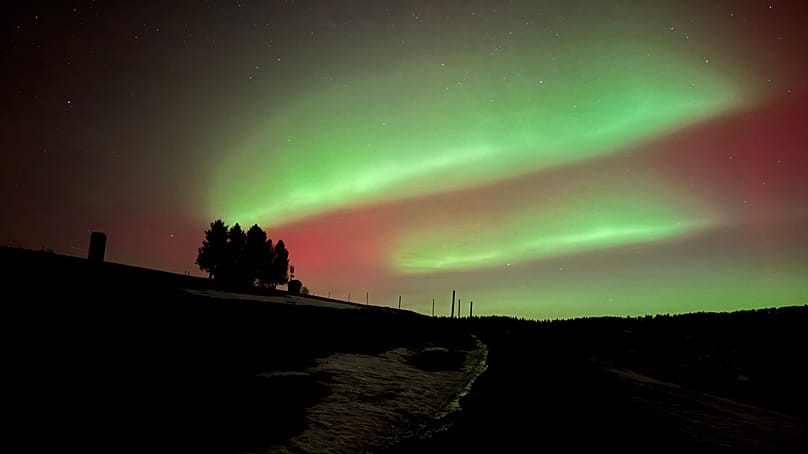
What brought the northern lights to Portugal?
The rare event was triggered by a solar storm on 19 January
Forecasts from the US Space Weather Prediction Centre (SWPC) pointed to intense geomagnetic storms and solar radiation, according to Shawn Dahl, the centre's service coordinator.
On the social network X, the service indicated that "a severe S4 level solar storm" began on Monday which, according to the organisation, "is the largest solar storm in more than 20 years".
In this event, the sun releases large amounts of energy, plasma and charged particles. When they come into contact with the Earth's magnetic field, these can create the aurora borealis and aurora australis.
Geomagnetic storms can also interfere with satellites
According to the SWPC, geomagnetic storms can also interfere with satellite operations, GPS communications and other infrastructure.
Shawn Dahl indicated that the current storm should weaken during the day on Tuesday, although severe levels were reached during the morning.
Solar radiation storms can affect objects in space and certain types of communication systems, but Dahl said that astronauts on the international space station are not at risk, at least for now.
The current solar storm is the most powerful seen "since 2003", when parts of Sweden were plunged into darkness and power infrastructure in South Africa was damaged.