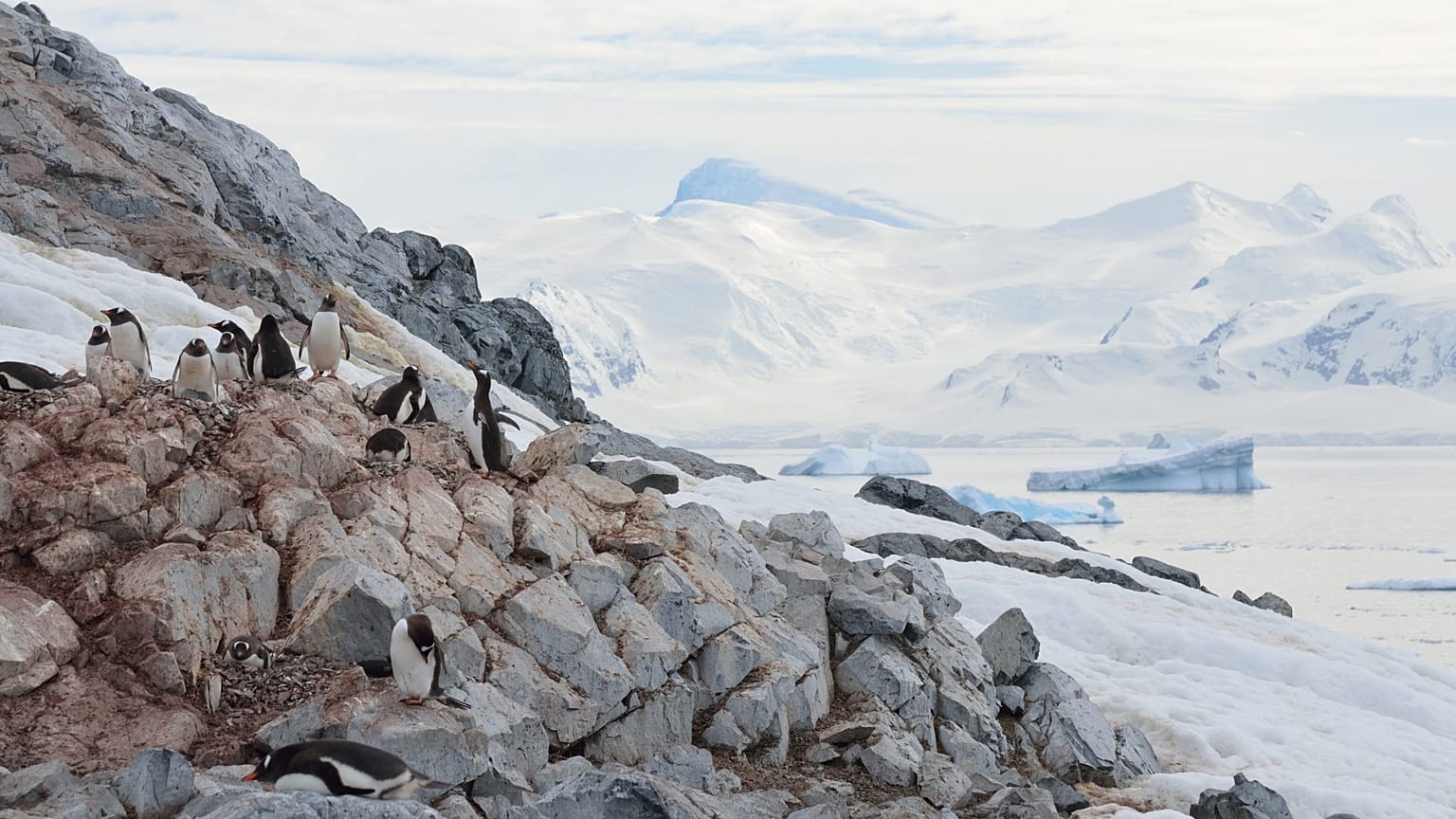













The breeding season of the Gentoo penguin in Antarctica has leaped forward by 14 days, sparking concern amongst scientists.
Antarctic penguins are going to extreme lengths to adapt to the climate crisis, as scientists uncover a “record shift” in breeding patterns.
 ADVERTISEMENT
ADVERTISEMENT
ADVERTISEMENT
Penguin species such as the Adélie, Chinstrap and Gentoo live in one of the fastest-warming habitats on Earth – with temperatures at colony locations increasing up to four times faster than the Antarctic average.
A decade-long study led by Penguin Watch at the University of Oxford and Oxford Brookes University says it is likely this rapid warming is why penguins have started advancing their breeding seasons. Published in the Journal of Animal Ecology, the research reveals the fastest shift in phenology (how recurring natural events like breeding relate to the climate) in any bird – and possibly any vertebrate – to date.
Why penguins are changing their breeding seasons
Scientists examined changes in the timing of penguin breeding between 2012 and 2022, specifically their “settlement” at the colony – the first date at which penguins continuously occupied a nesting zone.
More than 35 colonies, which ranged from a dozen up to hundreds of thousands of nests, were monitored using 77 time-lapse cameras.
The results showed that the timing of the breeding season for all three species advanced at record rates. Gentoo penguins showed the biggest change, with an average advance of 13 days per decade. In some colonies, the breeding season was brought forward by as much as 24 days.
Adélie and Chinstrap penguins advanced their breeding by an average of 10 days.
The ‘winners and losers’ of climate change
“Our results indicate that there will likely be ‘winners and losers of climate change’ for these penguin species,” says lead author Dr Ignacio Juarez Martínez.
“Specifically, the increasingly subpolar conditions of the Antarctic Peninsula likely favour generalists like Gentoos at the expense of polar specialists like Chinstraps and Adélies. Penguins play a key role in Antarctic food chains and losing penguin diversity increases the risk of broad ecosystem collapse.”
While statistical models suggest that the shift in breeding season is caused by rising temperatures, researchers say it remains unclear whether this is an adaptive response or not.
“Even in the best-case scenario, it is unclear how much more elasticity these species will be capable of displaying if temperatures keep rising at the current rate,” the study warns.
Are early breeding seasons bad?
Scientists warn that changes to breeding seasons can disrupt penguins’ access to food, a threat that is already responsible for thousands of penguin deaths in South Africa.
A 2025 study from the South African Department of Forestry, Fisheries and the Environment, in collaboration with the University of Exeter, found that between 2004 and 2011 around 62,000 African penguins died as a result of severe food shortages.
African penguins rely on sardines as a key food for survival. However, for every year except three since 2004, the biomass of the sardine species Sardinops sagax off the western coast of South Africa has dropped to just a quarter of what the population could be at its healthiest.
The study blames changes in ocean temperature and salinity along the west coast of Africa for making the fish's spawning less successful.