














The multi-Oscar nominated Hamnet is a moving ode to agonising loss and the possibility that healing can come through art. But you may find the emotions so signposted that your heartstrings feel more yanked than tugged.
To weep, or not to weep, that is the question.
 ADVERTISEMENT
ADVERTISEMENT
ADVERTISEMENT
It’s not really, as tears most likely will be shed in Chloé Zhao’s adaptation of Maggie O’Farrell’s historical fiction novel “Hamnet”, in which William and Agnes Shakespeare (Paul Mescal, Jessie Buckley) process the premature death of their 11-year-old son (Jacobi Jupe).
The tragedy that befalls the couple fractures their marriage, with William heading to London to work on his plays while Agnes is left to raise their two daughters. It will also become entwined with one of the greatest plays ever penned.
There’s little need to elaborate much further when it comes to plot, as what works about Hamnet is how both Mescal and Buckley sell devastating emotional turmoil - and boy do they. Buckley in particular manages to convey the suffocating stranglehold of loss in every one of her physical movements and line deliveries, transmitting the crippling anguish of grieving.
Credit is also due to Zhao, who doesn’t overdo it when it comes to heavy production design and crucially doesn’t make Hamnet the Hamlet origin story, nor the fawning portrait of a literary genius struck by tragedy. Much like the director's earlier films – The Rider and Nomadland – she is interested in what could be considered peripheral characters rather than those in the limelight, and therefore gives Agnes center stage.
However, there is a rub.
There is no denying that Hamnet is a searing meditation on death and how artists can channel their profound grief into art. But grief is a complex and messy process, not only of letting go but allowing the people we’ve lost to become a part of us. While Hamnet addresses this without completely toppling into cheap sentimentality, more subtlety was required to not oversimplify how healing can often be more painful than the actual wound.
From the epigraph explaining how 'Hamnet' and 'Hamlet' are essentially the same name (glad that was there, or everyone would’ve been lost for a moment) to some overly heavy-handed symbolism and overwrought moments of OSCAR CLIP ACTING THROUGH SCREAMING, there's a bluntness to Hamnet that feels at odds with the layered emotions it grapples with.
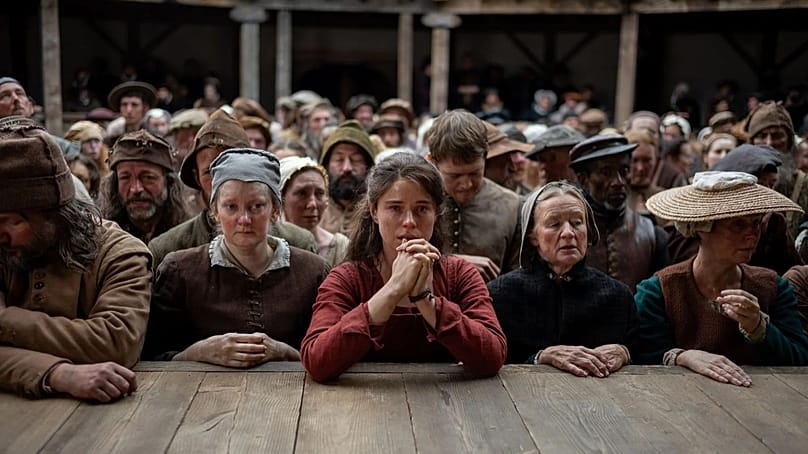
This leads to the finale, which sees Agnes travel to London to witness a performance of Hamlet. She has never seen her husband’s work, and it is meant to be a culmination, a moment which could have been the appropriation of pain but ends up as a vehicle for catharsis and rebirth. Buckley once again manages to make it heart-rending. However, it does also play out as a far too heavy-handed bid to pulverise the audience’s tear ducts into emotional submission – especially when Max Richter’s ‘On The Nature Of Daylight’ starts playing.
Richter, who also composed the original and beautifully ethereal score for the film, is one of the most important musicians of our time, and his affecting track from ‘The Blue Notebooks’ makes the 2004 album one of the greatest works of the 21st century. But its inclusion here feels clumsy. Worse, manipulative.
Had ‘On The Nature Of Daylight’ not been used in so many films and TV shows before (Stranger Than Fiction, Shutter Island, Arrival, The Handmaid’s Tale, The Last Of Us, to name but a few), it could have worked. Silence could have been used to make the moment work. But at this point, the cinematic shorthand for “Are you crying yet? Well, crack out the tissues, 'cause you're gonna!” cheapens the drama and highlights some of the film’s more exploitative aspects.
Granted, to criticise parts of Hamnet as emotionally manipulative is to ignore that all films are a form of emotional manipulation. It’s just that some films manage to perfectly tug on the heartstrings; Hamnet relentlessly yanks them to the point the artifice is exposed for all to see.
Hamnet is in cinemas now.