






























More than a workspace, this restoration laboratory is where Central Asia’s fragile past is uncovered and preserved through science, intuition and patience.
The Ostrov Krym laboratory, known as “Krym Island”, truly feels like an island from the inside. Set within a compact, self-contained area, it is surrounded by greenery that, in Almaty’s mild winters, turns into a quiet landscape of bare branches and dry bushes. At its centre stands a solid two-storey building, flanked by smaller annexes still undergoing reconstruction.
 ADVERTISEMENT
ADVERTISEMENT
ADVERTISEMENT
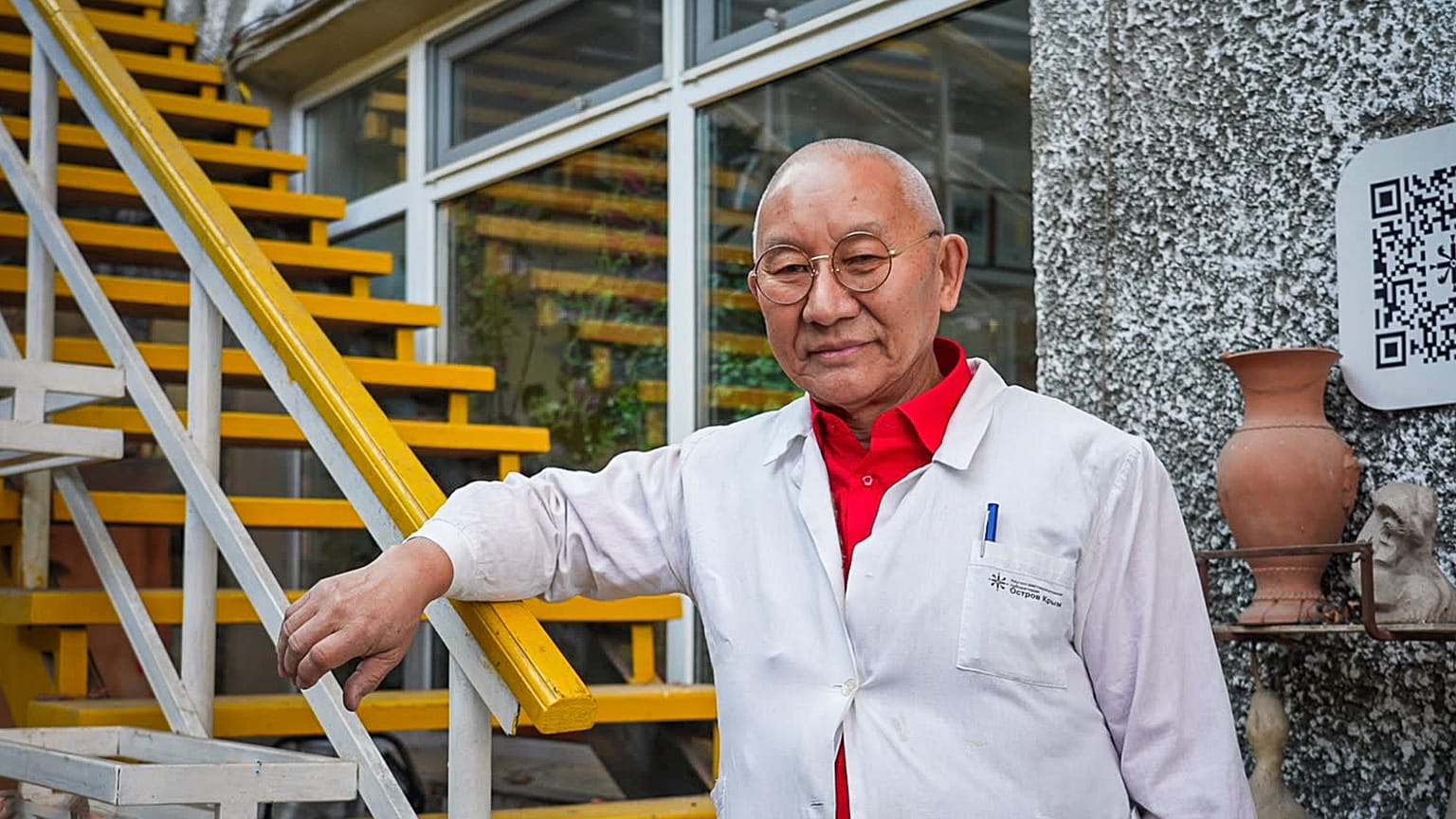
The name “Krym Island” refers both to the laboratory’s physical isolation and to its founder, Krym Altynbekov, a self-contained world shaped by his work and vision.
From the outside, the complex could easily be mistaken for a private house. This deliberate modesty keeps the laboratory out of public view, and for good reason. When people hear the word “artefact”, gold is often the first image that comes to mind. But at Ostrov Krym, gold is not the main treasure. In fact, there is almost none here. What the team truly values are ordinary objects. The more modest, fragile and ancient they are, the more precious they become.
Founded in 1996, the laboratory has grown into a key hub for archaeological conservation in the region. Altynbekov, now in his seventies, remains deeply involved in its daily work, continuing to lead restoration projects not only in Kazakhstan but also across Central Asia, Russia and Mongolia.
“As you see,” he says, “every monument is endlessly fascinating work. An artefact always has something to tell us. I’m always curious about what kind of information it holds, and that curiosity never lets me rest.”
Reconstructing the past
That curiosity has shaped some of the laboratory’s most internationally recognised work. Among its landmark achievements is the reconstruction of the iconic Golden Man, a Saka warrior unearthed in the Issyk burial mound by archaeologists Kemal Akishev and Beken Nurmukhanbetov.
Our understanding of how the warrior originally looked is largely the result of Altynbekov’s meticulous research, which challenged and reshaped earlier interpretations.
“When I studied the Golden Man,” Altynbekov explains, “I discovered a great deal of information that had previously been unknown. As a result, the reconstruction itself changed. That’s why he looks different today from the very first version that was created.”
Other renowned projects include the reconstruction of the famous horses from the frozen burial mounds of Berel and the Urjar Priestess from the Urjar kurgan, both dating back to the 5th–4th centuries BCE and discovered in eastern Kazakhstan. Together, these works established Ostrov Krym as a place where fragile remains are not only preserved, but carefully reimagined.
On the restoration table
Today, the laboratory employs a team of ten specialists. Among them is Elina Altynbekova, the daughter and successor of the laboratory’s founder.
“We’ve become a strong team with my father,” she says. “He’s a practitioner, while I like to think visually and bring clarity and beauty to the final result.”
One of the projects she speaks about with particular excitement is the conservation of monumental wooden doors from the Mausoleum of Khoja Ahmed Yasawi, built in the 14th century by order of Emir Timur. The team began working on the first set of double doors in 2018, those that once sealed the tomb of Yasawi himself, before moving on to the massive doors from the mausoleum’s main entrance.
Each door stands 3.5 metres tall, measures over one metre in width and weighs around 400 kilograms. To bring them into the laboratory, conservators even had to remove windows, a reminder of the scale and complexity of the work carried out behind closed doors.
The doors arrived in severely deteriorated condition after centuries of exposure to rain, wind, sunlight and sharp seasonal temperature shifts. While conservation work is still ongoing, the team has already made a remarkable discovery, traces of decorative inlay that had almost completely vanished from the surface.
“There was a metal layer mounted on a bronze base,” Elina explains. “When we removed it so that the wooden and metal elements could be conserved separately, we saw something that almost no one before us had ever seen, the inlay. The entire door was once incredibly richly decorated. I’m very happy that we managed to make this discovery.”
Following detailed research and a thorough assessment of the doors’ condition, the team will move into the next stage, full restoration.
Krym Altynbekov has no plans to retire anytime soon. He laughs that there are few household chores left for him now that he’s older, leaving work as the one thing that truly fills his days, and a conversation with the past that is far from over.