












Global markets rebounded after the US president shifted his stance on the Arctic island, claiming that a deal is in the works.
Global stock markets rallied on Thursday as US President Donald Trump rolled back tariff threats linked to Greenland.
 ADVERTISEMENT
ADVERTISEMENT
ADVERTISEMENT
Attending the World Economic Forum’s annual summit in Davos, Switzerland, Trump said he had agreed the “framework of a future deal” on Greenland after meeting with Mark Rutte, NATO’s secretary-general.
The president claimed he would not use military force to seize the island from Denmark, and also dropped plans to impose extra tariffs on European countries from 1 February.
Details of the future deal are scarce, although investors were visibly cheered by the de-escalation.
Just after the opening bell in Europe, France’s CAC 40 traded 1.31% higher, Germany’s DAX saw a 1.23% lift, Spain’s IBEX 35 was up 1.05%, while Italy’s FTSE MIB rose 0.97%. The UK’s FTSE 100 traded 0.76% higher, while the wider STOXX Europe 600 was up 1.15%.
A global boost as tensions ease
The optimism in Europe mirrored movements in Asian markets, with Japan’s Nikkei 225 rising 1.73%, China’s SSE Composite Index up 0.14%, and Australia’s S&P/ASX 200 up 0.75%. Hong Kong’s Hang Seng drifted less than 0.1% higher, while South Korea’s Kospi saw a 0.87% boost, breaching the 5,000 mark for the first time and closing at a record 4,952.53.
Over the last 12 months, the Kospi has emerged as the world’s best-performing index on the back of the AI boom, with South Korea home to pivotal chipmakers Samsung Electronics and SK Hynix.
Semiconductor firms, which are already highly valued, saw their stocks climb even further after Nvidia CEO Jensen Huang spoke at Davos on Wednesday. Huang claimed that the AI transition would require trillions of dollars of investment, easing fears around overvaluations — at least for now.
The Philadelphia Semiconductor Index, which tracks 30 US semiconductor companies, closed 3.18% higher on Wednesday.
Looking at broader US sentiment, S&P 500 futures traded 0.40% higher, Dow Jones futures were up 0.20%, while Nasdaq futures rose 0.64%.
Gold and US Treasuries
As EU-US tensions eased, demand for safe haven assets slid.
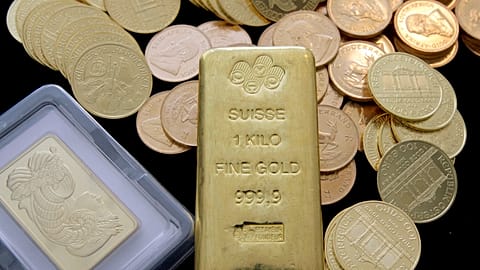
As of around 9:30am CET, gold traded 0.19% lower at $4,828.30 per ounce — following a record high of over $4,800 reached on Wednesday.
The metal’s popularity is linked to its liquidity and status as an inflation hedge, but a weaker dollar and falling US interest rates have also boosted bullion.
When the greenback falls in value, this makes gold comparatively cheaper for foreign buyers and therefore drives up demand and prices. Low US interest rates also increase gold’s appeal compared to interest-bearing assets, as investors aren’t significantly losing out if they choose the metal over assets like bonds.
The Dollar Index, which tracks the greenback against six other currencies, traded less than 0.1% higher at 98.81 on Thursday.
Yields on long-term US bonds also slid after a spike earlier in the week, linked to Greenland tensions and threats to Federal Reserve independence as Trump prepares to name a new chair. Another reason for the earlier yield spike is volatility in Japan, with some investors moving money away from US assets into higher-yielding Japanese debt.
In the days ahead, markets will be watching for more details on Trump’s Greenland deal, as Denmark has stressed that the island’s sovereignty is not up for negotiation. An emergency summit between EU leaders will take place in Brussels on Thursday to address the US threat.