















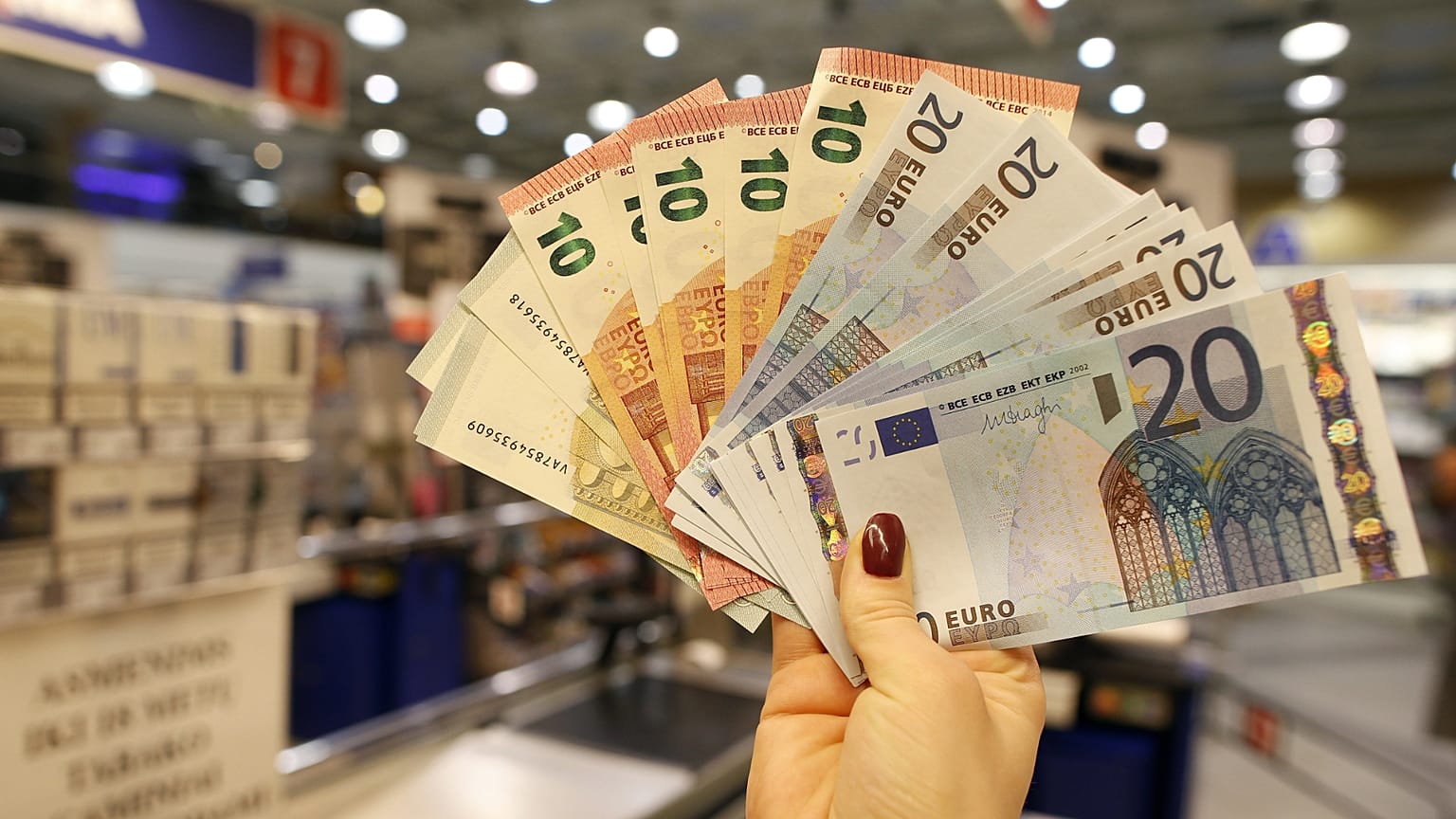













Fewer and fewer consumers are choosing to use cash, instead relying on cards and mobile payments. Even so, for some consumers and within certain sectors — cash remains king.
The use of coins and notes is steadily declining across Europe, yet it remains widespread. In many eurozone countries, cash is still the most common payment method both in terms of the number and value of transactions.
 ADVERTISEMENT
ADVERTISEMENT
ADVERTISEMENT
According to a European Central Bank (ECB) survey, the median amount of cash people keep in their wallets in the eurozone is €59 as of 2024. This amount varies considerably from €35 in the Netherlands to €82 in Luxembourg and Cyprus.
Among the EU’s ‘Big Four’ economies, Germany has the highest median amount of cash carried daily at €69, whereas France has the lowest at €50. Italy is closer to the lower end while Spain sits just above the eurozone median.
Speaking to Euronews Business, Professor Jakub Górka from the University of Warsaw underlined that cash usage is heavily influenced by national culture.
“Countries in Southern Europe, living in a warmer climate and with a habit of exchanging and trading more frequently in face-to-face interactions, are naturally more cash-oriented, while the countries in the North, such as Scandinavia, have historically had a stronger tendency to migrate more quickly to electronic banking and non-cash payments,” he said.
Cash use continues to decline
The share of cash payments at the point of sale (POS) has been gradually declining in the eurozone. The number of cash transactions fell by 27 percentage points from 79% in 2016 to 52% in 2024.
Over the same period, the value of cash payments dropped by 15 points, from 54% to 39%.
More than half of all transactions in cash
Slightly over half of all transactions in the eurozone (52%) were paid in cash in 2024.
In 14 of the 20 eurozone countries, cash remained the most frequently used payment method. It accounted for between 45% and 55% of transactions in about half of them. Cash use ranged widely from just 22% in the Netherlands to 67% in Malta. It is also above 60% in Slovenia, Austria, and Italy.
“In countries with strong historical attachments to cash — such as Germany and Austria, and Italy — cash remains deeply embedded in daily transactions due to long-standing trust in physical currency, the historical experience of banking crises, privacy concerns, and resistance to digital tracking,” Guillaume Lepecq, chair of CashEssentials, told Euronews Business.
In terms of value, cash accounts for a smaller share of payments. It represents 39% of all transactions in the eurozone. The national shares range from 17% in the Netherlands to 59% in Lithuania.
Cards, meanwhile, account for 39% of transactions and 45% of the total value of payments in the eurozone. The use of phones and smartwatches for shopping is also increasing.
Why does cash usage differ widely?
Business professor Olive McCarthy from University College Cork noted that there are a variety of explanations for cross-country variations in cash use, linked to social, economic, and cultural differences.
“Some reasons may include different levels of cash acceptance, the rate of digital adoption, and concerns about the privacy of digital payments, among many others,” she told Euronews Business.
In the eurozone, the Netherlands and Finland are the two countries with the lowest shares of cash payments and the smallest median cash amounts carried. Using them as examples, McCarthy noted that the Netherlands has a below-average cash acceptance rate, with only 79% of businesses accepting cash. It also has the lowest rate of cash acceptance among restaurants and cafés, which fell from 98% in 2021 to 85% in 2024.
Finland, meanwhile, has the lowest share of small and medium-sized enterprises that prefer cash payments — at just 8%.
“And unsurprisingly, both countries have among the highest rates of digital adoption globally,” she added.